On this page
Table of ContentsWhat Is a High Fade? High Fade vs Low Fade vs Mid Fade High Taper Fade vs High Skin FadeAll High Fade Variations High Fade by Hair TypeHigh Fade for Black Men High Fade with BeardBest Top Styles for a High Fade High Fade for Different Face Shapes How to Ask Your Barber Maintenance FAQ Related GuidesA high fade is a haircut where the sides and back are faded, with the blending starting high on the head, above the temples. It creates strong contrast between the short sides and whatever style sits on top. It works with most top styles, suits square and oval faces best, and needs a fresh cut every 2-3 weeks to stay sharp. The high skin fade and high taper fade are the two most requested versions.
Table of Contents
- What Is a High Fade?
- High Fade vs Low Fade vs Mid Fade
- High Taper Fade vs High Skin Fade
- All High Fade Variations
- High Fade by Hair Type
- High Fade for Black Men
- High Fade with Beard
- Best Top Styles for a High Fade
- High Fade for Different Face Shapes
- How to Ask Your Barber
- Maintenance
- FAQ
What Is a High Fade?
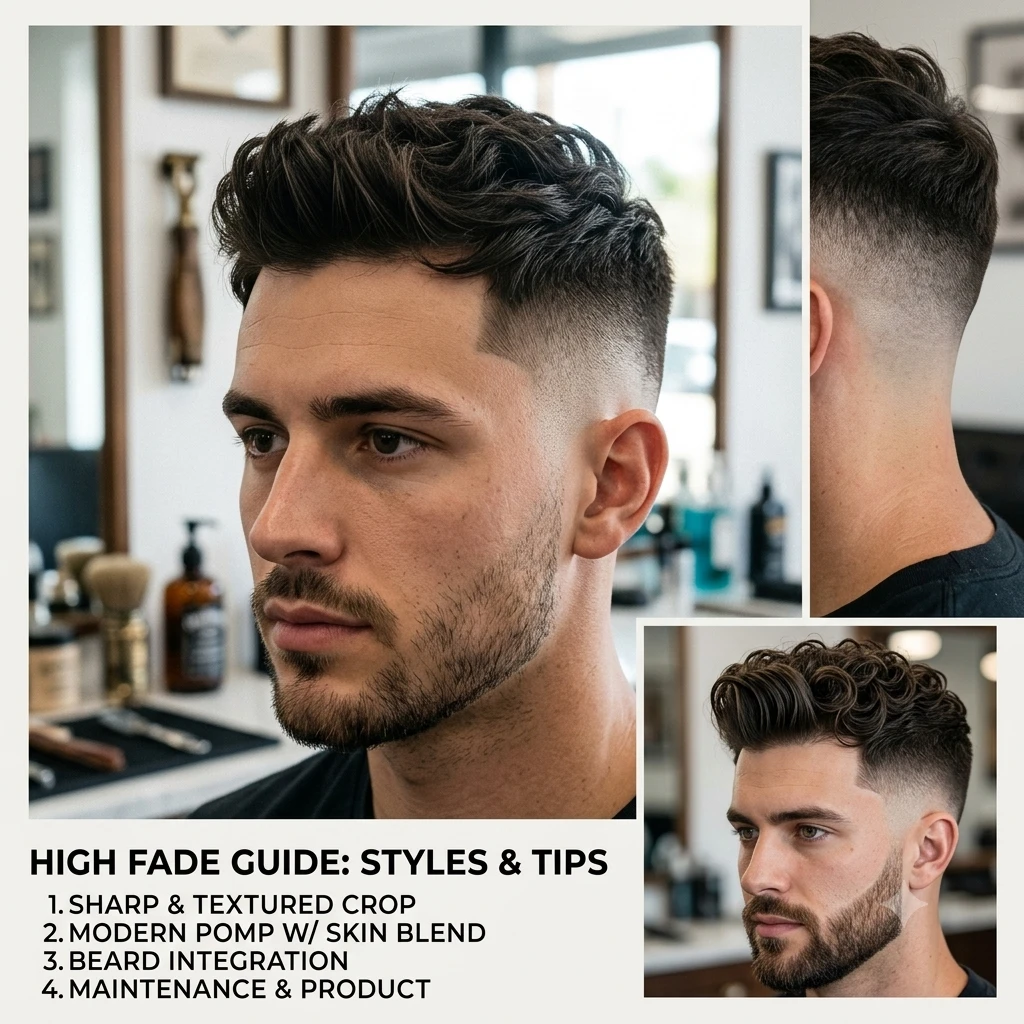
A high fade is a fade haircut where the blending starts high on the head, above the temples and around the upper portion of the sides. The hair transitions from the skin or very short at the base, through a gradient, up to the length on top, with the transition zone sitting in the upper third of the sides rather than the middle or lower section.
The result is high contrast. The difference between the very short sides and the longer hair on top is more dramatic with a high fade than with any other fade position. That contrast is the point. A high fade draws attention to the top style and gives the overall silhouette a sharp, defined edge.
This guide covers what a high fade is, how it compares to other fade types, all major variations, styling options, and how to communicate exactly what you want to your barber. It does not cover mid fades or low fades in depth since those are covered separately in the mid fade guide and low taper fade guide.
High Fade vs Low Fade vs Mid Fade
The position of the fade on the head is the single most important factor in how a fade looks. Here is how the three main positions compare:
| Feature | Low Fade | Mid Fade | High Fade |
| Fade starts at | Just above ears / neckline | Midpoint of sides | Above the temples |
| Contrast level | Low / subtle | Moderate | High / dramatic |
| Visible skin area | Small | Medium | Large |
| Best for | Professional, subtle | Most face shapes | Bold, angular looks |
| Maintenance | Every 3-4 weeks | Every 2-3 weeks | Every 2 weeks |
| Suits thick hair | Yes | Yes | Especially well |
The higher the fade starts, the more skin is visible and the stronger the contrast. If you want a clean, low-key cut, a low taper fade is the better starting point. If you want a bold, high-contrast result where the top style is the focus, the high fade delivers that.
High Taper Fade vs High Skin Fade
Within high fades, the two most common requests are the high taper fade and the high skin fade.
| Feature | High Taper Fade | High Skin Fade |
| Base finish | Very short hair, not skin | Bare skin at the base |
| Contrast | High | Very high |
| Grows out | More gradually | Visibly fast |
| Best for | First-time high fade | Defined, sharp look |
| Maintenance | Every 2-3 weeks | Every 1-2 weeks |
High taper fade: The fade starts high on the head and blends down to a very short length, but stops just short of bare skin at the base. The perimeter still has a thin layer of hair. This is less severe than a skin fade and grows out more gracefully.
Full guide: high taper fade.
High skin fade (high bald fade): The fade starts high and takes the sides all the way to bare skin at the base. The contrast is maximum. The line between the top hair and the shaved sides is very visible. This version requires the most frequent maintenance.
Full guide: high skin fade.
All High Fade Variations
High Fade with Design
A shaved design in the close-cut section of the sides, typically near the temple. Because the high fade leaves a large area of very short or shaved hair, there is more room for design work than with a low or mid fade. Common designs include lines, geometric patterns, and shaved parts. Grows out in 1-2 weeks.
High Fade Undercut
The top hair is kept long while the sides are faded starting high on the head. The high starting point of the fade creates a very sharp separation between the long top and the short sides. This is one of the boldest undercut combinations. Full guide: high fade undercut.
High Fade Buzz Cut
A buzz cut on top with a high fade at the sides. The top is clipped to a consistent guard length, the sides fade down from that point, and the high start of the fade creates a defined line around the head. At guards 1-2 on top, this is one of the cleanest, lowest-maintenance haircuts available.
High Fade Pompadour
A pompadour with volume at the front combined with a high fade creates a strong contrast between the height on top and the closely cut sides. The high fade pulls the eye upward, reinforcing the height of the pompadour. Works best on medium to thick hair with 3-5 inches of top length.
Full guide: pompadour haircuts.
High Fade Comb Over
The top hair is parted on one side and combed across, while the high fade on the opposite side creates a strong visual separation. One of the more popular professional-looking combinations because the high fade makes the comb over look more deliberate and modern.
High Fade Quiff
A quiff uses volume and forward-backward lift at the front of the head. With a high fade, the contrast between the lifted front section and the closely cut sides is sharp. Works on medium-length hair with a bit of natural texture or product hold.
Full guide: quiff hairstyles.
High Fade Mohawk
The sides are faded starting high on the head, leaving a strip of longer hair running front to back along the center of the scalp. The high fade makes the mohawk strip look more pronounced. A high skin fade version creates the most dramatic result.
Full guide: mohawk haircuts.
High Fade Crew Cut
A crew cut with a high fade on the sides. The crew cut keeps the top hair at a consistent short-to-medium length, and the high fade at the sides gives the cut more contrast than a standard crew cut. Works well on straight and wavy hair.
Full guide: crew cut guide.
High Fade with Straight Hair
Straight hair shows the gradient of a high fade very cleanly because there is no curl to break up the transition. The result is precise and polished. Works well with slick tops, comb overs, and side parts.
High Fade Short Hair
At shorter top lengths (1-3 inches), a high fade creates a very graphic look where most of the visible hair is on the top strip of the head. This suits men who want a structured, low-maintenance cut with maximum contrast.
High Fade by Hair Type
High Fade for Curly Hair
Curly hair and a high fade work well together because the natural volume of the curls is contained to the top, with the closely cut sides reducing the overall width of the silhouette. The result can look rounded and full on top with a clean perimeter.
The challenge is managing the length of curly hair at the transition point. Because curls shrink when dry, the section where the fade meets the top hair can look uneven if the barber does not account for curl shrinkage. A good barber will blend through the curl pattern rather than treating it like straight hair.
Full guide: high fade curly hair.
High Fade for Thick Hair
Thick hair benefits particularly from a high fade because the fade removes the bulk that would otherwise flare out at the sides. With thick hair and no fade, the sides can look wide and push outward. A high fade channels that density upward into the top, where it adds volume rather than width.
High Fade for Fine Hair
Fine hair works with a high fade but requires more careful guard selection. At very short lengths, fine hair makes the scalp very visible. A number 2 or 3 minimum at the shortest point tends to look better on fine hair than a skin fade. The high position of the fade compensates for the lower contrast of finer hair.
High Fade for Wavy Hair
Wavy hair at medium length with a high fade gives a clean, slightly casual look. The waves add natural texture on top without requiring product. The high fade keeps the sides from competing with the texture on top.
High Fade for Black Men
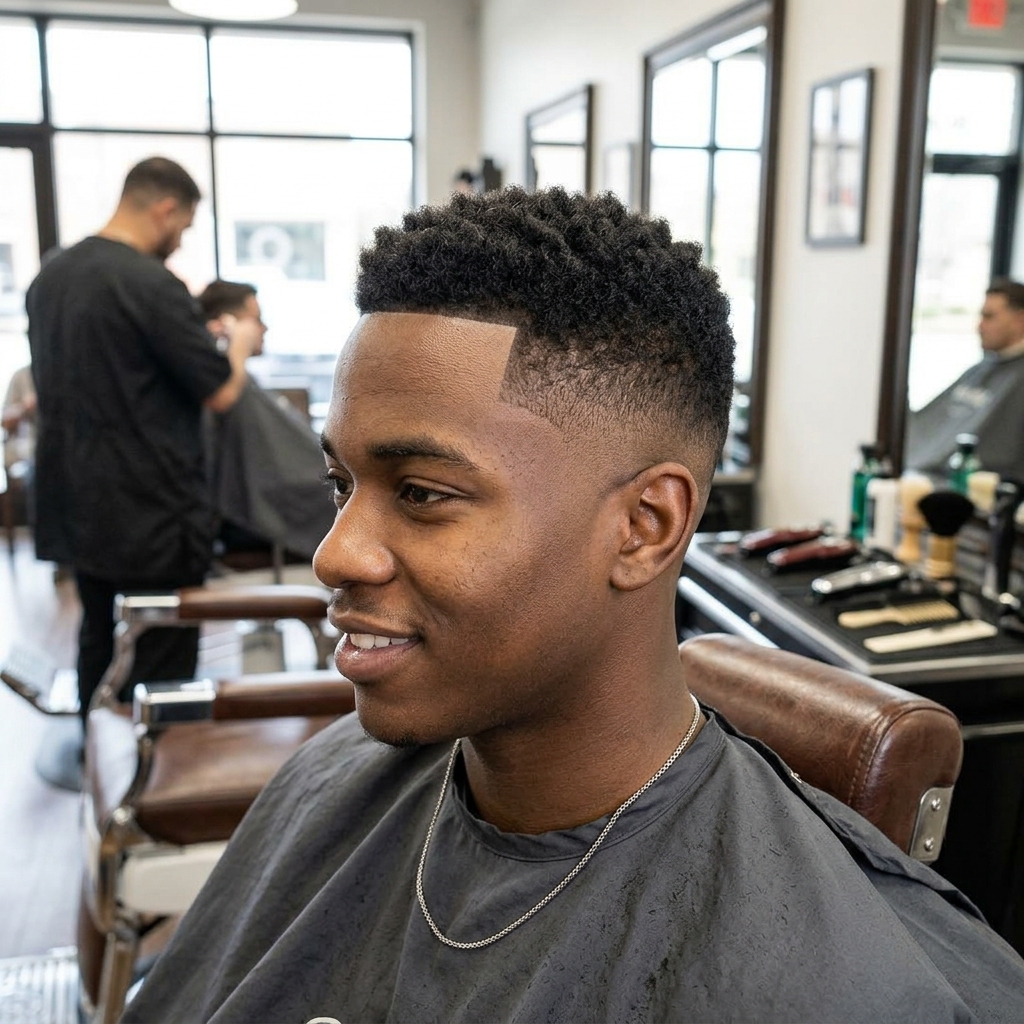
The high fade is one of the most requested cuts at Black-owned barbershops across the country. It works across natural hair textures from 3A curls to 4C coils and serves as the foundation for some of the most culturally recognized Black men’s haircuts.
High top fade: A classic style where the hair on top stands straight up in a flat or rounded shape above a high fade. The fade starts very high on the sides to maximize the visual height of the top section.
High fade with waves: A high fade at the sides combined with 360 waves on top. The high fade cleans up the perimeter, making the wave pattern look more defined.
High fade afro: The afro stays full and round above a high fade perimeter. The fade starts high to allow the afro to expand naturally above the blend line.
High fade with twists or locs: Twists or short locs on top with a high skin fade at the sides. The contrast between the defined texture on top and the clean sides is sharp.
A crisp line-up at the forehead and temples is almost always included with a high fade for Black men, since the edge-up completes the overall shape.
High Fade with Beard
A high fade with a beard works, but the proportions matter. Because the fade starts high and removes a large amount of hair from the sides, the beard becomes the main source of structure below the cheekbones.
A beard that is too short can look like it is floating below a very bare side section. A beard that is too long can look heavy against tightly faded sides. Medium beards, from heavy stubble to about 2 inches, tend to balance best.
The barber needs to handle the sideburn carefully. With a high fade, the sideburn area is faded very close to the skin, so the transition into the beard requires gradual blending to avoid a harsh gap between the faded side and the beginning of the beard.
Best Top Styles for a High Fade
The high fade does not dictate a specific top style. It works under almost anything, but some combinations are more common because the contrast suits certain styles particularly well.
| Top Style | Why It Works with High Fade | Length Needed |
| Pompadour | Height is amplified by the contrast | 3-5 inches |
| Quiff | Lift at front reads sharper against close sides | 2-4 inches |
| Comb over | Deliberate part looks stronger | 2-4 inches |
| Buzz cut | Maximum clean, minimal effort | 1-3 (guard length) |
| Mohawk | Strip is more prominent | 3+ inches |
| Textured crop | Casual, low-maintenance | 1.5-3 inches |
| Curly top | Natural volume stays on top only | 2-4 inches |
| Slick back | Clean, formal look | 3-5 inches |
High Fade for Different Face Shapes
Square face: A high fade with volume on top (pompadour, quiff) balances a square face by adding height. The strong angles of the fade complement a square jaw rather than fighting it.
Oval face: The most adaptable shape. A high fade works with any top style on an oval face.
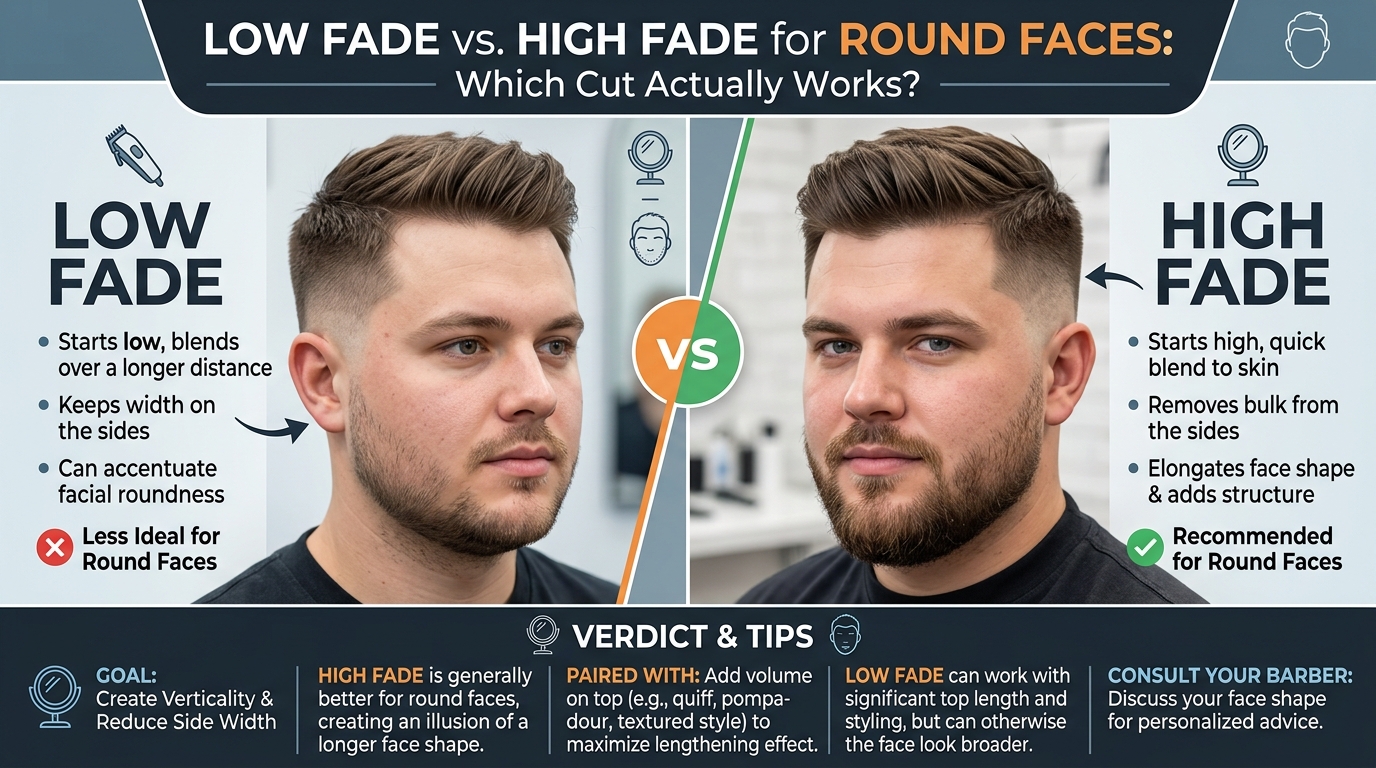
Round face: A high fade with height on top helps elongate the face. Avoid wide, flat tops that add visual width. A quiff or pompadour pointing upward is a better choice than a comb over that sweeps sideways.
Oblong or long face: A high fade can make a long face look even longer because it removes all hair from the sides and adds height on top. A low or mid fade is usually the better option for long faces. If you want a high fade, keep the top shorter and wider rather than tall.
Diamond face: Wider cheekbones and narrower forehead and chin. A high fade with a slightly wider top helps balance the width of the cheekbones without exaggerating them.
Heart face: A high fade with a textured, slightly wide top balances the narrower chin by adding visual width at the crown.
How to Ask Your Barber
“High fade” is understood by most barbers. Being more specific gets you a closer result:
Specify taper or skin. Say “high taper fade” if you want to stop short of bare skin at the base. Say “high skin fade” or “high bald fade” if you want it taken to skin.
Tell them how high. “Start the fade above my temples” is specific. You can also point to the exact spot on your head where you want the blend to begin.
Describe the top. Do you want it left at its current length? Trimmed? Styled in a certain direction? Tell them, or bring a photo.
Mention the line-up. If you want a sharp edge at the forehead and temples, ask for a line-up or edge-up as part of the cut.
Sample phrases that work:
- “High skin fade, start it above my temples, leave the top.”
- “High taper fade, not quite to skin, trim the top to about two inches.”
- “High fade with a line-up, pompadour on top.”
- “High fade undercut, shave the sides, keep the top long.”
Maintenance
The high fade grows out faster than lower fade positions because more of the skin at the base is exposed or very closely cut. Here is what to expect:
Skin fade version: Starts looking grown out within 1-2 weeks as the shaved base fills in with stubble. Most people with a high skin fade touch up every 2 weeks minimum.
Taper fade version: The gradient softens over 2-3 weeks. By week 3, the high starting point of the fade is less visible and the overall shape looks less defined.
General schedule: Every 2-3 weeks for a sharp result. Every 3-4 weeks if you can tolerate a slightly grown-out look mid-cycle.
Between visits: A trimmer handles the neckline and the lowest section around the ears. The high fade itself is harder to maintain at home because the starting point above the temples requires freehand blending technique.
FAQ
What is a high fade?
A high fade is a fade haircut where the blending starts high on the head, above the temples. The sides transition from the longer hair on top down to very short or bare skin at the base, with the gradient occupying the upper portion of the sides.
What is the difference between a high fade and a low fade?
A low fade starts blending just above the ears and stays subtle. A high fade starts blending above the temples and creates much stronger contrast. The higher the starting point, the more visible the transition and the more skin is exposed.
What is a high skin fade?
A high skin fade takes the sides all the way to bare skin at the base, with the fade starting high above the temples. It creates the maximum possible contrast between the short sides and whatever length is on top.
How long does a high fade last?
A high skin fade starts looking grown out in 1-2 weeks. A high taper fade holds for 2-3 weeks. Most people with a high fade visit the barber every 2-3 weeks.
Does a high fade suit a round face?
It depends on the top style. A high fade with a tall pompadour or quiff helps elongate a round face by adding height. A high fade with a flat or wide top can make a round face look wider. The key is adding vertical height on top.
What top styles work best with a high fade?
Pompadours, quiffs, textured crops, mohawks, and buzz cuts all work well. The high contrast of the fade suits bold, defined top styles more than very flat or natural ones.
What is a high bald fade?
A high bald fade is another name for a high skin fade. “Bald” refers to the bare skin at the base of the fade.
How do I ask for a high fade?
Tell your barber “I want a high fade, starting above my temples.” Specify whether you want it to go to skin (high skin fade) or stop short of skin (high taper fade). Bring a photo for the best result.
Does a high fade work on curly hair?
Yes. The high fade removes curl volume from the sides, concentrating the texture on top. The result looks full and defined. Ask the barber to account for curl shrinkage when blending the transition zone.
Is a high fade hard to maintain?
It requires more frequent barbershop visits than lower fade positions, typically every 2-3 weeks. The high starting point of the fade means there is more faded skin area that becomes visible as the hair grows.