
On this page
Why a Buzz Cut Works So Well for Thinning HairThe Classic Buzz Cut for Even ThinningBuzz Cut with a Low Fade for Receding HairlinesHigh and Tight Buzz Cut for Advanced ThinningTextured Buzz Cut for Thin Hair on TopThe Induction Cut for Maximum SimplicityHow to Choose the Right Buzz Cut for Your Face ShapeMaintenance and Upkeep for Buzz Cut StylesFrequently Asked QuestionsGet the Right Buzz Cut for Your Thinning HairA guy came into a barbershop last month, frustrated. He’d been trying to style over his thinning crown for years — pomade, strategic combing, the works. His barber sat him down and said, “Let’s just cut it short.” Twenty minutes later, he looked sharper than he had in five years. That’s the thing about a buzz cut for thinning hair — it doesn’t hide the problem. It neutralizes it. When you stop trying to cover thinning patches with longer hair, the contrast disappears. You look intentional, not self-conscious. And that shift changes everything.
At BuzzCutting, we’ve seen this transformation countless times. The buzz cut isn’t a surrender. It’s a strategy. And in 2026, it remains one of the most effective haircuts for men dealing with hair loss, receding hairlines, or diffuse thinning. The trick is knowing which variation works for your specific pattern of thinning and face shape. Not every buzz cut is the same length or style. Some are softer. Some are sharper. Some add texture on top while keeping the sides tight. The right choice depends on where you’re thinning and what look you’re after.
This guide breaks down the best buzz cut styles for thinning hair, why they work, and how to ask for them by name. No jargon. No fluff. Just the cuts that barbers actually recommend when a client sits down and says, “I’m losing my hair. What should I do?”
Why a Buzz Cut Works So Well for Thinning Hair
The visual contrast between thick and thin areas is what makes hair loss noticeable. When you have longer hair on top and visible scalp underneath, the eye goes straight to the gap. A buzz cut removes that contrast. By cutting everything to a uniform short length, you eliminate the frame of reference. There’s no “full” section to compare against the thin section. It all reads as one consistent texture.
This is why buzz cuts are often the first recommendation from barbers when a client mentions thinning. It’s not about giving up. It’s about resetting the baseline. And once you reset, you can start building a style that actually suits your current hair density instead of fighting it.
Buzz cuts also reduce the weight of the hair. Thinning hair often looks limp when it’s long because there isn’t enough density to hold volume. Shorter hair stands up better. It looks fuller because it’s not weighed down. That’s a mechanical advantage, not just an aesthetic one.
Another practical benefit — maintenance drops to nearly zero. No styling products. No blow-drying. No morning mirror panic. You wake up, maybe run a hand through it, and you’re done. For men who’ve spent years battling their hair every morning, that simplicity is worth the cut alone.
The Classic Buzz Cut for Even Thinning
If your hair is thinning evenly across the top and sides, the classic buzz cut is your best starting point. This is a uniform length all over — usually a #3 or #4 guard, which translates to about 10mm to 13mm. It’s short enough to eliminate contrast but not so short that you’re showing full scalp.
The classic buzz works because it’s neutral. No fades, no tapers, no design. Just a clean, even cut. That uniformity is exactly what makes thinning hair less noticeable. When everything is the same length, the eye has nowhere to focus. The thin spots blend into the rest.
Ask your barber for a #3 or #4 all over. If you’re nervous about going too short, start with a #4. You can always go shorter next time. If you want it tighter, a #2 is still in buzz cut territory but will show more scalp. That’s fine if you’re comfortable with it, but most guys with diffuse thinning prefer the #3 or #4 range.
One thing we’ve noticed — men often think they need to go as short as possible to “get ahead” of the thinning. That’s not always true. A #3 or #4 buzz still gives you coverage while keeping the look sharp. You don’t have to go full skin unless that’s the aesthetic you want.
Buzz Cut with a Low Fade for Receding Hairlines
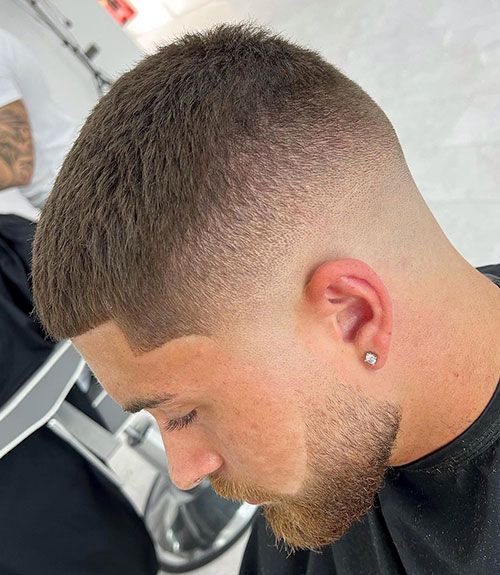
If your hairline is receding but the top still has decent density, a buzz cut with a low fade is a smart move. The fade keeps the sides and back shorter than the top, which draws attention upward. It also adds shape and structure, which can balance out a higher hairline.
The key is keeping the top at a #3 or #4 while the sides fade down to a #1 or skin near the ears and neckline. The transition should be gradual — not a harsh line. That gradient effect is what makes the fade look natural.
This style works particularly well for men with a buzz cut receding hairline who still want some definition. The fade adds a modern edge without requiring length on top. And because the sides are tighter, the overall look stays clean and low-maintenance.
When you book the cut, say “buzz cut with a low fade.” If your barber asks where you want the fade to start, point to just above your ears. That’s the classic low fade starting point. The top can stay at whatever length you’re comfortable with, but a #3 is usually the sweet spot for this style.
High and Tight Buzz Cut for Advanced Thinning
The high and tight is one of the most aggressive buzz cut styles, and it’s perfect for men with advanced thinning or a receding hairline that’s moved well back. This cut takes the sides and back down to a #1 or skin and keeps the top at a #2 or #3. The transition is high — right around the temples or just above — which creates a bold, defined look.
Why does this work for thinning hair? Because it stops trying to preserve length where there isn’t enough density. The high and tight embraces the reality of the hairline and builds the style around it. The result is sharp, intentional, and confident.
This cut also has military roots, which gives it a no-nonsense edge. It doesn’t try to hide anything. It just looks clean. And for men who are past the point of worrying about coverage, that clarity is freeing.
Ask for a “high and tight with a #2 or #3 on top.” Be specific about how high you want the fade to start. If you want it really tight, go with a #1 or skin on the sides. If you want a bit more softness, a #2 on the sides with a #3 on top keeps it in the same style family without going full military.
Textured Buzz Cut for Thin Hair on Top
If your thinning is concentrated on the crown or top, a textured buzz cut can add visual density. This style keeps the top slightly longer — around a #4 or #5 — and uses clipper-over-comb or scissor techniques to create subtle texture. The sides are usually faded shorter, which keeps the focus on the textured top.
The texture tricks the eye. Instead of seeing smooth, flat hair where the thinning is obvious, you see variation and movement. That variation breaks up the scalp visibility. It’s not a miracle fix, but it’s one of the better short haircuts thinning hair can pull off when you want something slightly less uniform than a classic buzz.
Textured buzz cuts work best if you still have some density on top. If the thinning is severe, the texture won’t have enough hair to grab onto. But if you’re in the early to moderate stage of hair loss, this style can buy you a few more years of visual fullness.
When you book this cut, say “textured buzz with a fade on the sides.” Your barber will know to leave the top longer and add texture with clippers or scissors. If they ask how much texture, say “enough to break up the flatness without adding bulk.”
The Induction Cut for Maximum Simplicity
The induction cut is the shortest buzz cut you can get without a razor. It’s usually a #1 or #2 all over, which means 3mm to 6mm of hair. This is the cut you see in military induction photos, and it’s one of the best hairstyles for balding men who want zero maintenance and total uniformity.
This cut works because it removes all pretense. There’s no styling, no product, no morning routine. You buzz it every few weeks, and that’s it. And because it’s so short, thinning areas are nearly invisible. The hair is too close to the scalp to show contrast.
The downside? It’s a bold look. Not everyone is comfortable going this short, especially if they’ve had longer hair most of their life. But for men who are tired of fighting thinning hair and want the simplest possible solution, the induction cut is it.
Ask for a “#1 or #2 all over, no fade.” If your barber starts talking about blending or tapering, tell them you want it uniform. The whole point of the induction cut is simplicity. No variation. Just short.
How to Choose the Right Buzz Cut for Your Face Shape
Face shape matters with buzz cuts because there’s no hair length to soften or balance your features. What you see is what you get. Round faces benefit from styles with height or fades that elongate the head — a high and tight or a textured buzz works well. Oval faces can pull off almost any buzz cut variation. Square faces look great with uniform lengths or low fades that don’t over-emphasize the jawline. Long faces should avoid too much height on top, which can make the face look even longer.
If you’re not sure, start with a classic buzz or a low fade. Those are the most forgiving styles. You can always adjust from there based on how the first cut looks. And remember — it grows back. Buzz cuts are one of the few hairstyles where you can experiment without much risk.
Maintenance and Upkeep for Buzz Cut Styles
Buzz cuts grow out fast. Depending on the length, you’ll need a trim every two to four weeks to keep the shape. A #1 or #2 will need touch-ups more often than a #3 or #4. Fades require more frequent maintenance than uniform cuts because the gradient grows out unevenly.
If you’re cutting it yourself, invest in a decent clipper. Wahl, Andis, and Oster make solid home clippers that’ll last years. Start with the guards that match your desired length and work slowly. You can always go shorter, but you can’t add length back.
Most guys who go the buzz cut route end up cutting their own hair within a few months. It’s not complicated once you get the hang of it. And the money you save on barber visits adds up. But if you want a fade or textured cut, those are better left to a barber. The blending takes skill.
Frequently Asked Questions
Does a buzz cut make thinning hair look worse?
No. A buzz cut usually makes thinning hair less noticeable because it removes the contrast between thick and thin areas. Longer hair often highlights the difference, while a short uniform cut neutralizes it.
What’s the best buzz cut length for a receding hairline?
A #3 or #4 on top with a low or mid fade on the sides is usually the best balance. It’s short enough to reduce contrast but not so short that you’re showing full scalp if you’re not ready for that.
Can I still style a buzz cut if my hair is thinning?
Not really. Buzz cuts are meant to be low-maintenance. If you want some texture or hold, you can use a small amount of matte pomade or sea salt spray, but the whole point of the cut is simplicity.
How often should I buzz my hair if it’s thinning?
Every two to four weeks, depending on the length. Shorter cuts need more frequent trims to stay sharp. If you’re doing it yourself, touch up the edges weekly to keep it clean.
Get the Right Buzz Cut for Your Thinning Hair
The best buzz cut for thinning hair isn’t the one that hides the most scalp. It’s the one that makes you stop worrying about it. Whether that’s a classic #3 all over, a high and tight with a sharp fade, or a textured cut with some movement on top, the goal is the same — confidence, simplicity, and a look that works with your hair, not against it.
At BuzzCutting, we’ve broken down every major buzz cut variation so you know exactly what to ask for when you sit in the chair. No guessing. No generic advice. Just the cuts that work. If you’re ready to make the move, pick the style that fits your thinning pattern and face shape, and book the cut. You’ll wish you’d done it sooner.