
On this page
What Actually Counts as a Buzz CutThe Seven Types of Buzz Cuts (And How to Tell Them Apart)How to Pick the Right Buzz Cut Length for Your Face ShapeDoing It Yourself: How to Buzz Your Own HairWhat Happens When a Buzz Cut Grows OutCommon Mistakes Guys Make with Buzz CutsHow Buzz Cut Styles Fit into 2026 Grooming TrendsWhen a Buzz Cut Doesn’t WorkFrequently Asked QuestionsGet the Cut That Actually Works for YouYou’re thinking about a buzz cut. Maybe because it’s low-maintenance. Maybe because everything else you’ve tried looks worse after three weeks. Maybe because you’re tired of explaining what you want to a barber who nods and then does something completely different.
Here’s the thing: most guys think a buzz cut is just one thing. It’s not. There are seven distinct types, each with different lengths, different tools, and completely different looks. The difference between a #1 guard and a #4 guard isn’t subtle—it changes your entire face shape. And once you understand the vocabulary, you’ll never walk out of a barbershop disappointed again.
At BuzzCutting, we’ve watched this confusion play out hundreds of times. Guys request “just a buzz cut” and get something they didn’t expect. That’s because they’re using one term for seven different haircuts. Let’s fix that.
What Actually Counts as a Buzz Cut
A buzz cut is any short haircut created with electric clippers, where the hair is cut uniformly close to the scalp. That’s the technical definition. But in practice, buzz cuts range from near-bald to short textured crops that still leave enough length to style.
The tool matters. Professional barbers use adjustable clippers with numbered guards—attachments that control how much hair gets left behind. Guard #0 leaves about 1.5mm. Guard #8 leaves about 25mm. Most buzz cuts sit between #1 and #5, but the extremes exist for a reason.
The confusion comes from regional differences and barbershop slang. What one barber calls a “burr cut,” another calls a #2 all over. What Americans call an “Ivy League,” Brits might call a short Harvard clip. The guards don’t lie, though. If you know the number, you know the length.
The Seven Types of Buzz Cuts (And How to Tell Them Apart)
Induction Cut
This is the military default. Guard #0 or a straight razor. Scalp-visible. No graduation, no fade, just uniform stubble across the entire head. It’s what you get in basic training because it’s fast, identical on everyone, and requires zero maintenance.
You’ll see skin. If that bothers you, this isn’t your cut. If you’ve got an uneven head shape or visible scars, a slightly longer option works better. The induction cut doesn’t hide anything.
Burr Cut
Guard #1 or #2. Still very short, but you get a slight shadow of hair texture. This is where most guys should start if they’ve never buzzed before. It’s short enough to be low-maintenance but long enough that mistakes aren’t catastrophic.
The burr cut works well if you’re balding. It evens everything out without emphasizing the contrast between thick areas and thin ones. And if you hate it, you’re only two weeks from something longer.
Butch Cut
Guard #3 or #4. Now we’re leaving enough length to see texture and natural hair direction. The butch cut is still a buzz cut you’re using clippers, not scissors but it starts to look intentional rather than functional.
This is the sweet spot for a lot of guys. You can still run clippers over your head once a week at home, but it doesn’t look aggressively short in professional settings. If you’ve got a round face, the butch cut adds a bit of height without requiring product.
Brush Cut
Guard #4 or #5 on top, shorter on the sides. This is where buzz cuts start to become actual styles rather than just lengths. The top has enough length to stand up slightly, mimicking the look of a brush—hence the name.
The brush cut requires a bit more upkeep than a uniform buzz. You’ll need to trim the sides every week or so to keep the contrast visible. But it’s still fast. Two guards, five minutes, done.
Crew Cut
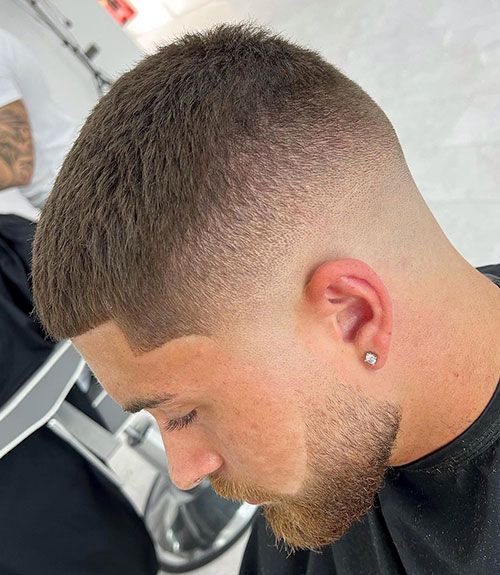
Longer on top (usually #5 to #7), faded or tapered on the sides. The crew cut is technically a buzz cut because clippers do all the work, but it’s long enough that most people wouldn’t describe it that way. The top can be styled with light product if you want.
This is the most versatile option. It works in conservative offices. It works at the gym. It works if you’ve got a slightly receding hairline, because the longer top draws attention forward. The downside: you’ll need a barber every two to three weeks to maintain the fade.
Ivy League Cut
A longer crew cut with enough length on top to part or comb to the side. Think classic American college athlete from the 1960s. The top might be an inch long, while the sides taper down to a #2 or #3.
The Ivy League is the edge of what most people still consider a buzz cut. Some barbers call it a short Ivy or a Princeton clip. You’re still using clippers for most of the cut, but the top might get touched up with scissors. If you want something professional and polished but still low-effort, this is it.
High and Tight
Military-inspired. Very short or shaved sides, slightly longer top. The contrast is dramatic there’s no gradual fade, just a hard line where the length changes.
The high and tight works if you’ve got strong facial features and a defined jawline. It doesn’t work if you’ve got a narrow face or a weak chin, because it emphasizes the shape of your skull. It’s also high maintenance. The sides need to be cleaned up every week, or it starts to look uneven.
How to Pick the Right Buzz Cut Length for Your Face Shape
Most guys choose a buzz cut length based on convenience. That’s fine. But if you actually care how it looks, face shape matters more than you’d think.
Round face: go shorter on the sides, longer on top. A uniform buzz will make your face look rounder. A crew cut or brush cut adds height and breaks up the circular shape.
Oval face: you’ve got the most flexibility. Anything from a butch cut to an Ivy League works. Don’t overthink it.
Square face: you can pull off the aggressive contrast of a high and tight. The strong jawline balances the dramatic sides.
Long or narrow face: avoid anything that adds height. A uniform butch cut or burr cut keeps proportions balanced. The crew cut and Ivy League will make your face look longer.
We’ve seen guys ignore this and regret it. One client insisted on a high and tight despite having a long, narrow face. It worked in his head. It didn’t work in the mirror. Two weeks later, he came back for a uniform #3 butch cut and immediately looked better. Face shape isn’t optional.
Doing It Yourself: How to Buzz Your Own Hair
You’ll need clippers. Not a beard trimmer. Actual hair clippers with numbered guard attachments. Wahl and Oster are reliable. You don’t need to spend more than $50 unless you’re cutting hair professionally.
Start with the sides. Pick a guard longer than you think you need say a #4 if you’re aiming for a #3—and make one pass. You can always go shorter. You can’t go longer.
Go against the grain on the first pass. That means pushing the clippers upward from the neckline toward the crown. Move slowly. Overlapping strokes prevent missed patches.
Now do the top. If you’re doing a uniform buzz, use the same guard. If you’re doing a crew cut or brush cut, switch to a longer guard. Work front to back, then side to side. Check in the mirror from multiple angles. Your phone camera is useful here flip it to selfie mode and check the back of your head.
The neckline is where most DIY buzz cuts fail. Don’t try to freestyle it. Use your natural hairline as the guide. Clean up stray hairs below that line with a trimmer or razor, but don’t go higher. A neckline that’s too high looks like a mistake.
First time doing this? You’ll miss spots. You’ll take too much off in one area. That’s fine. Hair grows back. By the third or fourth time, you’ll be faster and cleaner than most cheap barbershops.
What Happens When a Buzz Cut Grows Out
Here’s what no one tells you: buzz cuts don’t stay buzz cuts. Within two weeks, a #2 burr cut starts to look like a #4 butch cut. By week three, it’s long enough that the shape of your head matters again.
If you want to maintain a specific length, you’ll need to buzz it every seven to ten days. That’s the realistic cadence for a consistent look. Anything longer and it starts to grow into a different style.
Some guys embrace the grow-out. They’ll buzz down to a #2, let it grow for a month, then buzz it again. That works if you don’t care about looking the same every week. It doesn’t work if you’re trying to keep a specific shape or fade.
The awkward phase hits around week four. You’re too long for a buzz cut but too short for anything styled. If you’re growing it out intentionally, push through. If you’re just being lazy about maintenance, book a barber or run the clippers over your head again.
Common Mistakes Guys Make with Buzz Cuts
Going too short too fast. You can always buzz shorter. You can’t undo it. Start with a #4 or #5 if you’ve never done this before. See how it looks. Go shorter next time if you want.
Ignoring the fade. A uniform buzz cut is fine. A badly executed fade is not. If you don’t know how to blend guards, either learn or pay someone who does. A harsh line between a #1 and a #4 looks unfinished.
Using the wrong clippers. Beard trimmers and body groomers are not the same as hair clippers. They’ll work, technically, but they’re slower, they overheat, and they won’t give you an even cut. Spend $40 on real clippers.
Skipping the lineup. Even a perfect buzz cut looks sloppy if the edges aren’t clean. That means tidying up the hairline around the ears, the sideburns, and the back of the neck. A trimmer with a narrow blade works for this. Two minutes of cleanup makes a huge difference.
Waiting too long between cuts. Buzz cuts look best fresh. By week three, they start to lose shape. If you’re doing it yourself, maintenance is easy. If you’re paying a barber, plan on visiting every two weeks.
How Buzz Cut Styles Fit into 2026 Grooming Trends
Buzz cuts aren’t a trend. They’ve been around since electric clippers were invented. But the way guys wear them has shifted. In 2026, the clean, low-effort aesthetic is back. Not as a statement just as a default.
The high-maintenance, heavily-styled cuts from a few years ago are fading. Guys want something that looks good without requiring product, a blow-dryer, and a mirror. Buzz cuts deliver that. Pair it with a clean beard or a well-shaped stubble, and you’ve got a look that works in almost any context.
The other shift: more guys are doing it themselves. Barbershop prices went up. Quality went down in a lot of places. Clippers got cheaper and better. The math stopped making sense for a lot of men, especially for something as simple as a buzz cut.
At BuzzCutting, we’ve noticed more questions about home maintenance and clipper recommendations than ever before. That’s not because barbershops are going away. It’s because guys realised they don’t need a professional for something this straightforward.
When a Buzz Cut Doesn’t Work
Be honest about your hairline. If you’re significantly receding or balding on top, a very short buzz cut (like an induction or burr) will emphasize it, not hide it. A slightly longer butch or crew cut blends everything better.
Head shape matters. If you’ve got a very flat or uneven skull, a buzz cut will show it. Most people’s heads aren’t perfectly round that’s fine at longer lengths, but at a #1 or #2, every bump and flat spot becomes visible.
Scarring. If you’ve got scars on your scalp from surgery, injuries, or skin conditions, a buzz cut will make them more obvious. That’s not necessarily a dealbreaker, but it’s something to consider.
Some guys just don’t like how they look with short hair. There’s no logic to it—it’s just preference. If you buzz it and hate it, grow it back out. It’ll take six to eight weeks to get back to a short styled cut, three to four months to get back to medium length.
Frequently Asked Questions
How short is a #2 buzz cut?
A #2 guard leaves about 6mm (or 1/4 inch) of hair. You’ll see scalp through the hair, but it’s not skin-tight like a #0 or #1. It’s one of the most common buzz cut lengths because it’s short enough for minimal maintenance but not so short that it looks extreme.
Can you buzz your hair if it’s curly or coarse?
Yes. Curly and coarse hair actually works well with buzz cuts because the texture adds visual density. A #3 or #4 buzz on curly hair looks fuller than the same length on straight hair. The main difference is how fast it grows out curly hair may need touch-ups slightly sooner to maintain the shape.
How often should you get a buzz cut to keep it looking fresh?
Every 7 to 14 days if you want a consistent length and clean edges. If you’re less strict about it, every three weeks works. Anything longer than that and you’re not really maintaining a buzz cut anymore you’re just letting it grow into something else.
What’s the difference between a buzz cut and a crew cut?
A buzz cut is usually uniform or close to it same length all over, or just slightly shorter on the sides. A crew cut is longer on top (often an inch or more) and faded or tapered on the sides and back. Crew cuts require more maintenance and regular barber visits. Buzz cuts you can handle at home.
Get the Cut That Actually Works for You
Most guys pick a buzz cut because it’s simple. That’s a good reason. But now you know it’s not one haircut—it’s seven, each with different tradeoffs. The induction cut works if you want zero maintenance and don’t care about showing scalp. The Ivy League works if you want something you can still comb. The butch cut is the middle ground that works for most guys most of the time.
At BuzzCutting, we’ve built every guide around one principle: clarity. You shouldn’t need to guess what a barber means or hope they interpret “just a buzz” the same way you do. Know the guard number. Know the style name. Walk in with that information and you’ll walk out with what you wanted.
If you’re ready to try it yourself, grab clippers, start with a longer guard than you think you need, and go slow. If you’d rather see more examples and breakdowns of specific styles, we’ve covered every variation in detail across the site. Either way, you’ve got what you need to get it right.
