
On this page
Trimming Your Beard While It’s WetSkipping the Pre-Trim Brush or CombUsing the Wrong Guard Length or No Guard at AllTrimming Too High on the Neck or Too Low on the CheeksTrying to Style and Trim at the Same TimeOver-Trimming Out of Impatience or PanicNot Trimming Often Enough—or Trimming Too OftenUsing Dull or Low-Quality TrimmersIgnoring Your Beard’s Natural Growth PatternForgetting to Check Your Work from Multiple AnglesFrequently Asked QuestionsStop Trimming Blind—Trim with IntentionYou’ve grown the beard. You’re past the itchy phase. Now you just need to keep it sharp.
That’s where most guys mess up. Not in growing the beard—in trimming it. One wrong angle with the clippers and you’re stuck with a patchy neckline or a lopsided fade that screams “I did this in bad lighting.” We’ve seen it dozens of times: guys who think they can eyeball a trim end up with a shape that works against their face, not with it. The difference between a beard that looks intentional and one that looks neglected often comes down to five minutes and a few preventable errors.
At BuzzCutting, we’ve spent years breaking down what separates a clean beard trim from a disaster. This isn’t about expensive products or barber-level skills. It’s about knowing where people consistently go wrong—and how to avoid those traps before you pick up the trimmer.
Trimming Your Beard While It’s Wet
Here’s the thing: wet hair lies flat. Dry hair doesn’t.
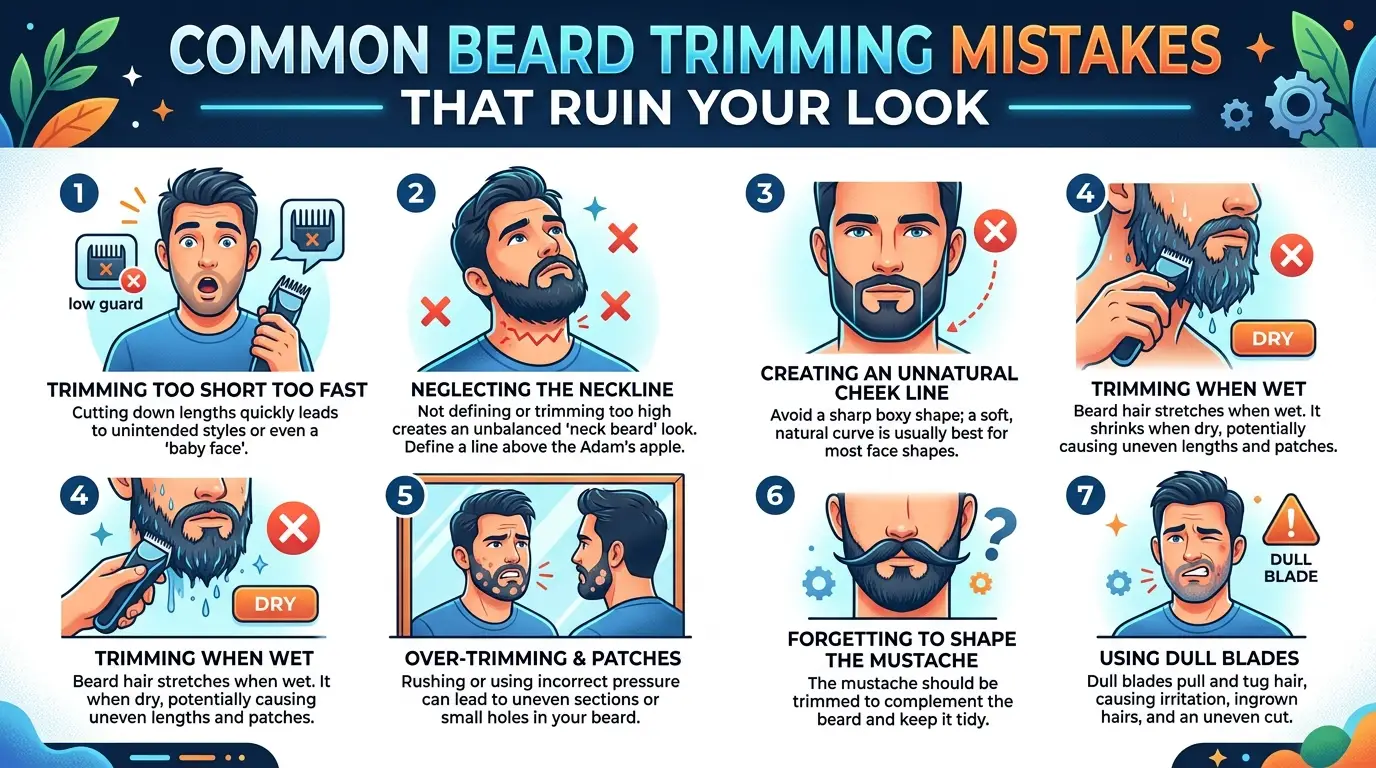
When you trim your beard fresh out of the shower, you’re trimming a version of your beard that doesn’t exist in real life. The moment it dries, it’ll spring back up, and suddenly you’ve cut way more than you meant to. This is one of the most common beard trimming mistakes, and it’s completely avoidable.
Wet beards look longer and behave differently under the trimmer. The hair clumps together, the guard glides smoother, and you think you’re being conservative. Then it dries. The curl returns. The volume comes back. And you’re left with a beard that’s shorter and patchier than you planned.
Always trim dry. Wash your beard, dry it fully, comb it out, and let it settle into its natural state. That’s the beard you’re actually walking around with. That’s the one you should be trimming. If you want to clean up the outline or check symmetry, a damp beard is fine—but length work? Dry only.
Skipping the Pre-Trim Brush or Comb
You can’t trim what you can’t see.
If your beard’s tangled or compressed, the trimmer won’t move evenly through it. You’ll catch on knots, miss entire sections, or take off more in one area just because the hair was sitting flat. Before every trim, run a beard comb or brush through your entire beard. Start from the roots and work outward. Get the hair standing up and away from your face.
This does two things. First, it shows you the actual length and shape you’re working with. Second, it lifts the hair so the trimmer guard can pass through evenly. If you skip this step, you’re basically trimming blind. That’s how you end up with uneven patches and random bald spots that only show up later in the right lighting.
BuzzCutting recommends keeping a simple wide-tooth comb in your bathroom kit. Nothing fancy. Just something that can detangle and lift your beard before you start cutting. It takes 30 seconds and saves you from a week of regret.
Using the Wrong Guard Length or No Guard at All
Most beard grooming errors come down to misjudging length. You think a number 3 guard will leave you with a solid, even trim. Then you realize it’s way shorter than expected, and now you’re committed.
Here’s what actually works: always start one guard size longer than you think you need. If you’re aiming for a number 3, start with a 4. You can always go shorter. You can’t add length back. This is especially true if you’re new to trimming your own beard or if you’ve just switched trimmers—different brands measure guards differently.
Going in with no guard is where guys really run into trouble. Clippers without a guard cut down to the skin. There’s no room for error. If your hand slips or you misjudge the angle, you’ve just carved a line straight through your beard. We’ve heard from readers who’ve done this trying to define their cheek line or clean up their neckline. It rarely ends well.
Use guards. Start longer. Test a small section first if you’re unsure. Once you know how a guard performs on your beard texture, you can move faster. Until then, slow down.
Trimming Too High on the Neck or Too Low on the Cheeks
This is the mistake that makes a good beard look sloppy—or worse, accidental. Your neckline and cheek line define the shape of your beard. Get them wrong and the whole thing falls apart.
The most common error? Trimming the neckline too high. Guys look down into a mirror, see what looks like a double chin, and shave up to eliminate it. Bad move. When you lift your head back to normal position, that neckline sits way too high, making your beard look thin and your jawline unclear. The correct neckline sits about two fingers above your Adam’s apple, following the natural curve of your jaw. Not your chin. Your jaw.
On the flip side, trimming your cheek line too low makes your beard look patchy and shrinks your face. Unless you’ve got a naturally low cheek line, don’t carve it down. Let it grow where it wants to grow. If you need to clean it up, only remove strays above your natural line—don’t create a new one.
Use a handheld mirror to check your neckline from the side. That’s the angle other people see. If it looks good there, you’re set. If it looks too high or too geometric, adjust before you go any further.
Trying to Style and Trim at the Same Time
Styling is not trimming. Trimming is not styling.
One of the biggest beard maintenance tips we give: never apply beard oil, balm, or styling product before you trim. You’re adding weight and texture that changes how the hair sits. You’ll trim based on a styled version of your beard, and when you wash it out, the shape will be completely different.
Trim first. Style after. Always in that order.
Once you’ve finished trimming, that’s when you clean up, apply your beard oil to condition the hair and skin, and use balm or wax if you need hold. Trying to shape your beard with product and then trim around that shape is backward. You’ll end up chasing a look that doesn’t match your beard’s natural behaviour.
If you want to see how a product affects your beard shape, do a test run the day before trimming. But on trim day, start clean and dry.
Over-Trimming Out of Impatience or Panic
You take off a little. It looks uneven. So you take off a little more. Then the other side looks too long. So you trim that. Then the first side looks short. And before you know it, you’ve trimmed your way into a beard that’s half the length you wanted.
This is one of those beard styling mistakes that starts small and snowballs. The fix? Set the trimmer down. Walk away. Come back in ten minutes and reassess with fresh eyes. Seriously.
When you’re staring at your own face in a mirror under bright bathroom lighting, every tiny asymmetry looks massive. In reality, no one’s beard is perfectly even. A millimetre difference from one side to the other is normal. Chasing perfect symmetry is how you end up with no beard left.
If you’ve already gone too short in one spot, resist the urge to “balance it out.” Let it grow back. It’s faster than you think. One bad trim can be grown out in two weeks. A beard you’ve over-corrected into oblivion takes months.
Not Trimming Often Enough—or Trimming Too Often
There’s no universal schedule for how to trim beard properly. It depends on your growth rate, your style, and how tight you want the shape. But most guys fall into one of two traps: they wait too long and the beard gets unruly, or they trim too often and never let it fill in.
If you’re maintaining a short, shaped beard—something like a tight fade or a defined corporate look—you’ll probably need to clean up the lines every week to ten days. If you’re growing it out or keeping it medium length, every two to three weeks is enough. Trimming weekly when you’re trying to add length just slows your progress and increases your chances of a mistake.
Here’s a good rule: if you can’t see a difference from last time, you don’t need to trim yet. Let the beard grow into the shape before you start cutting it back. That patience is what separates a beard that looks full from one that looks constantly patched together.
Using Dull or Low-Quality Trimmers
Your tools matter more than you think.
A dull trimmer doesn’t cut cleanly. It pulls, snags, and leaves uneven edges. You think you’re trimming evenly, but you’re actually tearing through the hair. That’s what causes those jagged, frizzy ends that make even a well-shaped beard look rough.
If your trimmer’s more than two years old and you haven’t replaced the blades, that’s probably your problem. Blades dull over time, especially if you’re trimming through thick or coarse hair. Some trimmers let you replace the blades. Others are cheap enough that you just replace the whole unit.
At BuzzCutting, we steer guys toward mid-range clippers with adjustable guards and self-sharpening blades. You don’t need a £200 professional-grade trimmer unless you’re trimming daily. But you also don’t want a £15 model that dies after three uses. Find something in between that’s built for repeated use and easy to clean.
And clean your trimmer after every use. Hair and oil build-up degrades performance fast. A quick brush-off and a drop of clipper oil once a month keeps it cutting clean.
Ignoring Your Beard’s Natural Growth Pattern
Your beard doesn’t grow in a uniform grid. Some areas grow faster. Some grow at an angle. Some barely grow at all. Fighting that is a losing game.
One of the most frustrating beard trimming mistakes is trying to force a style that doesn’t match your growth pattern. If your cheeks grow thin, don’t try to maintain a full cheek line by trimming everything down to match. If your beard grows thicker on one side, trying to over-trim the thicker side just leaves you with a weaker overall shape.
Work with what you’ve got. Let the thick areas define the shape. Clean up the edges. Fill in sparse spots with length if you can, or adjust the style to play to your strengths. Trying to trim your way into a beard you don’t naturally have is how you end up with a shape that looks forced.
Take a photo of your beard after a wash, when it’s dry and unstyled. Look at where it’s dense, where it’s sparse, and how the hair direction changes from your chin to your cheeks. That’s your blueprint. Trim to enhance that, not to fight it.
Forgetting to Check Your Work from Multiple Angles
You’ve finished trimming. It looks great straight-on in the bathroom mirror. Then you see yourself in a car window or a phone photo and realize one side is longer, the neckline’s crooked, or the cheek line curves up weirdly.
The problem? You only checked from one angle.
Always use a handheld mirror to check your sides and your neckline from below. Tilt your head up and down to see how the lines sit when your face is in motion. Take a quick phone photo if you need to. What looks even from straight ahead can look completely off from the side, and that’s the angle most people actually see.
This takes an extra two minutes. It’s worth it. Catching an uneven line before you leave the bathroom is a lot easier than realizing it halfway through your day.
Frequently Asked Questions
What’s the biggest mistake when trimming a beard for the first time?
Trimming while the beard’s wet and using a guard that’s too short. Start with a longer guard than you think you need and always trim on a completely dry beard so you can see the real length and texture you’re working with.
How often should I trim my beard to keep it looking sharp?
If you’re maintaining a short, shaped style, every 7 to 10 days works. For medium to longer beards, every 2 to 3 weeks is enough. Trim only when you can actually see growth that’s affecting the shape—over-trimming slows progress and increases mistakes.
Can I fix a bad beard trim, or do I have to shave it off?
Most bad trims can be evened out with a slightly shorter guard or by adjusting the shape rather than the length. If you’ve cut a deep line or taken off too much in one area, let it grow for two weeks before trimming again—asymmetry usually evens out faster than you expect.
Should I trim my beard with scissors or clippers?
Clippers with guards for overall length and shape. Scissors for detail work like trimming the mustache or cleaning up individual long hairs. Scissors give more control but take longer and require steadier hands—clippers are faster and more forgiving for general maintenance.
Stop Trimming Blind—Trim with Intention
Most beard trimming mistakes aren’t about skill. They’re about skipping steps, rushing, or working with bad information. You don’t need barber training to keep a sharp beard. You just need to slow down, check your work, and stop trimming on assumptions.
At BuzzCutting, we’ve built our reputation on making grooming advice practical and repeatable. This isn’t about trends or complicated routines. It’s about knowing what actually matters when you’ve got a trimmer in your hand and a mirror in front of you.
Trim dry. Start with a longer guard. Define your neckline properly. Check from the side. And if something looks off, put the trimmer down and reassess. Those five rules will keep you out of trouble.
For more step-by-step grooming guides and breakdowns of every major beard and haircut style, head to BuzzCutting’s full library of tutorials. We’ve covered fades, tapers, mustache maintenance, and every variation in between. Real advice. No fluff.
