
On this page
Why pair a low taper fade long hair plan with a grow-out?How long does it take to grow your hair out?What does each length look like and what can you style?Low taper fade long hair stage 1: 5 to 7 cm, short topLow taper fade long hair stage 2: 8 to 10 cm, medium topLow taper fade long hair stage 3: 11 to 14 cm, long topLow taper fade long hair stage 4: 15 to 19 cm, flowLow taper fade long hair stage 5: 20 cm and over, long hairWhat should you tell the barber during a grow-out?Low taper fade long hair: how often should you visit the barber?Low taper fade long hair: how do you survive the awkward stage?How do you care for long hair on top?What should the back and nape look like as the top grows?What happens on the days you cannot style it?How do you sleep and exercise without damaging growing hair?A sample 10-month plan from 5 cm to 15 cmWhich hair types grow out best with low taper fade long hair?Low taper vs other fades during a grow-outWho should grow a long top, and who should wait?Frequently asked questionsMore in this seriesQuick answer. A low taper fade with long hair on top keeps the sides neat while the top grows past about 10 cm into flow, slick backs or a tied-back style. Hair grows roughly 1 cm a month, so going from 5 cm to 15 cm takes around 8 to 10 months. Keep the taper at a #2 or #3 bottom guard, tidy the sides every 4 to 5 weeks, and trim only the ends of the top every 8 to 10 weeks.
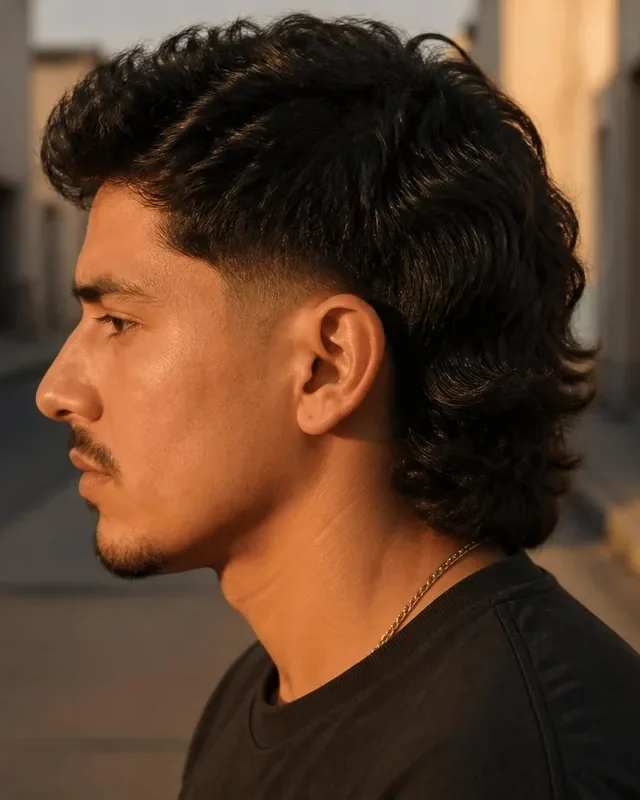
Most men who want longer hair give up around month three. The top is too long to style like a short cut and too short to tie back or comb into a flow. Sides begin to puff out. The nape starts to look scruffy. A low taper fade long hair plan solves that exact problem: the sides stay neat while the top does the growing, so you look intentional at every stage.
This guide is part of our low taper fade series. Instead of a gallery, it is organised as a timeline. You will see what the top looks like at each length, how to style it, what to ask the barber, and how to survive the awkward months.

Why pair a low taper fade long hair plan with a grow-out?
A low taper is the least dramatic fade. It trims the sideburns, the area around the ears and the neckline, and leaves everything else. For a man growing his hair, that has three advantages:
- The sides stay in proportion. Without upkeep, side hair grows outward and makes the head look wide. A taper keeps the sides flat.
- The nape stays tidy. A clean neckline is the difference between “growing out” and “forgot to get a haircut”.
- It does not fight the top. There is no high contrast to compete with the length, so the hair on top looks like the main feature.
It also gives you reasons to visit a barber during the grow-out, which lowers the temptation to cut it all off. If you prefer a shorter, structured look instead, our guide to the mid fade covers sharper contrast.
How long does it take to grow your hair out?
Growth speed is the starting point for any plan. According to the Cleveland Clinic, hair grows about 1 centimetre per month. Some men grow a little faster, around 1.25 cm. Using both figures gives you a realistic range.
| Starting length | Target length | Growth needed | Time at 1 cm/month | Time at 1.25 cm/month |
|---|---|---|---|---|
| 5 cm | 10 cm | 5 cm | 5 months | 4 months |
| 5 cm | 15 cm | 10 cm | 10 months | 8 months |
| 8 cm | 15 cm | 7 cm | 7 months | 5.6 months |
| 8 cm | 20 cm | 12 cm | 12 months | 9.6 months |
| 10 cm | 20 cm | 10 cm | 10 months | 8 months |
The table ignores trims. Every time the ends are cut, you lose a little length, so allow an extra month or two. Curly and coily hair also shrinks, so the visible length lags behind the real length. If that applies to you, read our guide for curly hair before you plan your timeline.
What does each length look like and what can you style?
Length decides what you can do each month. The table below describes the main stages.
| Top length | Stage name | What you can style | Typical month |
|---|---|---|---|
| 5 to 7 cm | Short top | Textured crop, side sweep, messy fringe | Start |
| 8 to 10 cm | Medium top | Quiff, side part, textured sweep | 3 to 5 |
| 11 to 14 cm | Long top | Slick back, pushed-back flow, loose quiff | 6 to 8 |
| 15 to 19 cm | Flow | Full slick back, curtains, half tie | 9 to 12 |
| 20 cm and over | Long hair | Man bun, ponytail, full-length flow | 12 and beyond |
The five stages below show what to do at each length and what to ask the barber. Think of them as a staircase, not a single decision.
Low taper fade long hair stage 1: 5 to 7 cm, short top
You start here, with low taper fade long hair still months away. The hair is short enough to style with a matte paste or clay, and the low taper makes the whole cut look neat. This stage is also a good time to decide how far to go. If you only want a longer, softer version of a short cut, you can stop at 8 cm.
Ask the barber to leave the top untouched and shape only the taper. If they trim the top, ask for no more than 1 cm taken off. Good styling options include a textured crop or a simple side sweep.
Low taper fade long hair stage 2: 8 to 10 cm, medium top
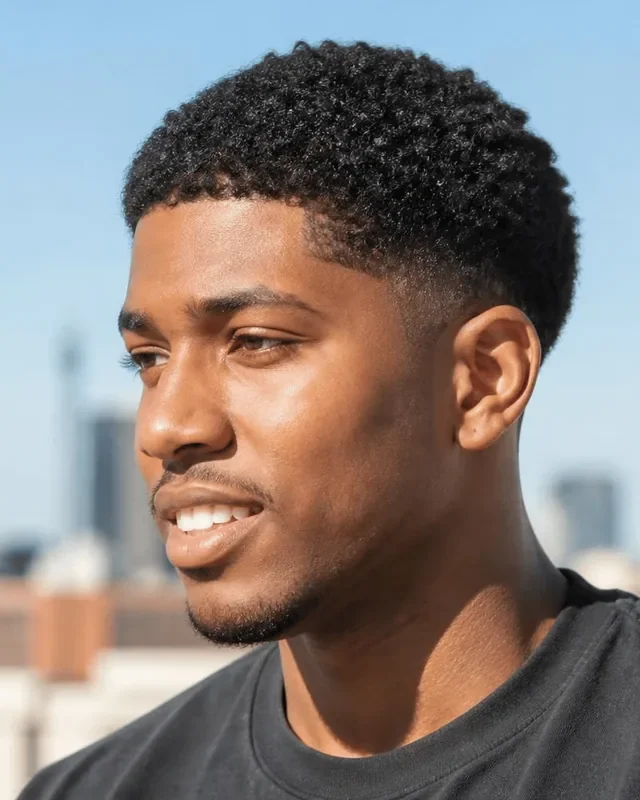
Around month three, low taper fade long hair becomes possible: the top is long enough to style upward. A quiff or side part looks natural. This is also the stage where the nape and ears begin to look messy, which is why the taper matters. Get it tidied every 4 weeks.
At this stage you can try a quiff with a blow-dry and light hold, or a side part for a polished finish. Use a volumising spray so the hair stands up rather than falling flat.

Low taper fade long hair stage 3: 11 to 14 cm, long top
The “awkward stage” often starts here. The top is too long to hold a quiff and too short to push back without sticking up. Many men give up in this window. A few rules make it easier:
- Use a fringe or side sweep. Brushing the hair forward or to the side hides the gap between lengths.
- Add a little product. A cream or light paste controls flyaways.
- Keep the taper sharp. A tidy edge helps the top look like a choice and not neglect.
- Use headbands or caps sparingly. They can help, but they hide progress.
You can now style a slick back with a firm product, or a loose pushed-back flow. Ask the barber to keep layers long, so the weight falls evenly.

Low taper fade long hair stage 4: 15 to 19 cm, flow
This is the milestone most men are growing toward, and the point where low taper fade long hair looks deliberate. The hair is long enough to comb back, tuck behind the ears or sweep to the side in a single piece. It is also the length for classics such as the curtain haircut, which splits at the centre and frames the face, and the bro flow.
Styling is easier than at stage three because gravity helps. A leave-in conditioner or light oil keeps the ends smooth. Use a wide-tooth comb on damp hair, and avoid brushing dry hair, which causes breakage.

Low taper fade long hair stage 5: 20 cm and over, long hair
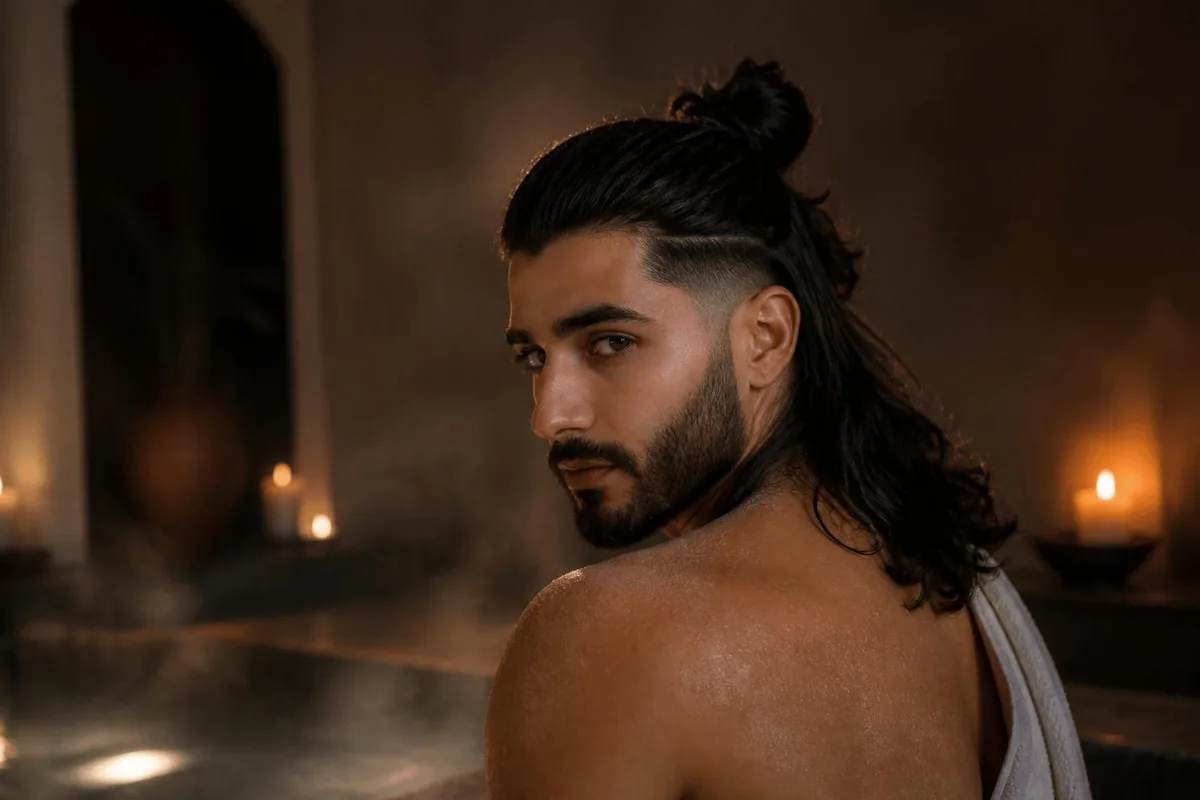
At this length low taper fade long hair can be tied back. A low ponytail or man bun is possible, and the neat taper looks even sharper next to long hair. You will want a trim every 8 to 12 weeks to remove split ends, and a taper refresh every 4 to 5 weeks.
For more on very long styles, see our long hairstyles for men guide. It covers hair care, tying techniques and cuts beyond this series.
What should you tell the barber during a grow-out?
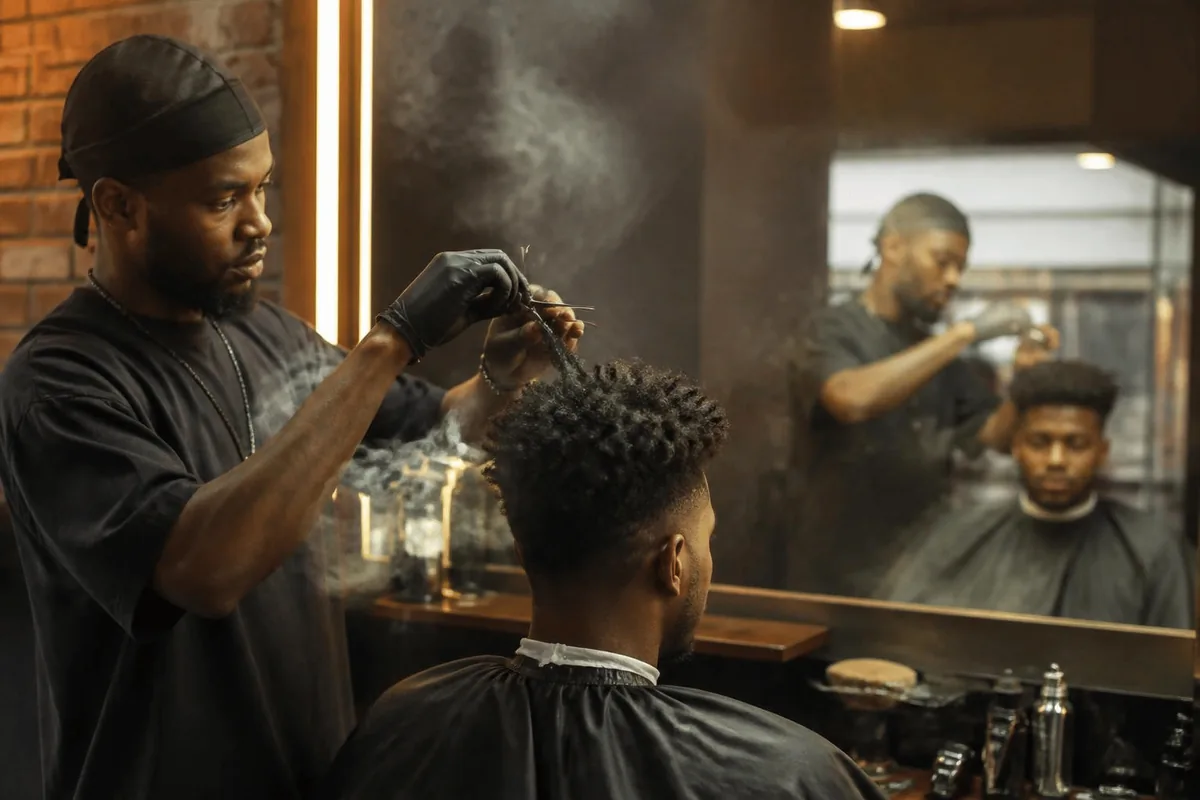
Barbers cut short hair by default, so low taper fade long hair needs a clear brief. Without direction, they may trim an inch off the top “to tidy it”. Use a clear script every time.
- “I am growing the top out.” This changes how they approach the visit.
- “Please do not take length off the top.” Or “only trim the ends, no more than 1 cm”.
- “Low taper fade on the sides with a #2 at the bottom.” The #2 keeps the contrast low so the top does not look overgrown.
- “Tidy the neckline and sideburns.” These edges are what keeps a long-top cut tidy.
- “Blend the sides into the top.” This prevents a hard line between the taper and the long hair.
Our guide on how to ask for a haircut gives more phrases you can use. Bring a photo of the stage you are aiming for, as well as the stage you are at.
Low taper fade long hair: how often should you visit the barber?
A grow-out has two clocks. The sides and neckline run on a short clock, because they grow out of shape quickly. The top runs on a long clock, because you are trying to grow it. The table separates the two.
| Area | Visit every | What to ask for |
|---|---|---|
| Sides and neckline | 4 to 5 weeks | Low taper refresh, tidy sideburns and nape |
| Top, short (under 10 cm) | As needed | No cut, or only shaping |
| Top, long (over 10 cm) | 8 to 12 weeks | Trim split ends only, 0.5 to 1 cm |
| Full reshape | Every 4 to 6 months | Layers to remove bulk and keep a good shape |
Compare this with a short cut in our guide to how often to get a haircut. A grow-out often needs fewer top trims but the same number of side visits.
Low taper fade long hair: how do you survive the awkward stage?
Most grow-outs fail between 8 and 14 cm. These tactics help you get through it.
| Problem | Why it happens | Fix |
|---|---|---|
| Hair sticks out at the sides | Taper has grown out | Keep the taper refreshed every 4 to 5 weeks |
| Top looks flat or shapeless | No layers; weight pulls it down | Ask for long layers, not a cut |
| Hair flicks out at the neck | Back is longer than the sides | Tidy the nape; use a tapered neckline |
| Fringe falls into your eyes | Front is the same length as the top | Sweep to the side, or use a clip or headband |
| Hair looks greasy | Product build-up or over-washing | Wash every 2 to 3 days with a gentle shampoo |
| You want to cut it all off | Frustration | Take a photo each month so you can see progress |
A monthly photo is the cheapest motivation tool. It looks slow from the mirror and fast in a photo comparison.

How do you care for long hair on top?
Low taper fade long hair needs a different routine from a short cut. The ends are older and more fragile.
- Wash every 2 to 3 days. Washing daily strips natural oils and makes hair brittle.
- Condition the ends. Concentrate conditioner on the lower half, not the scalp.
- Detangle gently. Use a wide-tooth comb on damp hair, starting from the ends.
- Limit heat. Use the lowest heat setting that works, and a heat protectant if you style hot.
- Trim regularly. Splits travel up the hair. Small trims prevent big cuts later.
- Protect from the sun. The scalp near the taper is exposed. See the AAD guidance on applying sunscreen, which includes the scalp and ears.
Our overview of hair products for men compares creams, pastes and sprays by hold and finish.
What should the back and nape look like as the top grows?
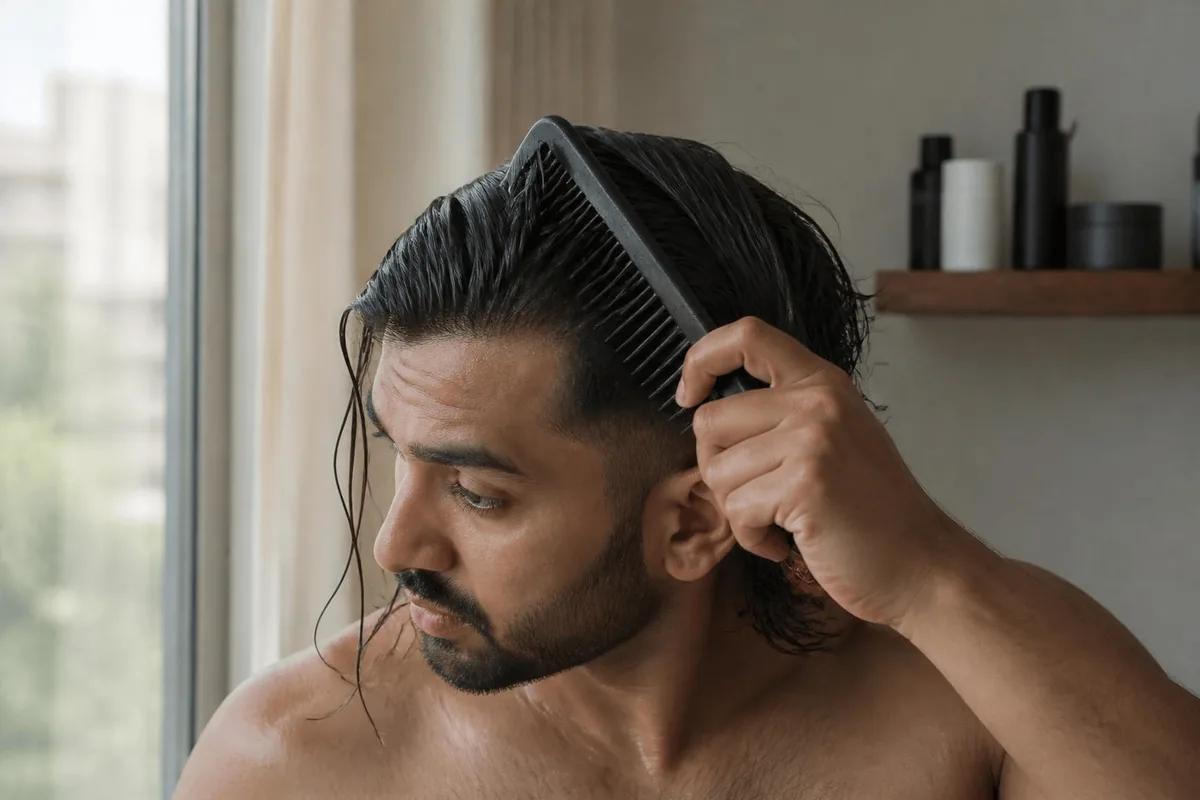
On low taper fade long hair, the back of the head is where a grow-out looks messy first, because the hair behind the ears and over the nape grows into the longer hair on top. A tidy nape signals care. A fuzzy one signals neglect, however good the top looks.
| Nape option | Look | Works best with | Upkeep |
|---|---|---|---|
| Tapered | Fades out to the skin; soft | Almost any length on top | Every 4 to 5 weeks |
| Rounded | Gentle curve across the nape | Flow and tied-back styles | Every 4 to 5 weeks |
| Natural | Follows your hairline | Long hair; low upkeep | Every 6 weeks |
| Blocked | Straight, square line | Short tops only | Every 2 to 3 weeks |
Blocked necklines suit short styles and look harsh under long hair. Pick tapered or rounded for a grow-out. If you tie your hair back, the nape is visible all day, so keep it tidy.
What happens on the days you cannot style it?
Not every morning goes to plan. A few quick fixes keep a grow-out looking intentional on a bad hair day.
- Wet comb back: a wide-tooth comb and a few drops of water can slick hair back at stage three or later.
- Cap or beanie: hats hide flat hair, but fluff the roots before you leave the house.
- Dry shampoo or powder: a quick spray at the roots absorbs oil and adds volume.
- Headband or clip: holds a long fringe off the face during the awkward stage.
- Tuck behind the ears: the simplest style at 12 to 15 cm.
How do you sleep and exercise without damaging growing hair?
Daily habits protect length on low taper fade long hair. Friction is the main enemy: it roughens the hair surface, causes tangles and breaks ends before they grow.
- Pillowcase: satin or silk reduces friction compared with cotton.
- Tying back for the gym: use a soft elastic with no metal clasp, and do not pull tight at the same spot every day.
- After swimming: rinse chlorine or salt water from the hair, then condition.
- Towel drying: pat with a towel instead of rubbing.
These are small habits, but they protect length. Over ten months, a few millimetres saved from breakage add up to several centimetres of visible hair.

A sample 10-month plan from 5 cm to 15 cm
Here is how the stages fit together over ten months, assuming growth of about 1 cm a month and a #2 bottom guard. Your own pace may differ, so treat the dates as a guide.
| Month | Top length | Barber visit | Styling focus |
|---|---|---|---|
| 0 | 5 cm | Set the taper; shape only | Textured crop with matte paste |
| 1 | 6 cm | Taper refresh | Side sweep |
| 2 | 7 cm | Taper refresh | Light volume at the front |
| 3 | 8 cm | Taper refresh, tidy neckline | Quiff with blow-dry |
| 4 | 9 cm | Taper refresh | Quiff or side part |
| 5 | 10 cm | Taper refresh, add long layers | Pushed-back texture |
| 6 | 11 cm | Taper refresh | Fringe to the side; use a clip if needed |
| 7 | 12 cm | Taper refresh, dust the ends | Loose slick back |
| 8 | 13 cm | Taper refresh | Slick back with cream |
| 9 | 14 cm | Taper refresh, trim split ends | Flow with tucked sides |
| 10 | 15 cm | Taper refresh, full reshape | Slick back, curtains or half tie |
Notice that the barber visits are almost all taper refreshes. The top grows untouched, and the barber’s job is to keep the framework tidy. That is why a low taper works so well for this goal.
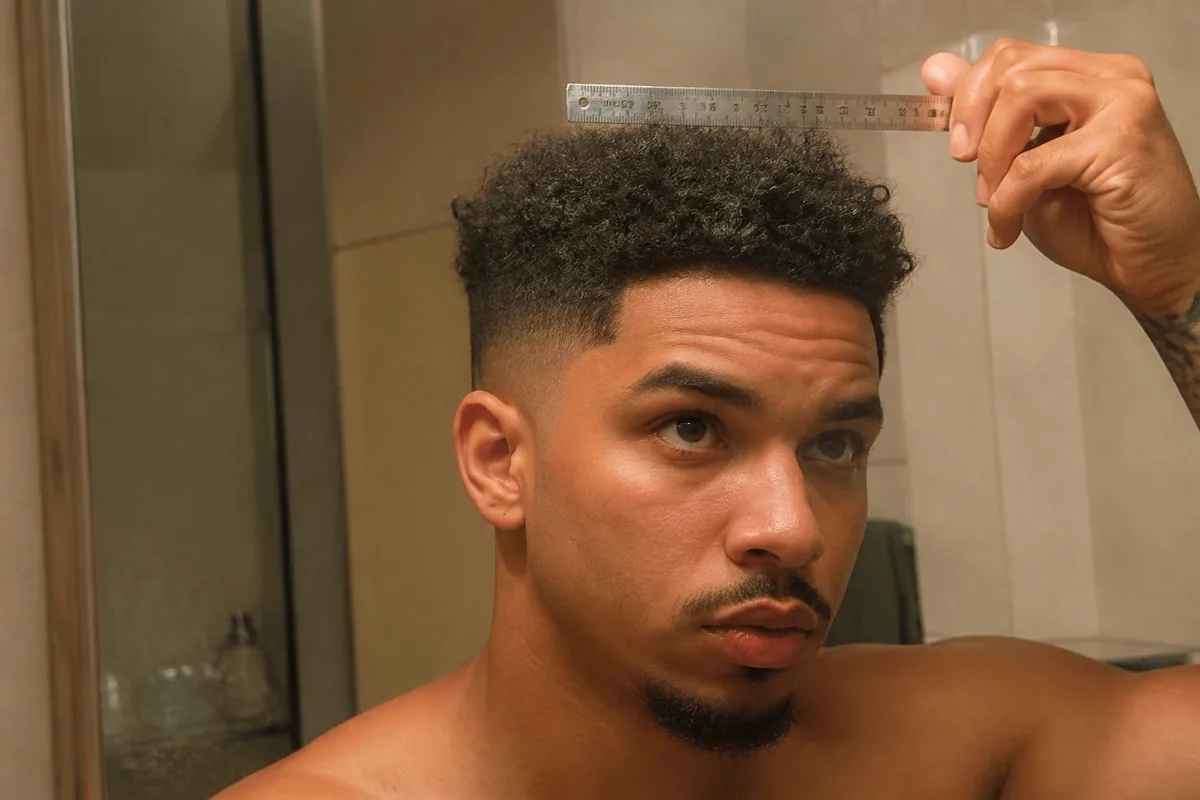
If your hair is curly or coily, add a column for shrinkage. A 15 cm stretched length may sit at 8 cm on your head, and the stages above shift accordingly. A measuring tape and a photo each month give you the most reliable guide.
Which hair types grow out best with low taper fade long hair?
All types can grow out as low taper fade long hair, but each behaves differently.
| Hair type | Grow-out experience | Tip |
|---|---|---|
| Straight, thick | Heavy; can look bulky at 10 to 14 cm | Ask for internal layers to remove weight |
| Straight, fine | Falls flat; needs volume | Use mousse and a blow-dry; see the straight hair guide |
| Wavy | Waves appear around 8 cm; natural movement | Light cream; air dry |
| Curly | Shrinks, so looks shorter than it is | Measure when stretched; moisturise |
| Coily | Shrinks heavily; length shows in a twist-out | Consider twists; see twist hairstyles for men |
Low taper vs other fades during a grow-out
Why a low taper and not something else? Higher fades are sharper, but they require more upkeep and create a larger gap between sides and top. The table shows how they compare.
| Cut | Contrast with long top | Visit every | Grow-out friendliness |
|---|---|---|---|
| Low taper fade | Low | 4 to 5 weeks | Best |
| Low fade | Medium | 3 weeks | Good |
| Drop fade | Medium to high | 3 weeks | Good, with a curve |
| Skin fade | Very high | 2 weeks | Poor; high upkeep |
If you prefer a hard design on the sides, our guide for part lines and designs explains which details work with a long top.
Who should grow a long top, and who should wait?
Low taper fade long hair suits men who want a flexible look with a neat base. It fits office jobs that allow longer hair, creative work and weekends. It suits men with medium to thick hair, and works with wavy or curly hair too.
You might wait if your workplace requires short hair, or if your hair is thinning at the crown or hairline. In that case, a shorter top keeps the contrast low. The American Academy of Dermatology notes that male pattern hair loss tends to appear gradually, and a board-certified dermatologist can advise on options. For style choices, read our guide to haircuts for a receding hairline.
Frequently asked questions
Can you get a low taper fade with long hair?
Yes. The taper only trims the edges, so the top can stay as long as you like. It is one of the neatest ways to grow out a cut.
How long does low taper fade long hair take to grow?
Hair grows about 1 cm a month, so going from 5 cm to 15 cm usually takes 8 to 10 months. Allow longer if you trim the top.
How often should I trim long hair with a taper?
Refresh the taper every 4 to 5 weeks. Trim only the ends of the top every 8 to 12 weeks to remove splits.
What is the best guard for a taper under a long top?
A #2 or #3 at the bottom keeps contrast low and grows out gently. A #1 looks sharper but needs visits every 3 to 4 weeks.
How do I get through the awkward stage?
Keep the sides and neckline tidy, use a fringe or side sweep, and take a monthly photo. The awkward phase usually passes within 2 to 3 months.
Can I tie my hair back with a taper?
Yes, once the top reaches about 18 to 20 cm. The taper keeps the sides short and the ponytail or man bun looks cleaner.
Do I need special products?
A light cream or leave-in conditioner is enough for most. Add a firm hold product only for slick backs.
More in this series
This guide is one of five cluster pages under the low taper fade pillar. The others cover curly hair, straight and fine hair, part lines and designs and cutting one at home. See the full range on our fade haircuts hub.
The length stages and timelines above are estimates based on typical growth, which varies by person, and the growth figure follows the Cleveland Clinic. Our editorial policy explains how we label estimates.