
On this page
Pick your short haircut in three questionsWhat counts as a short haircut for men?The 13 short haircuts for men at a glanceThe 13 short haircuts for men explainedWhich short haircut suits your hair type?Which short haircut suits your face shape and hairline?How is a short haircut different from a fade or an undercut?How do you ask your barber for a short haircut?How often should you get a short haircut?How do you style a short haircut?How do you avoid razor bumps and irritation on a short cut?Can you cut a short haircut at home?What are the most common short haircut mistakes?Are short haircuts still in style?Related collectionsShort Haircuts for Men FAQAbout this hubQuick answer. The best short haircuts for men fall into 13 cuts: buzz cut, crew cut, Caesar cut, textured crop, French crop, undercut, pompadour, quiff, slick back, side part, mullet, Edgar cut and warrior cut. Pick by how much hair you want on top, how much styling time you have, and how your hair grows. Then ask your barber by name, with a number and a photo.
You sit down, the barber asks what you want, and you say “short on the sides, a bit longer on top.” Two minutes later you are looking at a cut you did not picture. That gap between what you said and what you meant is why this guide exists. Short haircuts for men share a few simple measurements, and once you know them, ordering gets easy.
Start with the three-question chooser below. If you already know the cut you want, jump to the table of all 13 styles and read the section that matches. Each section tells you what the cut is, who it suits, how to ask for it and how often it needs a trim.
Pick your short haircut in three questions
Three answers will point you to a cut. The first sets the top length, the second sets the upkeep, and the third sets the finish on the sides. Where two answers disagree, trust the one about upkeep, because that is the one you will live with every morning.
| Question | If you answer | Look at |
|---|---|---|
| 1. How much hair do you want on top? | Almost none, one guard all over | Buzz cut |
| A short, even layer you can leave alone | Crew cut, Caesar cut, Edgar cut | |
| Enough to shape and push around | Textured crop, French crop, side part | |
| Enough to lift, comb or sweep back | Pompadour, quiff, slick back | |
| 2. How much styling time do you have? | None, I towel dry and go | Buzz cut, crew cut, Caesar cut |
| Two minutes with a little product | Textured crop, French crop, side part | |
| Five to ten minutes with a dryer | Pompadour, quiff, slick back | |
| 3. What should the sides do? | Stay neat and tapered | Crew cut, side part, Caesar cut |
| Fade to the skin | Edgar cut, warrior cut, textured crop | |
| Drop away sharply from a longer top | Undercut, pompadour | |
| Stay short while the back grows | Mullet |
Example: a man who wants a short, even layer, zero styling and tapered sides lands on a crew cut or a Caesar cut. A man who wants lift, ten minutes with a dryer and a sharp drop at the sides lands on a pompadour with an undercut.
What counts as a short haircut for men?
A short haircut for men is any cut where the sides and back are clipped close and the top stays under about 8 cm (3 inches) once it is dry and unstyled. Barbers measure the length with clipper guards, numbered #1 to #8. A higher number leaves more hair, so a #1 is nearly bare and a #4 is a soft stubble.
The guard numbers below are the standard clipper sizes. Brands differ a little, so ask your barber to show you the guard before the clippers touch your head.
| Guard | Length left | Looks like |
|---|---|---|
| #1 | 3 mm (1/8 in) | Close stubble, scalp visible |
| #2 | 6 mm (1/4 in) | Short, even shadow |
| #3 | 10 mm (3/8 in) | Soft, easy texture |
| #4 | 13 mm (1/2 in) | The classic buzz length |
| #5 | 16 mm (5/8 in) | Short enough to leave alone |
| #6 | 19 mm (3/4 in) | Starting to show a shape |
| #7 | 22 mm (7/8 in) | Short top, first hint of styling |
| #8 | 25 mm (1 in) | The longest standard guard |
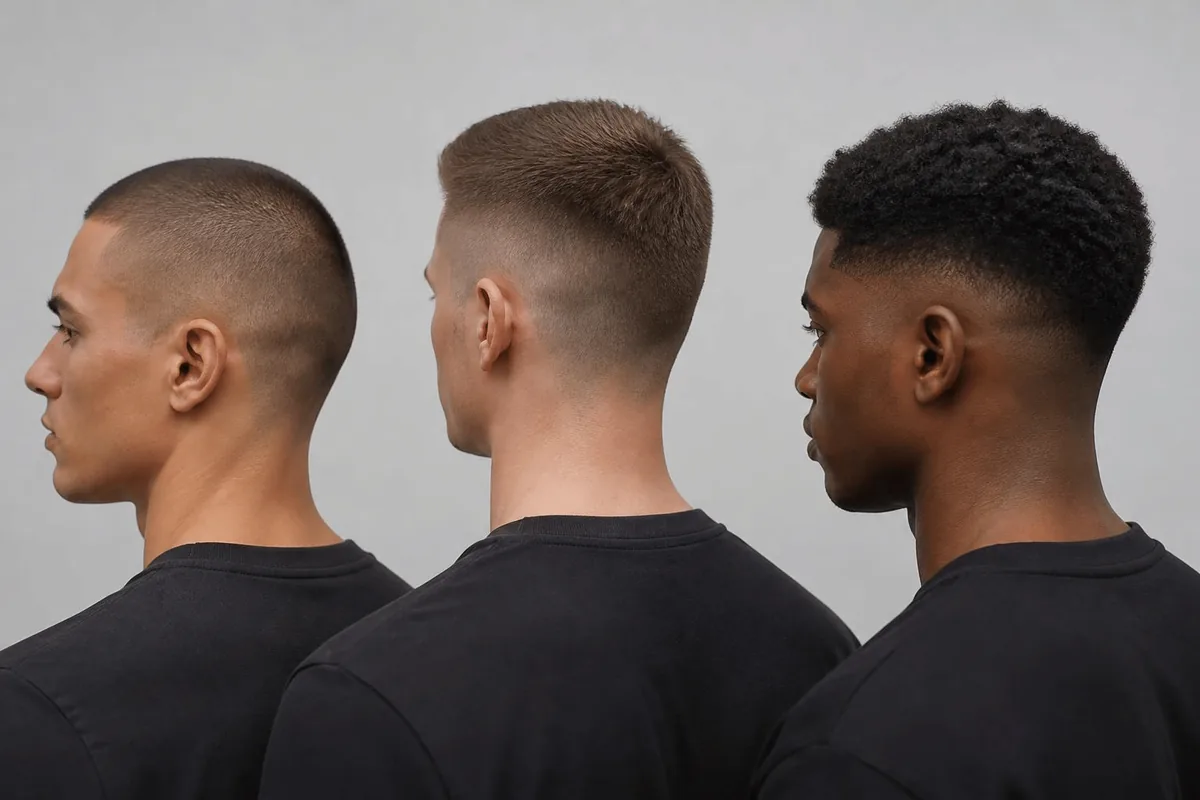
Hair grows about 1 to 1.25 cm a month on average, so a short cut changes shape quickly. A buzz cut at #2 grows to close to a #5 in a month. A crew cut loses its crisp edge in two to three weeks. Plan your trims around that, and the cut looks planned instead of grown out.
The 13 short haircuts for men at a glance
This table puts all 13 cuts side by side with a typical top length, how the sides finish, how often to trim and who the cut suits. Figures are typical, and a good barber adjusts them to your head.
| Cut | Top length | Sides | Trim every | Suits |
|---|---|---|---|---|
| Buzz cut | 3 to 13 mm, one guard | Same length or faded | 2 to 3 weeks | Zero styling, heat, thinning hair |
| Crew cut | 1 to 3 cm, longest at the front | Tapered | 2 to 4 weeks | Office, sport, military look |
| Caesar cut | 1 to 3 cm, even, straight fringe | Short taper | 3 to 4 weeks | Receding hairlines |
| Textured crop | 3 to 6 cm, choppy | Fade or taper | 3 to 4 weeks | Thick or wavy hair |
| French crop | 2 to 4 cm, blunt fringe | Fade or taper | 3 to 4 weeks | Straight to wavy hair |
| Undercut | 5 cm and up | Very short, no blend | 2 to 3 weeks | Strong contrast, thick hair |
| Pompadour | 7 cm and up, swept high | Faded or undercut | 3 to 4 weeks | Volume, formal events |
| Quiff | 5 to 8 cm, lifted | Faded or tapered | 3 to 4 weeks | Relaxed volume |
| Slick back | 5 to 10 cm, combed back | Tapered, faded or undercut | 3 to 5 weeks | A neat, polished look |
| Side part | 3 to 8 cm, parted | Tapered | 3 to 4 weeks | Fine hair, business wear |
| Mullet | Short front, long back | Short or faded | 4 to 6 weeks | Wavy or curly hair |
| Edgar cut | 1 to 3 cm, blunt fringe | Fade with a sharp line-up | 2 to 3 weeks | Straight, thick hair |
| Warrior cut | Textured, varies by barber | Faded | 3 to 4 weeks | Thick hair, bold look |
The 13 short haircuts for men explained
Each cut below gets the same four answers: what it is, who it suits, what to say in the chair and how much upkeep it costs you. Read the ones that matched your three answers, and skip the rest.
Buzz cut
A buzz cut is a single clipper guard run over the whole head, usually between #1 and #4 (3 to 13 mm), sometimes with the sides faded shorter. It is the lowest-effort short haircut there is, and it hides thinning better than most cuts because there is no length to expose the gaps. Ask for “a number 3 all over, with a clean neckline.” Trim every two to three weeks, because a buzz cut loses its shape fast. The full set of guard choices sits in our buzz cuts for men length guide, and the buzz cut for thinning hair guide covers the crown and hairline.

Crew cut
A crew cut keeps the sides and back tapered short and leaves the top a little longer, with the most length at the front. It grew out of military and college-sport haircuts, and it still reads as tidy in any office. Ask for “a crew cut, number 2 on the sides tapering up, about two centimeters on top.” It needs a trim every two to four weeks to hold the line. If you want something tighter and more military, ask for a high and tight instead.
Caesar cut
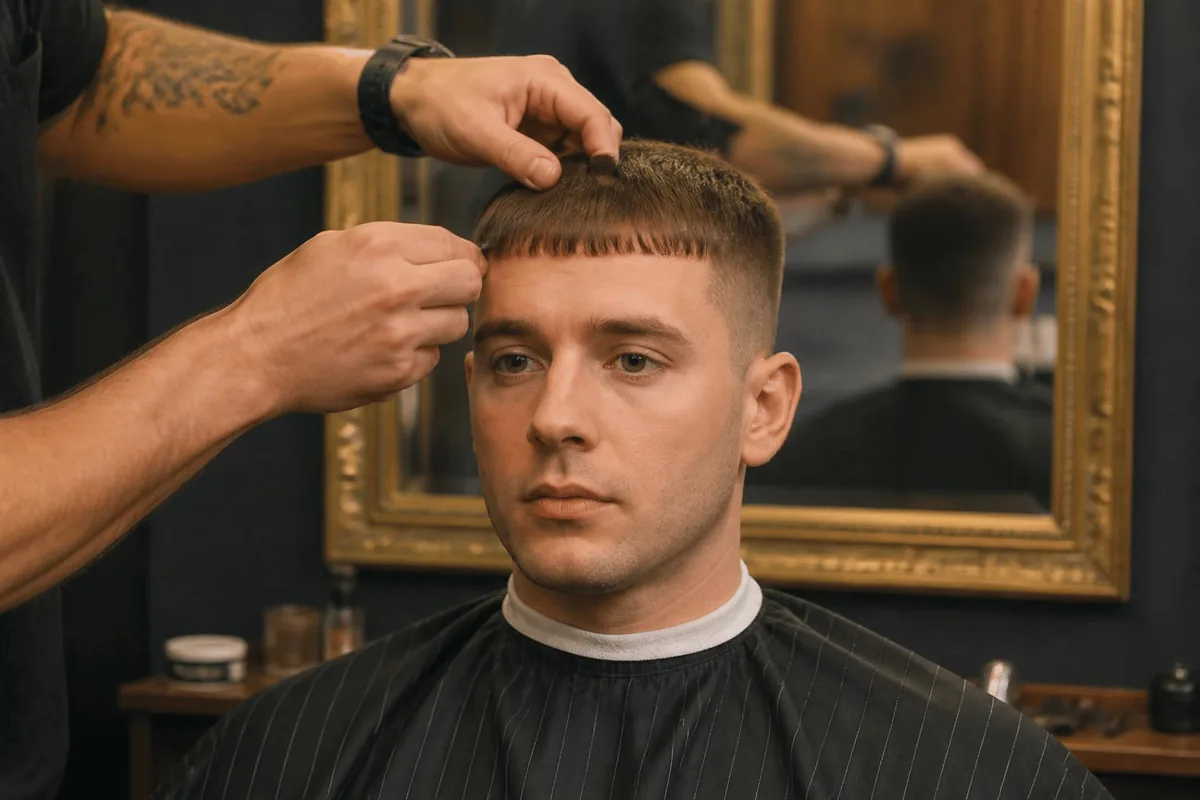
A Caesar cut is a short, even top with a straight fringe cut across the forehead, over tapered sides. The blunt fringe is the whole point. It is one of the easiest cuts to live with, because the hair falls into place without product, and the straight line softens a receding hairline. Ask for “a Caesar cut, even length on top, straight fringe, short taper on the sides.” Trim every three to four weeks.
Textured crop
A textured crop is a short-to-medium top cut with choppy, point-cut ends that sit forward over the forehead, paired with faded or tapered sides. The cutting technique gives the top movement, so the style looks styled even when you did almost nothing. It works best on thick, wavy or slightly coarse hair. Ask for “a textured crop with a low fade, point-cut on top, fringe forward.” Trim every three to four weeks. The low taper fade with a textured crop guide shows six ready-made versions.

French crop
A French crop is a short top with a blunt fringe brushed forward, over tight tapered or faded sides. It sits close to the Caesar cut, but the top is usually a little longer and a little more textured. The result is neat and easy, and it suits straight to wavy hair. Ask for “a French crop, two to four centimeters on top, blunt fringe, mid taper.” Trim every three to four weeks.
Undercut
An undercut cuts the sides and back very short with no gradual blend, so the longer top drops straight down to the short hair. The contrast is the look. Barbers call the no-blend version “disconnected.” It works on thick hair and looks sharp slicked back or swept to the side. Ask for “an undercut, number 1 or 2 on the sides, disconnected, five centimeters on top.” Trim every two to three weeks, because the hard line shows growth quickly. Our undercut guide for men covers connected and disconnected versions in depth.
Pompadour
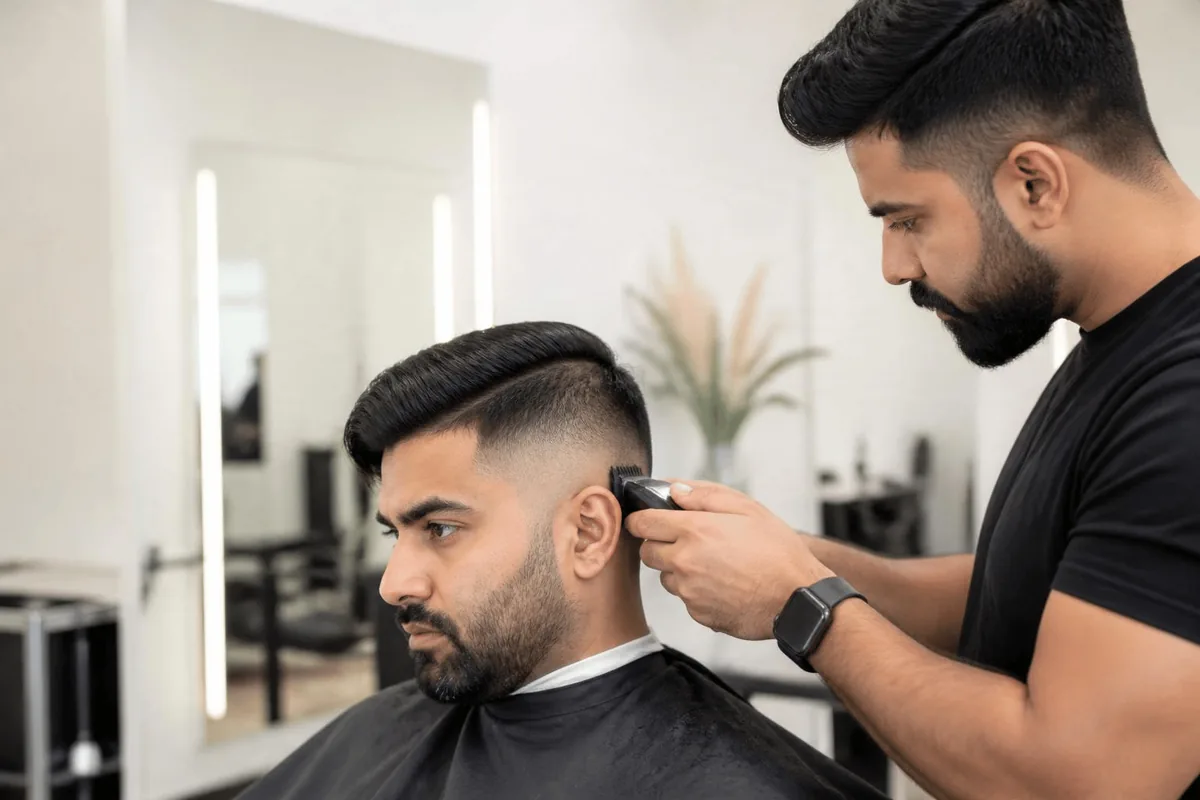
A pompadour sweeps the top up and back from the forehead into a rise of volume, with the sides cut short or faded. You need roughly 7 cm (3 inches) or more on top to get the lift. It looks best for formal events, and it takes five to ten minutes with a dryer and a strong-hold product. Ask for “a pompadour, longer on top, faded sides, keep the length at the front.” Trim every three to four weeks. For a version with a curved fade underneath, see the drop fade pompadour steps.

Quiff
A quiff lifts the front of the hair up and slightly forward, with a more relaxed finish than a pompadour. It needs less height, around 5 to 8 cm, and it tolerates a messier day. The sides are faded or tapered. It suits men who want volume without a formal look. Ask for “a quiff, textured on top, mid fade on the sides, front longer than the back.” Trim every three to four weeks.
Slick back
A slick back combs the top straight back from the forehead, held with pomade or gel. Length runs about 5 to 10 cm, and the sides can be tapered, faded or cut as an undercut. It looks polished on straight and wavy hair, and it needs more product than any other short haircut. Ask for “a slick back with a low taper, length kept on top so it combs back.” Trim every three to five weeks.

Side part
A side part divides the top to one side and combs it across, with tapered sides. It is the classic business cut, and it flatters fine hair because it adds visual weight on one side. A hard part, where the barber shaves the parting line in, gives a sharper finish. Ask for “a side part, three to six centimeters on top, tapered sides, hard part optional.” Trim every three to four weeks. Find your natural part by combing the hair back wet and letting it fall.
Mullet
A mullet keeps the front and sides short and lets the back grow long. The modern version fades the sides and blends the length into the nape instead of leaving a hard step. It works on wavy and curly hair, where the back length gets natural shape. Ask for “a modern mullet, faded sides, longer back, keep the top textured.” Trim every four to six weeks. Our modern mullet guide covers the styles, and the drop fade mullet page shows how a curved fade changes the shape.

Edgar cut
An Edgar cut pairs a blunt, straight fringe with a fade on the sides and a sharp line-up at the forehead and temples. It is popular in Latino communities in the United States, and it is sometimes called the Takuache. It suits straight and thick hair, and the crisp lines need a trim every two to three weeks. Ask for “an Edgar cut, blunt fringe, mid fade, sharp line-up.” The Edgar cut guide explains how to describe it to a barber who has not cut one before.
Warrior cut
The name warrior cut gets used loosely. In most barbershops it means faded sides with a textured top left longer in the middle, often with a sharp line-up. Because barbers disagree on the exact shape, this is the one cut where a photo matters more than the name. Bring two photos, one from the front and one from the side, and ask the barber to describe back to you what they will cut. Trim every three to four weeks.
Which short haircut suits your hair type?
Hair type changes how a short cut behaves more than almost anything else. Straight hair shows every clipper line. Curly hair shrinks and hides them. Pick a cut that works with the way yours grows, and the barber has an easier job.
| Hair type | Cuts that work | Watch for |
|---|---|---|
| Straight | Caesar cut, French crop, side part, slick back, Edgar cut | Cowlicks at the crown show on very short cuts |
| Wavy | Textured crop, quiff, mullet, French crop | Waves puff out if the top is left too short |
| Curly | Textured crop, mullet, buzz cut, undercut | Curls shrink noticeably once dry, so cut longer than you think |
| Coily | Buzz cut, crew cut, undercut, fade with a short top | Razor bumps on the neckline, so use a guard first |
| Fine or thinning | Buzz cut, Caesar cut, crew cut, side part | Long, flat tops make gaps more visible |
| Thick | Undercut, pompadour, textured crop, warrior cut | Thick hair needs thinning shears or it sits too wide |
If your hair is thinning at the temples or crown, the buzz cut and the Caesar cut give you the cleanest edges. The American Academy of Dermatology explains the options for male pattern hair loss, and a dermatologist is the right person to ask if you notice sudden shedding.

Which short haircut suits your face shape and hairline?
Face shape gives you a starting point, not a rule. Barbers use it to decide where to add height and where to keep the sides tight. These are the common pairings.
| Shape or hairline | Try | Why |
|---|---|---|
| Round face | Pompadour, quiff, undercut | Height on top and tight sides make the face look longer |
| Square face | Crew cut, buzz cut, side part | Short, clean lines match a strong jaw |
| Oval face | Almost any cut | The balanced shape carries most styles |
| Oblong face | Caesar cut, French crop, textured crop | A fringe shortens the forehead and avoids extra height |
| Heart-shaped face | Side part, textured crop, French crop | A forward fringe balances a wider forehead |
| Receding hairline | Caesar cut, buzz cut, French crop | Short or forward-combed hair keeps attention off the temples |
| High forehead | Fringe cuts, textured crop | Hair across the forehead shortens the visual space |
The same cut can look different on two men with the same face shape, so use the table to narrow the list and then look at photos of men with your hair type.
How is a short haircut different from a fade or an undercut?
A short haircut describes the length. A fade describes how the sides blend. An undercut describes how the sides meet the top. You can combine them, and most men do. A textured crop with a low fade is a short haircut with a fade, and a pompadour with a disconnected side is a short haircut with an undercut.
That is why the same cut can be ordered three ways. If your barber hears “short on the sides,” they will pick a taper, a fade or a straight cut for you. If you say “number 2 on the sides, low fade, longer on top,” they cut exactly that. Our fade haircuts guide explains the height, finish and shape choices, and the low taper fade and drop fade pages cover the two most requested blends.
How do you ask your barber for a short haircut?
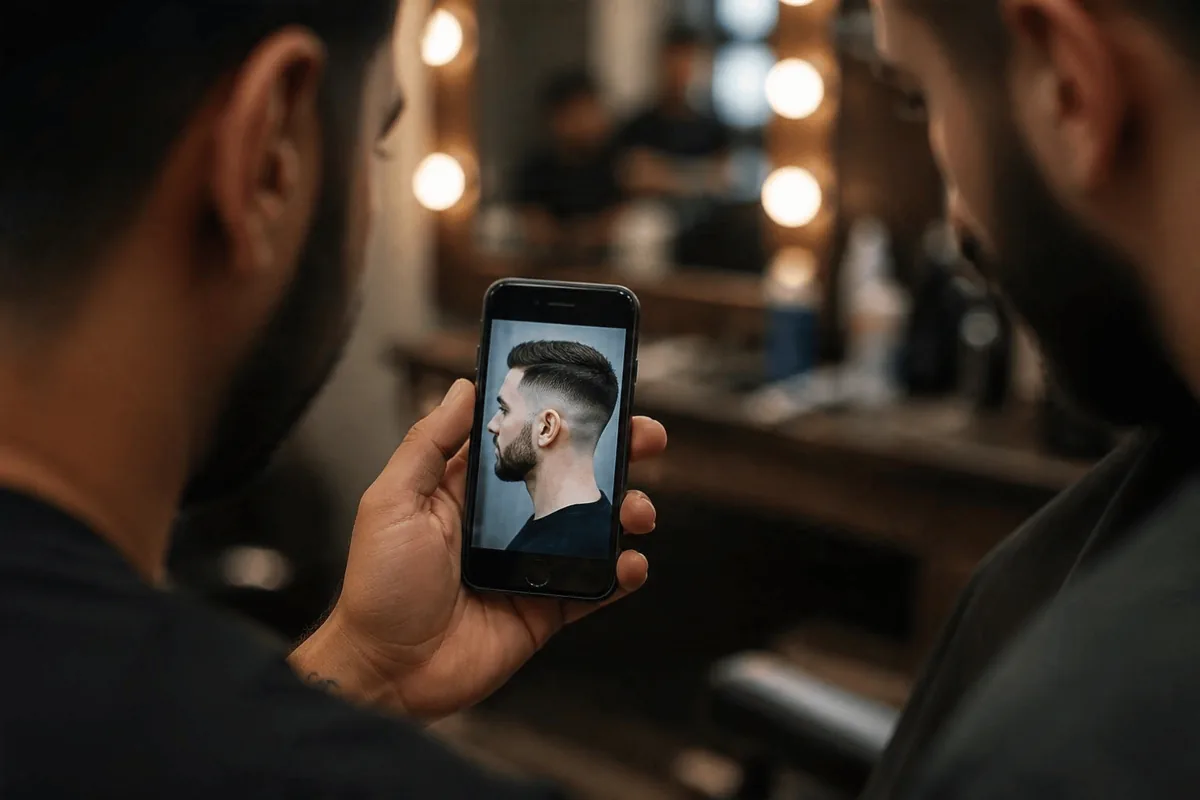
Ask for a short haircut by naming the cut, the guard number for the sides, the length on top and the neckline shape, then show a photo. Barbers work from what they see, so a photo beats a description every time. Walk through these steps in the chair.
- Name the cut. Say “textured crop” or “crew cut,” not “short on the sides.”
- Give the sides a number. Say “number 2” or “low fade,” and ask to see the guard.
- Say the top length in centimeters or inches. Hold two fingers up if you are unsure, and ask the barber to confirm.
- Pick the neckline. Choose rounded, squared or tapered, and say how far down the nape you want the clippers to go.
- Show two photos. One from the front and one from the side, ideally of someone with your hair type.
- Ask for the plan back. Let the barber repeat what they will cut before the clippers start.
What goes wrong: asking for “a short back and sides” with no number. The barber guesses a #1, you wanted a #3, and you spend a month growing it out. Say the number, and show the photo. Our how to ask for a haircut guide has a full barbershop script.
How often should you get a short haircut?
Most short haircuts need a trim every two to four weeks. The shorter and sharper the cut, the faster it loses shape. Hair grows about 1 to 1.25 cm a month, and on a 6 mm #2 that growth doubles the length in under a month.
| Cut | Trim every | Why |
|---|---|---|
| Buzz cut, Edgar cut, undercut | 2 to 3 weeks | Hard lines and short lengths show growth quickly |
| Crew cut, Caesar cut | 2 to 4 weeks | Even tops lose their edge as they grow |
| Textured crop, French crop, quiff, pompadour, side part, warrior cut | 3 to 4 weeks | Tops tolerate a little grow-out |
| Slick back | 3 to 5 weeks | More length hides the sides growing in |
| Mullet | 4 to 6 weeks | Only the sides and top need regular work |
If you cannot visit that often, book a quick neck-and-edge clean-up between full cuts. It costs less and keeps the shape.
How do you style a short haircut?
Style short hair with the lightest product that holds the shape. Rub a pea-sized amount between your palms, work it from the back to the front, and finish with your fingers. Use matte clay on textured tops, pomade on slick backs and pompadours, and sea salt spray on wavy hair for grip.
- Towel dry first. Product on dripping hair slides off and does nothing.
- Use a dryer for any cut with lift. Direct the airflow upward and backward for a pompadour or quiff.
- Start with less product than you think. You can add more, but you cannot take it out without washing.
- Skip product on a buzz cut or a Caesar cut. A clean scalp and a dab of moisturizer are enough.
How do you avoid razor bumps and irritation on a short cut?
Short sides mean clipper contact close to the skin, and that is where bumps start. Ask the barber to clip with the grain, avoid close shaving over a fresh cut, and apply a calming, fragrance-free moisturizer afterward. The American Academy of Dermatology has clear steps for razor bump prevention.
A very short cut also exposes the scalp to sun. The American Academy of Dermatology advises applying sunscreen with SPF 30 or higher to exposed skin, which includes a buzzed scalp.
Can you cut a short haircut at home?
Yes, a buzz cut or a simple crew cut is the easiest short haircut to cut at home, because one guard does most of the work. Fades, line-ups and textured tops take practice, and a mistake at the neckline stays visible for weeks. Start with a single guard longer than you think you need.
- Pick a guard one size longer than your target, so you can cut shorter later.
- Cut dry, clean hair against the direction of growth, starting at the back.
- Work in slow, overlapping strokes and keep the clipper flat to the head.
- Check both sides in a handheld mirror before you switch guards.
- Clean the neckline last, with the clipper bare and the guard off, and only lightly.
What goes wrong: taking the neckline too high, which leaves you with a bare band that grows back in a hard line. Keep it low and soft. If you want a blend, see how to cut a low taper fade at home.
What are the most common short haircut mistakes?
These mistakes cost men the most grow-out time.
- No number. “Short on the sides” can mean a #1 or a #4. Always name a guard.
- Cutting curly hair wet. Curls shrink noticeably when dry, so a cut that looks right wet comes up too short.
- Too much product on short hair. It leaves residue and flattens the shape. Use a pea-sized amount.
- Skipping trims. A sharp cut grown out for six weeks looks neglected. Book the next visit before you leave.
- Choosing a cut that fights your hair. A slick back on tight curls or a pompadour on very fine hair takes daily effort and rarely works.
- Ignoring the neckline. A tidy neckline makes an average cut look sharp.
Are short haircuts still in style?
Yes. Short cuts with textured tops, soft fades and blunt fringes remain among the most requested men’s styles because they are practical and flatter many head shapes. Trends move between sharper and softer versions, so the safest approach is to choose a cut that matches your hair and routine, then adjust the details when a new look appeals to you.
Related collections
Short haircuts overlap with several other collections on this site. Browse the full men’s haircut directory for every cut we cover, or read the fade haircuts hub to choose how the sides should blend.
Short Haircuts for Men FAQ
What is the best short haircut for men?
The best short haircut is the one that matches your hair type, face shape and styling time. A crew cut or Caesar cut suits low-effort routines, a textured crop suits thick or wavy hair, and a pompadour or quiff suits men who want volume.
What is the easiest short haircut to maintain?
The buzz cut is the easiest short haircut to maintain because it needs no styling. The Caesar cut and crew cut come next, since the even top falls into place on its own.
What guard number should I ask for?
Ask for #1 to #2 for a very short look, #3 to #4 for a soft stubble, and #5 to #8 when you want the hair to keep some shape. Ask the barber to show you the guard, since sizes vary slightly by brand.
How long does hair need to be for a short haircut?
A buzz cut can be done at any length, because the clippers do the work. Cuts with shape, such as a crew cut or French crop, need about 2 to 4 cm. A pompadour needs about 7 cm or more on top.
Do short haircuts work on thinning hair?
Yes. A buzz cut, Caesar cut or crew cut keeps the hair even, so thinning areas stand out less. A dermatologist can advise on treatment if you notice rapid shedding.
What short haircut is best for curly hair?
A textured crop, a mullet, a buzz cut or an undercut suit curls well. Cut curly hair longer than you think, because it shrinks when it dries.
How often should I get a short haircut?
Every two to four weeks for most cuts. Buzz cuts, Edgar cuts and undercuts need the shortest gap, and a slick back or a mullet can go four to six weeks.
Can I ask for a short haircut with a fade?
Yes. Many short haircuts pair with a fade on the sides. Name the cut, the fade height and the finish, for example “textured crop with a low fade.”
How do I tell my barber what I want?
Name the cut, the guard number for the sides, the length on top and the neckline, then show two photos from different angles.
About this hub
Buzzcutting publishes this hub as general information about men’s haircuts. It uses standard clipper guard sizes and typical lengths, which vary by barber and by the brand of clipper. The 1 to 1.25 cm monthly growth figure is a commonly cited average, and the trim intervals are typical ranges, not rules. The razor bump, sunscreen and hair loss pointers come from the American Academy of Dermatology, linked above. This hub has not been reviewed by a licensed barber or dermatologist, so check the details with your own barber.
Hold one photo of the cut you want and a second of the cut you do not, and your barber will understand you faster than any description. Read how we write and review guides in our editorial policy.