
On this page
What counts as a low taper fade with design?Low taper fade with design: seven options ranked from safest to riskiestDesign 1: the clean edge-upDesign 2: the soft natural partDesign 3: the shaped sideburnDesign 4: the hard part (razor part)Design 5: the curved or stepped temple shapeDesign 6: the thin line or grooveDesign 7: patterns, shapes and letteringThe regret test: should you get a low taper fade with design?How do you find a barber who can cut a clean design?What does a low taper fade with design cost, and how long does it take?How do you keep a low taper fade with design sharp between visits?Which low taper fade with design options suit which hair type?Which top styles pair best with a low taper fade with design?How do you place a part line on your head?What should you do in the first 48 hours after a design?Low taper fade with design for specific occasionsCommon mistakes with a low taper fade with designFrequently asked questionsMore in this seriesQuick answer. A low taper fade with a design adds one deliberate detail to a soft, low-contrast cut: usually a shaved part line, a sharp edge-up, or a short pattern cut into the sides. Because the taper removes little hair, the design is small by nature. Pick one detail, ask the barber to draw it first with a trimmer, and expect to refresh it every 2 to 3 weeks, since fine lines blur faster than the taper does.
A plain taper is quiet. A low taper fade with design is the same quiet cut with one line that says someone planned it. That line might be a razor-sharp part, a curved shape-up at the temple, or a thin groove cut through the hair above the ear. The detail is small, but it changes how the whole head reads.
Most guides show a gallery and stop. This one ranks seven designs by how much they cost in time, skill and regret, then covers placement, barber checks and upkeep. It belongs to our low taper fade series, so the basics of the taper itself are on the pillar page.

What counts as a low taper fade with design?
A design here means any shape cut into the hair or hairline beyond the plain taper. On a low taper that usually happens in three places: along the part on top, around the hairline (temples, forehead, nape) and in the short hair above the ears. The taper itself leaves only a narrow band of short hair, so designs on the sides are shallow unless you ask the barber to go shorter.
Keep this limit in mind. If you want large patterns across the sides, a taper is the wrong base, and a mid fade or skin fade gives you more room. The low taper suits subtle, refined detail.
Low taper fade with design: seven options ranked from safest to riskiest
The table ranks designs by risk. “Risk” means how hard the design is to cut well, how visible mistakes are, and how long it takes to grow out.
| Rank | Design | Where it sits | Skill needed | Grow-out if you hate it |
|---|---|---|---|---|
| 1 | Clean edge-up (line-up) | Forehead, temples | Low | 1 to 2 weeks |
| 2 | Soft natural part | Top of head | Low | None; it is combed |
| 3 | Shaped sideburn | Beside the ear | Medium | 2 to 3 weeks |
| 4 | Hard part (razor part) | Top, left or right | Medium | 2 to 3 weeks |
| 5 | Curved or stepped temple shape | Temple | Medium to high | 3 to 4 weeks |
| 6 | Thin line or groove | Above the ear | High | 3 to 5 weeks |
| 7 | Pattern, shape or lettering | Sides or back | Very high | 4 to 8 weeks |
The numbers for grow-out are estimates based on typical growth. Hair grows about 1 centimetre a month, according to the Cleveland Clinic, so a groove cut 3 mm deep disappears faster than a bold pattern shaved to the skin.
Design 1: the clean edge-up
An edge-up, also called a line-up or shape-up, straightens the hairline at the forehead and temples with a trimmer or razor. It is the most common detail on a taper and the least risky. The line makes the whole cut look sharper without adding any new shape.
Ask for a “natural line-up” if you want to keep your real hairline, or a “defined” one if you want it squarer. Natural is safer, particularly if your hairline is receding. Our guide to haircuts for a receding hairline explains why an overly low or straight line can look odd when the hairline shifts.
What goes wrong: a line placed too low across the forehead, which makes the forehead look small, or an uneven pair of temples. Check both sides against each other before the barber finishes.

Design 2: the soft natural part
A natural part follows the way your hair already falls. The barber finds the part by combing the hair back and letting it fall where it wants. It is the right choice for most men because it needs no extra upkeep and works with the taper’s softness.
To find yours at home, comb your hair straight back, then push the front forward with your fingers. The hair will split along its natural line. Our guide to the side part haircut covers parts in more depth.

Design 3: the shaped sideburn
The sideburn is part of every low taper, so it is an easy place to add detail. Options include a straight cut, an angled slope, or a pointed tip. Straight cuts look neat and modern. Pointed tips look sharper and more retro.
- Length: middle of the ear for modern, bottom of the ear for classic, jawline for retro.
- Width: keep it between 3 and 5 cm unless you also wear a beard.
- Match: both sides must end at the same height; hold a comb horizontally against both ears to check.
If you wear a beard, the sideburn needs to connect cleanly. See our guide to the beard fade for blending the two.

Design 4: the hard part (razor part)
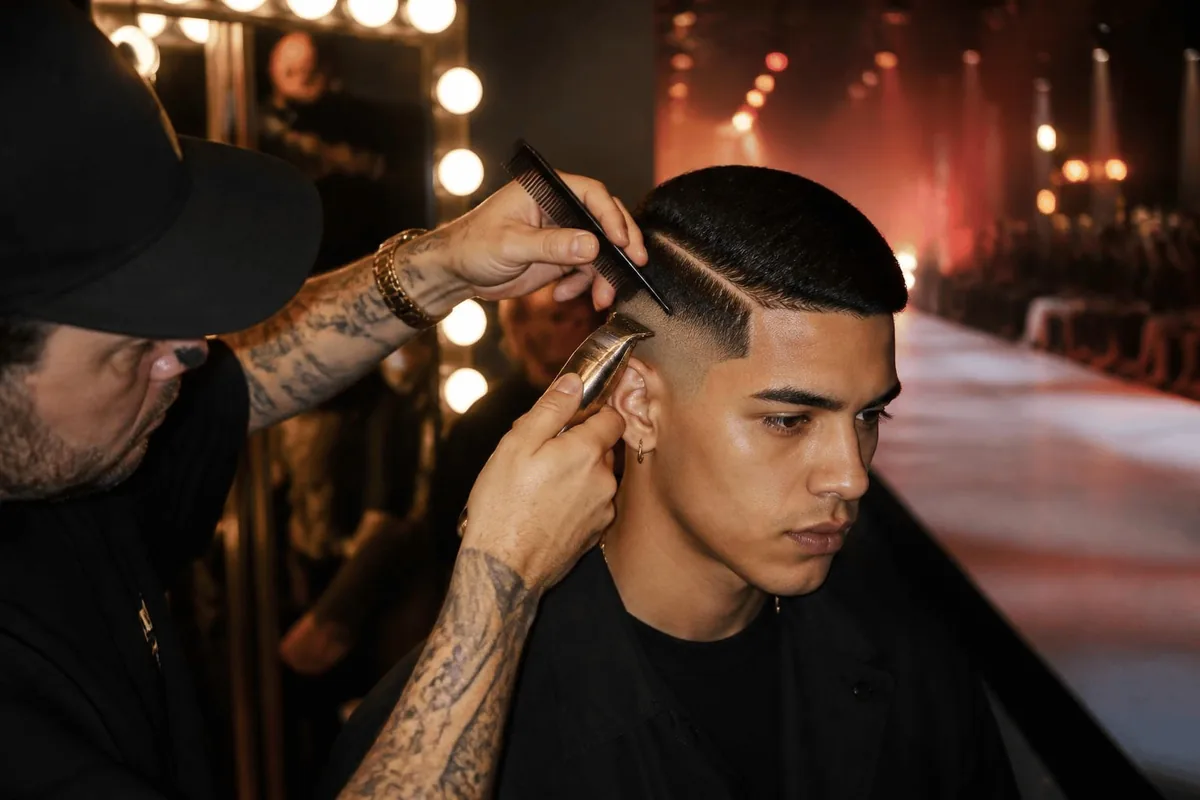
On a low taper fade with design, a hard part is a thin line shaved or trimmed into the hair to mark where the part falls. It is the most popular design on a low taper, because it adds sharpness to the top without touching the sides.
Here is how the barber usually cuts one:
- Find the natural part. The barber combs the hair to the side to see where it parts.
- Mark the line. They draw it lightly with the edge of a trimmer, or with a comb and a dry razor.
- Cut it with a trimmer. A close-cutting trimmer or foil shaver removes the hair along the line, usually 1 to 2 mm wide.
- Clean up. The barber brushes away loose hair and checks the line against the head shape.
What goes wrong: a line that is crooked, too long or too low. A hard part usually starts just behind the temple and runs back 4 to 6 cm. It should follow the curve of the head. Tell the barber which side your hair falls on, and take a photo of the part so you can ask for the same one next time.
| Part depth | Look | Upkeep |
|---|---|---|
| Short (3 to 4 cm) | Subtle, office-friendly | Every 3 weeks |
| Medium (5 to 6 cm) | Classic and visible | Every 2 to 3 weeks |
| Long (7 cm or more) | Bold, high maintenance | Every 2 weeks |

Design 5: the curved or stepped temple shape
This low taper fade with design adds a curve or step at the temple instead of a straight edge. It suits men who want something distinctive but still wearable. Done well, it draws attention to the cheekbone and softens a square jaw.
It needs a barber with strong trimmer skills, because the curve has to be identical on both sides. Look at their portfolio before asking. If a barber cannot show you at least three temple shapes done cleanly, choose a simpler design. Our guide on the temp fade explains how temple shaping and tapers interact.

Design 6: the thin line or groove
On a low taper fade with design, a groove is a narrow line, 2 to 3 mm wide, cut through the short hair above the ear. It is a popular detail on tapers and fades because it adds interest without much hair loss. It is also easy to get wrong: the line must be level, the right length and the right depth.
Because the low taper’s short zone is thin, a groove can look crowded. Keep one line, not several, and place it where the taper is longest, around 1 to 2 cm above the ear.

Design 7: patterns, shapes and lettering
Patterns and lettering sit at the far end of the risk scale. They need a deep, short base (a #0.5 or skin) to show, which is not typical for a low taper. Barbers who specialise in designs will often shave the side to the skin first, then draw the pattern.
If you want this, consider whether you really want a taper. A low fade or burst fade gives a cleaner canvas, and the design will show properly.

The regret test: should you get a low taper fade with design?
A low taper fade with design is fun, but a bad one lasts weeks. Before you book, run this quick check.
- Imagine it at your next big event. A wedding, interview or family photo in the next three weeks? If yes, pick a safer design.
- Check workplace and school rules. Some uniforms and dress codes limit visible lines.
- Look at your hairline. A receding or uneven hairline makes sharp temple designs harder.
- Ask how long it takes to grow out. The table above gives estimates.
- Take a photo of your head from behind. A design looks different from the back, and a barber’s portfolio may only show the front.
If you pass the test, go ahead. If not, start with the edge-up or the natural part and add more at the next visit.
How do you find a barber who can cut a clean design?
For a low taper fade with design, the barber matters more than the design. A cheap haircut at a busy shop can turn a good idea into a bad result. Check these things before you sit down:
- Portfolio: look for close-up photos of lines from several angles, ideally on different hair types.
- Tools: a barber should have clean trimmers, a foil shaver or straight razor, and a fresh blade.
- Consultation: a good barber asks where you want the line, then draws or marks it first.
- Time: a detailed design takes 10 to 20 minutes longer than a plain taper. Beware of anyone who rushes it.
- Hygiene: clean tools and a fresh neck strip are non-negotiable.
For a script that works with any barber, see our guide on how to ask for a haircut. Bring two photos: one of the design you want, and one of your own head so the barber can see how it will sit.
What does a low taper fade with design cost, and how long does it take?
Prices vary by city and shop, so treat these as ranges rather than quotes. A plain low taper costs the standard men’s cut price. Designs usually add a small fee for time, often from nothing for a line-up up to a noticeable extra for a pattern.
| Design | Extra time | Typical price effect |
|---|---|---|
| Edge-up or natural part | 2 to 5 minutes | Usually included |
| Shaped sideburn | 3 to 5 minutes | Usually included |
| Hard part | 5 to 10 minutes | Often included or a small extra |
| Temple shape or groove | 10 to 15 minutes | Small to moderate extra |
| Pattern or lettering | 20 minutes or more | Moderate extra; ask first |
Ask for the price before the barber starts. A transparent shop tells you immediately.
How do you keep a low taper fade with design sharp between visits?
Lines look crisp for about a week and soft by week three. A little care slows that down.
- Wash gently around the line. Do not scrub the shaved area with a rough towel.
- Use a light moisturiser or aftershave balm. Dry skin shows redness next to a fresh line.
- Do not touch it up unless you are confident. A home trimmer can widen a line by accident.
- Sleep on a clean pillowcase. Clean fabric reduces irritation.
Shaving close to the skin can cause bumps. The American Academy of Dermatology explains how to prevent razor bumps, and the advice is useful for any design that uses a razor or foil shaver: use a clean, sharp blade, shave with the grain and avoid pulling the skin tight.
Which low taper fade with design options suit which hair type?
Hair type changes how a low taper fade with design looks. Straight hair shows every line clearly. Curly and coily hair softens the edges but hides subtle detail.
| Hair type | Best designs | Watch out for |
|---|---|---|
| Straight or fine | Natural part, shaped sideburn, hard part | Crooked lines are obvious |
| Wavy | Edge-up, hard part, temple shape | Lines blur as waves grow |
| Curly or coily | Edge-up, part, groove | Razor bumps; keep the line shallow |
For hair-type specifics, see our cluster guides on curly hair and straight and fine hair.
Which top styles pair best with a low taper fade with design?
The detail you pick should match what happens on top. A sharp part wants hair that holds a line. A soft edge-up works with almost anything. The table pairs common top styles with the designs that suit them.
| Top style | Best design | Why it works | Skip |
|---|---|---|---|
| Slick back | Hard part or clean edge-up | Combed hair shows the line clearly | Heavy patterns that compete with the shine |
| Pompadour | Edge-up, shaped sideburn | Frames the volume without clutter | Deep grooves that get lost in the height |
| Textured crop | Edge-up, natural part | Keeps the messy top neat at the edges | Hard part; the texture hides it |
| Side sweep | Hard part, shaped sideburn | Part defines the sweep direction | Very short temple curves |
| Natural curls | Edge-up, short groove | Contrast between curls and clean lines | Long thin lines; they vanish in the curls |
Pairing matters more than most people expect. A beautiful hard part under a heavily textured top looks like a mistake, because the eye cannot find the line. The reverse is also true: a plain top with a bold temple curve looks unfinished. Choose the top first, then the detail.
How do you place a part line on your head?
Placement decides whether a hard part looks natural or forced. Three details matter: which side, how far back and how straight.
- Side: use the side your hair already falls to. Fighting it makes the hair stand up at the line.
- Start point: begin above the outer edge of the eyebrow, or just behind the temple corner. Going further forward looks cartoonish.
- Angle: the line should curve slightly with the skull, not run dead straight. A ruler-straight line on a round head looks odd.
- Length: shorter lines suit slimmer faces, and longer lines suit larger heads. Medium works for most.
If you are unsure, ask the barber to mark the part with a comb before cutting. Look at it in the mirror from the front, then from both sides, and only then say yes. Moving a mark takes seconds. Moving a cut takes weeks.
What should you do in the first 48 hours after a design?
Freshly shaved skin is sensitive, and a design makes that skin visible. The first two days set how well the lines settle.
| Time | Do | Avoid |
|---|---|---|
| Same day | Rinse with cool water; pat dry; apply a light balm | Hot showers on the shaved area, heavy styling products |
| Day 1 | Wash hair gently; keep product off the line | Hats and tight caps that rub the edge |
| Day 2 | Moisturise once; check for redness | Picking at ingrown hairs or scratching |
| Day 3 onward | Return to your normal routine | Shaving over the line yourself |
Redness that fades in a day is normal. Redness that spreads, or bumps that stay for more than a few days, are worth showing to a doctor or dermatologist rather than guessing.
Low taper fade with design for specific occasions
A single design does not suit every situation. If you wear a low taper every day, you can change the detail to fit the week.
- Job interview or client meeting: natural part and a clean edge-up. Nothing that draws a second look.
- Wedding or formal event: a sharp hard part and an even neckline. Book three to five days ahead so redness has settled.
- Weekend or night out: a stepped temple shape or a groove, if you are comfortable with the look.
- Sport: keep it simple. Sweat and helmets blur lines quickly.
- School or uniform rules: check the code first, because some schools restrict visible lines.
Treat the detail on a low taper fade with design as a variable and the taper as the constant. If you grow tired of the part line, the taper underneath still looks tidy, and you can change the detail at your next visit without starting again.

Common mistakes with a low taper fade with design
| Mistake | Why it happens | Fix |
|---|---|---|
| Line too deep or too wide | Barber rushed or used the wrong tool | Grow it out; next time say “thin and shallow” |
| Uneven left and right | No reference line | Ask for a mirror check before they finish |
| Design gets lost in curls | Hair too long or too dense | Ask for a shorter base around the line |
| Skin irritation | Dry shave or dull blade | Use a balm and a clean blade next time |
| Design too big for a low taper | Taper leaves a narrow short zone | Switch to a low fade for more room |
Frequently asked questions
Can you get a low taper fade with design?
Yes. Because the taper removes little hair, designs are small and subtle, such as a hard part, a sharp edge-up or a shaped sideburn.
What is the safest low taper fade with design for a first time?
A natural edge-up or a soft natural part. Neither needs special skill and both grow out in one to two weeks.
How often should I refresh a design?
Every 2 to 3 weeks for lines and parts. Tapers last 3 to 4 weeks, but fine lines blur faster.
Will a hard part work on curly hair?
Yes, but keep the line shallow and the hair around it short, and use a balm afterwards to reduce bumps.
How much does a low taper fade with design cost?
Prices vary by shop. Simple lines are often included, and complex patterns usually cost extra. Ask before the barber starts.
Can I do the part line at home?
You can trim it with a small trimmer, but a mistake is permanent for weeks. For a safer start, read our guide to cutting a low taper at home, and leave the part to a barber at first.
More in this series
This is one of five cluster guides under the low taper fade pillar. The others cover curly hair, straight and fine hair, long hair on top and cutting one at home. The full range sits on our fade haircuts hub.
Design timings, widths and prices above are typical ranges that differ by barber and city, and growth figures follow the Cleveland Clinic. See our editorial policy for how estimates are labelled.