
On this page
Low taper fade straight hair: why does it need a different plan?What are the five most common mistakes with straight hair tapers?How dense is your hair? A two-minute self-testWhich top length gives fine hair the most volume?How should the barber cut the sides?What does a texturised top mean?Low taper fade straight hair: how do you style it?Which products suit fine straight hair?What if your hair is thinning, not just fine?What if you have a cowlick or a double crown?How often should you tidy the taper?Three ready-to-use briefs for your barberHow should the barber blend the join on fine hair?Which blow-dry tools and settings help fine hair?How do weather and daily habits affect straight, fine hair?What does grow-out look like for a straight-hair taper?Low taper fade straight hair vs other fadesWho should pick this cut, and who should not?Frequently asked questionsMore guides in this seriesQuick answer. A low taper fade straight hair cut works best with the sides kept a little longer than usual (a #2 or #3 at the bottom), 5 to 9 cm left on top, and a texturised top so the hair does not lie flat. Fine hair shows scalp quickly when the sides go too short, so soften the taper, add volume with a blow-dry and a light matte product, and tidy it every 3 to 4 weeks.
Straight hair has nowhere to hide. Every line the clippers leave is visible, every uneven patch shows, and a top that has no lift lies against the head like a lid. Add fine strands, which are thin and light, and the problems multiply: the scalp shows through, the style falls flat by noon and product makes the hair look greasy. A low taper fade straight hair cut can fix most of this, but only if you plan the sides, the top and the styling together.
This guide is part of our low taper fade series. For low taper fade straight hair, it is written for men with fine or low-density strands, and it is organised around the problems that group runs into most, with a fix for each.
Low taper fade straight hair: why does it need a different plan?
Straight hair lies flat and reflects light, so a cut’s outline is the first thing people notice. Fine hair has thinner strands, which means less bulk and less natural lift. Both traits change how a taper looks:
- Short sides expose the scalp. On thick hair a #1 looks like a soft shadow. On fine hair the same guard can look nearly bald.
- The top lacks support. Without bulk, long hair on top collapses unless it is cut and dried with lift in mind.
- Every line shows. A slightly uneven blend is invisible on curls and obvious on straight hair.
Low taper fade straight hair is a good match anyway, because it changes the least hair. It keeps density at the sides, which protects the look of fullness, and leaves enough length on top for volume.

What are the five most common mistakes with straight hair tapers?
Most disappointing low taper fade straight hair cuts come from the same five errors. Check yourself against the list before you book.
| Mistake | What it looks like | Better choice |
|---|---|---|
| Guard too short at the bottom | Pale scalp shows through the sides | Start with a #2 or #3 and go shorter later |
| Top left at one even length | Hair lies flat like a helmet | Ask for texturising and layers on top |
| Heavy pomade or wax | Greasy, clumped strands | Use a matte clay, paste or sea salt spray |
| Hard neckline | Sharp square line that grows in untidily | Choose a tapered or rounded neckline |
| Ignoring cowlicks | Hair that sticks up at the crown or hairline | Tell the barber where they are before the cut |
How dense is your hair? A two-minute self-test
Density, meaning how many hairs grow per square centimetre, matters more than strand thickness when picking a guard for low taper fade straight hair. You can estimate yours at home.
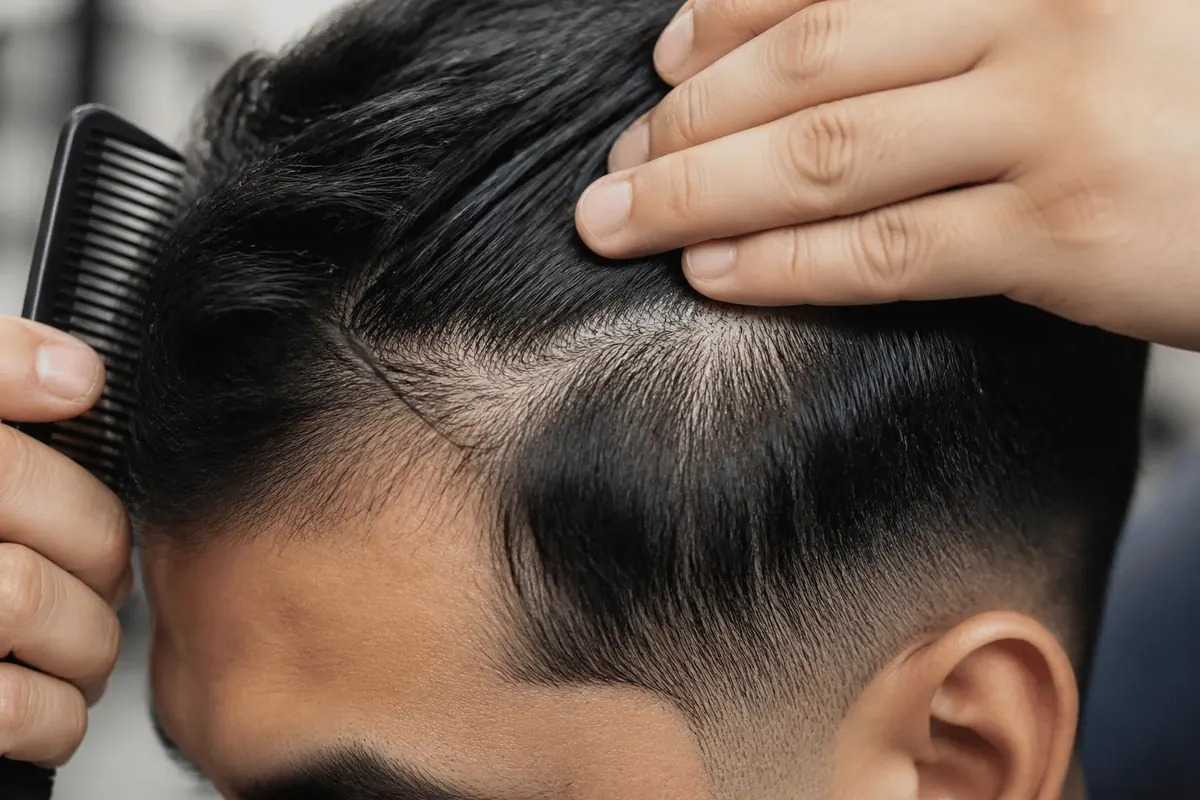
- Stand in good light with dry, unstyled hair. Daylight from a window is best.
- Part the hair at the crown with a comb. Pull it straight back from the part.
- Look at the scalp along the part. If you see it clearly, your density is low. If it is hard to see, density is medium or high.
- Repeat above the ear. Check the sides where the taper will sit.
- Take a photo of each area. Show the barber the photos and let them judge.
What goes wrong: checking wet hair, which clumps and looks thinner than it is. If the scalp shows more than it did a year or two ago, or your part is widening, see the section on thinning below, because that is a different question from fine hair.
| Scalp visibility | Density | Bottom of taper | Top length |
|---|---|---|---|
| Clearly visible along the part | Low | #3 (about 10 mm) or #2 | 5 to 7 cm, texturised |
| Faintly visible | Medium | #2 (about 6 mm) | 6 to 9 cm |
| Hard to see | High | #1 (about 3 mm) or shorter | 7 to 10 cm |
Which top length gives fine hair the most volume?
Length on top is the second decision for low taper fade straight hair. Very long fine hair loses volume to its own weight. Very short fine hair has no style left to show. The middle range, 5 to 9 cm, is the sweet spot for most men. Pick a recipe based on the look you want.
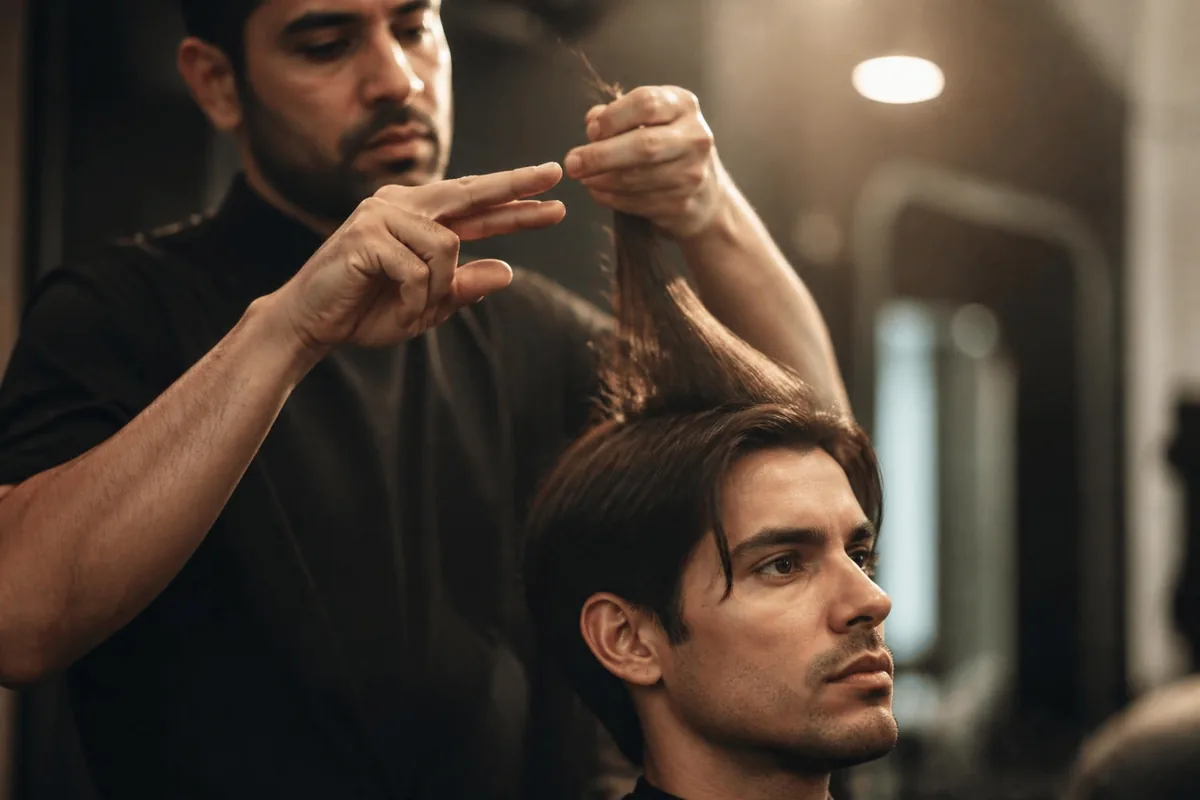
| Recipe | Top length | How it is cut | Style it with |
|---|---|---|---|
| Textured crop | 4 to 6 cm | Point-cut or razor-textured, forward fringe | Matte clay and fingers |
| Side sweep | 6 to 8 cm | Layered, slightly longer at the front | Light paste, blow-dry to the side |
| Quiff | 8 to 10 cm | Longer layers at the front, shorter at the back | Volumising spray, blow-dry, light hold |
If you want to compare these tops with similar cuts, see our guides to the textured crop and the quiff. Both pair well with low taper fade straight hair.
How should the barber cut the sides?
The sides are where low taper fade straight hair gets into trouble, so brief the barber with care. Ask for a taper that begins low, about 1 to 2 cm above the ear, and uses a longer guard than you would on thicker hair. Our guide on haircut numbers lists guard sizes in millimetres.
- Bottom guard: a #2 or #3 for low density, a #1 or #2 for medium.
- Blend: ask for a soft blend and request scissor-over-comb at the join, which blends better than clippers on straight hair.
- Sideburns: keep them slightly longer if the temples look sparse, because it hides the pale skin.
- Back: follow the head shape; a rounded or tapered neckline looks more natural than a block.
For a script, our guide on how to ask for a haircut shows what to say and what to bring.
What does a texturised top mean?
On low taper fade straight hair, texturising means removing small amounts of bulk from the ends and interior of the hair so the pieces separate and move instead of lying in one flat sheet. On fine hair it must be light, because too much thinning leaves the top wispy. Ask for “point cutting” or “light texture”, and avoid the word “thinning”, which some barbers read as heavy removal.
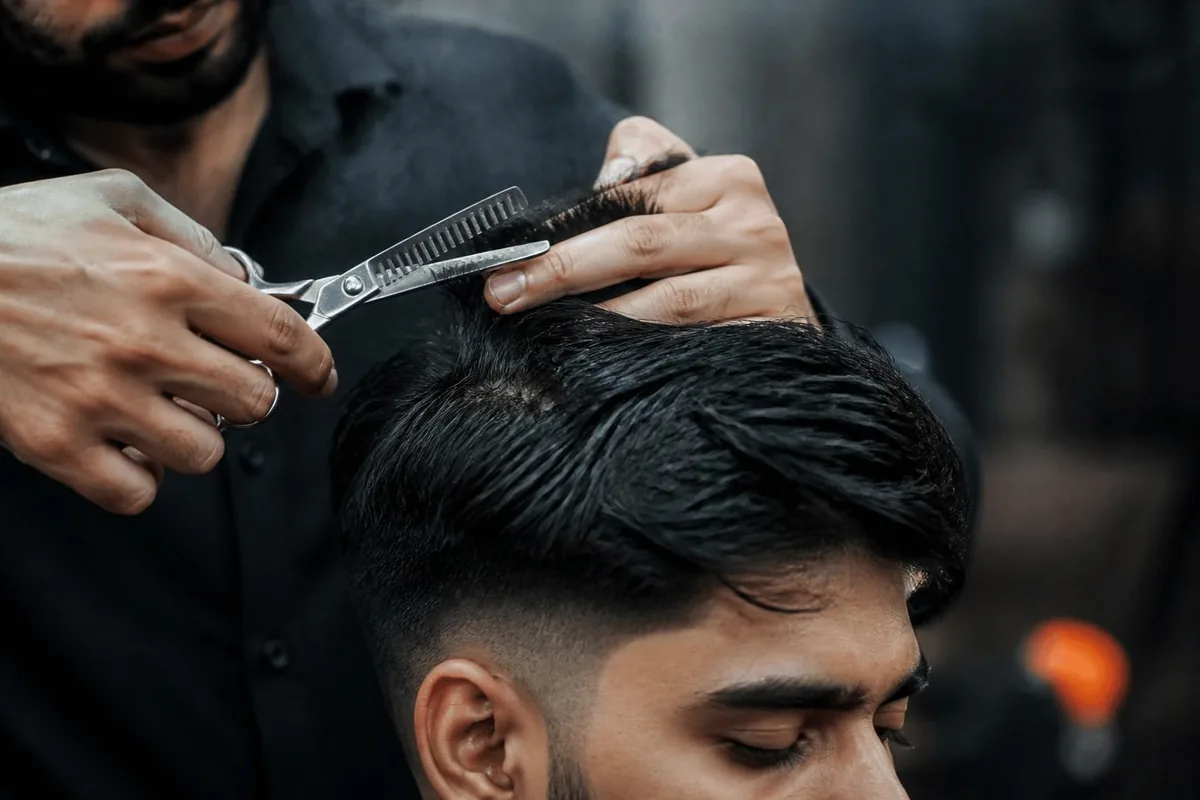
A texturised top gives you three benefits. The hair separates, so the scalp is less visible. The style holds shape with less product. And the grow-out is more even, because the layers fall into place.
Low taper fade straight hair: how do you style it?
Styling is where low taper fade straight hair gets its volume. The method below works for 5 to 9 cm tops.

- Wash with a volumising shampoo. Skip heavy conditioners on the roots; use conditioner on the ends only.
- Towel dry to damp. Hair at about 70 percent dry takes volume best.
- Apply a volumising spray or sea salt spray at the roots. Two to three sprays are enough.
- Blow-dry upward and back. Use a medium heat and point the nozzle down the hair shaft. Lift the roots with your fingers while you dry.
- Cool shot. Finish with a few seconds of cool air to set the shape.
- Add a pea-sized amount of matte clay or paste. Rub it between your palms, then work it through from the back to the front.
What goes wrong: using too much product, which turns fine hair into stringy clumps. Start small. You can always add more, but you cannot take product out without washing.
Which products suit fine straight hair?
Low taper fade straight hair needs light products that add grip and lift without weight. The right formula matters more than the brand. Our guide to the best hair products for men compares formulas in more depth.

| Product | Effect | Good for | Avoid when |
|---|---|---|---|
| Sea salt spray | Grip and texture | Casual, tousled tops | Your hair is dry or brittle |
| Volumising mousse | Lift at the roots | Quiff and side sweep | You want a natural finish |
| Matte clay or paste | Hold without shine | Textured crops | You overload; a small amount is enough |
| Hair powder | Instant volume | Very fine hair | You go swimming or sweat heavily |
| Heavy pomade | Shine and strong hold | Slick, classic looks | Hair is fine; it often weighs it down |
What if your hair is thinning, not just fine?
Fine hair and thinning hair are different. Fine hair means thin strands that have always been that way. Thinning means you are losing density over time, often at the temples or crown. The American Academy of Dermatology notes that male pattern hair loss tends to develop slowly, and that a board-certified dermatologist can advise on causes and treatment.

A haircut cannot treat hair loss, but it can make thinning less obvious. Three adjustments help:
- Keep the sides longer so the contrast with the top is smaller.
- Keep the top short to medium; very long thin hair draws attention to gaps.
- Avoid very sharp temple lines, which can make a receding edge look more obvious.
If hair loss worries you, read our guide to haircuts for a receding hairline and consider seeing a dermatologist rather than guessing.
What if you have a cowlick or a double crown?
On low taper fade straight hair, a cowlick is a patch where hair grows in a different direction from the rest, most often at the front hairline or the crown. Straight hair shows cowlicks clearly because it has no curl to hide them. A low taper does not change the cowlick, but your top length and styling should work with it.

- Front cowlick: leave a little extra length so the weight pulls it down, or style the fringe to the side.
- Crown cowlick or double crown: keep the top slightly longer, at least 5 to 6 cm, because very short hair sticks up.
- Tell the barber first. They cut with the direction of growth and can plan around it.
How often should you tidy the taper?
Low taper fade straight hair shows regrowth quickly, so aim for every 3 to 4 weeks. The Cleveland Clinic says hair grows about 1 centimetre a month, so after a month the taper has grown out visibly. If you chose a #3 at the bottom, you can stretch to 5 weeks, because the contrast is small. Our guide on how often to get a haircut compares upkeep across styles.
| Bottom guard | Visit every | Why |
|---|---|---|
| #3 | 5 to 6 weeks | Low contrast, grows out gently |
| #2 | 4 to 5 weeks | Balanced contrast |
| #1 | 3 to 4 weeks | Higher contrast, shows regrowth faster |
Three ready-to-use briefs for your barber
The fastest way to avoid a bad low taper fade straight hair result is to give the barber a complete brief. Pick the one that matches your hair and read it out, or show it on your phone.
Brief A: low density, wants it to look fuller
“Low taper fade, starting about 1.5 cm above the ear, with a #3 at the bottom and a soft blend. Please use scissors to blend the join. Leave 5 to 6 cm on top and point-cut it so it has movement. Natural neckline, slightly rounded. I would like the sides to look full, not shaved.”
Brief B: medium density, office look
“Low taper fade with a #2 at the bottom. Keep 7 cm on top, layered so it sweeps to the side. Light texture only. Tapered neckline. I want it neat enough for a client meeting and easy to style with a bit of paste.”
Brief C: high density, wants a quiff
“Low taper fade with a #1 at the bottom and a clean blend. Leave 9 to 10 cm at the front, tapering to 6 cm at the back, so I can blow-dry it up and back. Round the neckline. I will style it with mousse and a matte clay.”
Each brief names the guard, the starting point, the top length, the technique and the neckline. That is the five-point checklist a barber needs, and it leaves very little room for a surprise.
How should the barber blend the join on fine hair?
On low taper fade straight hair, the join, where the tapered hair meets the longer hair, decides whether the cut looks professional. Fine, straight hair shows an uneven join immediately. A skilled barber usually follows this order:
- Set the outline. The trimmer marks the sideburn, the ear arc and the neckline first, so the shape is symmetrical.
- Cut the longest guard first. The barber runs a #3 or #2 over the sides with a scooping motion, flicking out at the top of the taper.
- Step down. A shorter guard goes over the bottom 1 or 2 cm only, with the same flick to avoid a line.
- Blend with a comb. Scissor-over-comb or clipper-over-comb smooths the zone between guards.
- Check from both sides. The barber compares the left and right in the mirror and fixes any difference.
What goes wrong: a visible line where a guard stopped, or a hollow patch above the ear where the clippers dug in. Both are easy to fix if you point them out before you leave the chair. A good barber welcomes the check.
Which blow-dry tools and settings help fine hair?
You do not need salon equipment for low taper fade straight hair, but a few details make the difference between a lifted top and a flat one.
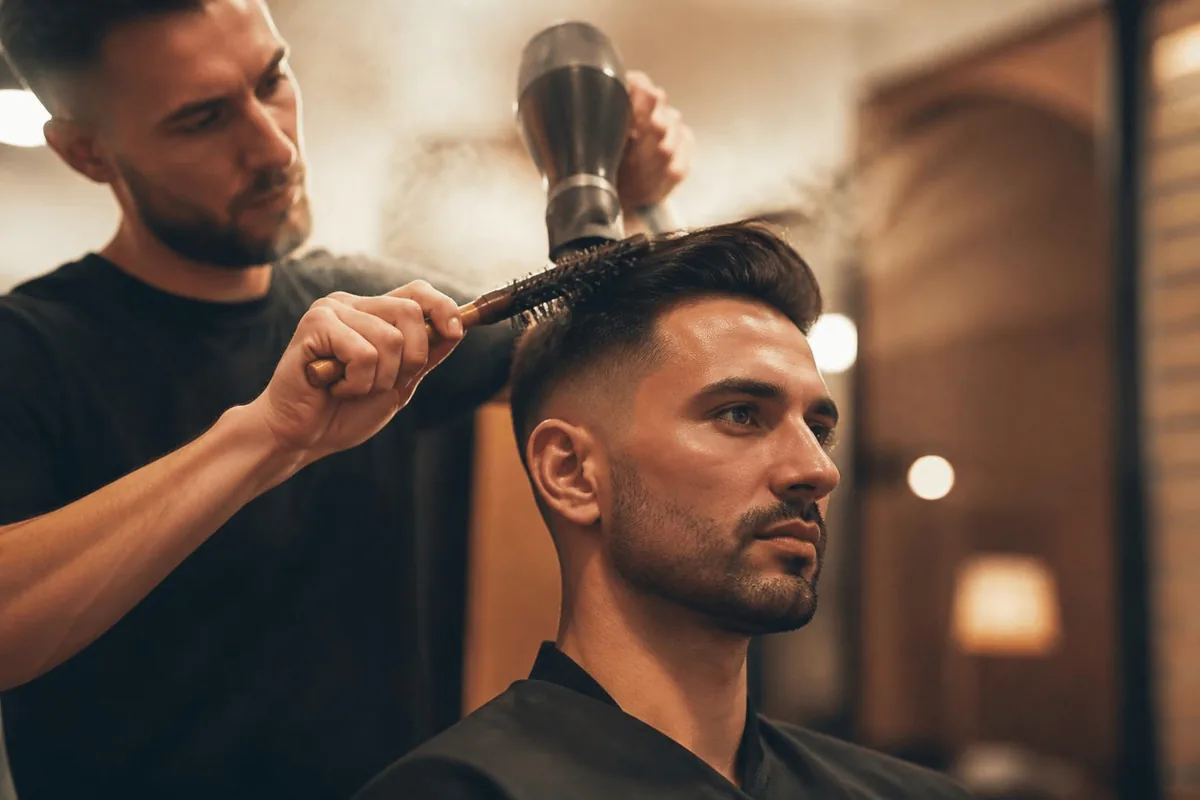
| Tool or setting | What to use | Why it helps |
|---|---|---|
| Dryer nozzle | A narrow concentrator nozzle | Directs air at the roots and smooths the cuticle |
| Heat | Medium, not high | Fine hair burns easily and loses shine |
| Brush | A small round brush or your fingers | Lifts at the roots without pulling |
| Direction | Against the way the hair falls, then back | Builds lift before the final shape |
| Cool shot | 10 to 15 seconds at the end | Sets the shape so it lasts longer |
Dry the roots first and the ends last. Drying the ends too long makes fine hair frizzy and flat.
How do weather and daily habits affect straight, fine hair?
Low taper fade straight hair reacts quickly to its surroundings. A style that looks right at home can collapse in the first hour outside.
- Humidity: moisture in the air makes fine hair limp. A light-hold hairspray or a matte paste resists it better than a gel.
- Wind and caps: hats flatten the top. Fluff the roots with your fingers after taking one off, rather than combing.
- Static in winter: a tiny amount of leave-in conditioner on the ends, or a wooden comb, reduces flyaways.
- Sweat: straight hair gets oily faster, so wash every one or two days with a gentle shampoo rather than every few days.
- Sun: the scalp can burn where hair is short or thin. The AAD advice on applying sunscreen covers the scalp and ears.
What does grow-out look like for a straight-hair taper?
Low taper fade straight hair is among the easiest cuts to grow out, which is part of its appeal. The table shows a typical timeline for straight hair with a #2 bottom guard.
| Time since cut | What you see | What to do |
|---|---|---|
| Week 1 to 2 | Crisp taper, clean neckline | Enjoy it; style normally |
| Week 3 to 4 | Sides begin to soften, neckline fuzzes | Tidy the neckline or book a touch-up |
| Week 5 to 6 | The taper has gone; sides look even | Book a full cut |
| Week 8 and beyond | Overall shape grows out evenly | Switch to a regular trim to keep the shape |
Because the change is gradual, there is no awkward stage. If you plan to move toward a longer style, see how the same cut works with a long top.
Low taper fade straight hair vs other fades
Low taper fade straight hair is the safest fade option for fine hair, but it is not the only one. Compare it with the main options:
| Cut | Scalp exposure | Fit for fine, straight hair |
|---|---|---|
| Low taper fade | Very low | Best starting point |
| Low fade | Low to medium | Fine if density is medium or high |
| Mid fade | Medium | Works with medium to high density |
| Skin fade | High | Hard on low density; shows scalp |
If your hair is wavy or curly rather than straight, our guide for curly hair covers that case.
Who should pick this cut, and who should not?
Low taper fade straight hair suits men with fine or medium-density hair who want a clean, professional look with minimal fuss. It is easy to wear at work, and it grows out gracefully. It is a weaker fit if you want a bold, high-contrast fade, because the taper is subtle. In that case, look at the fade haircuts hub for options.
It also works as a stepping stone. Many men start with a low taper, then move to a low fade once they know how their hair behaves.
Frequently asked questions
Is a low taper fade good for thin hair?
Yes. Low taper fade straight hair works on thin hair when the guard is kept longer. A #2 or #3 at the bottom hides the scalp better than a #1 or skin, and the top can be styled for volume.
What guard should I ask for with fine straight hair?
A #2 (about 6 mm) suits most. If you can see your scalp clearly through the hair, ask for a #3 (about 10 mm).
How long should the top be?
Between 5 and 9 cm, depending on the style. A textured crop sits at the short end, and a quiff at the long end.
How do I add volume to fine hair?
Use a volumising spray on damp roots, blow-dry upward and finish with a light matte product. Avoid heavy pomades.
Should a barber use scissors or clippers on straight hair?
Both. Clippers shape the taper and scissors blend the join and texturise the top. Straight hair shows clipper lines, so the scissor blend improves the finish.
Will a taper make my hair look thinner?
Not if low taper fade straight hair is cut soft. The low taper removes the least hair of any fade, and a longer guard keeps the sides looking full.
Can I get this cut if I have a cowlick?
Yes. Low taper fade straight hair works with a cowlick: tell the barber where it is and keep the top long enough to control it, usually at least 5 or 6 cm.
More guides in this series
This low taper fade straight hair page is one of five cluster guides under the low taper fade pillar. Read the others for curly hair, part lines and designs, long hair on top and cutting one at home. The full range is on our fade haircuts hub.
The density bands, guard choices and top lengths above are typical values that vary by barber and by head, and the growth figure follows the Cleveland Clinic. Our editorial policy explains how we label estimates.