

 →
 →
 →
 →
 →
 →
 →
 →
 →
 →
On this page
What is an Ivy League cut?How long does hair need to be for an Ivy League cut?What is the difference between an Ivy League cut and a crew cut?How is an Ivy League cut different from a side part, a Harvard clip and a Caesar cut?What are the types of Ivy League cut?Who suits an Ivy League cut best?How do you part an Ivy League cut?Which Ivy League cut suits your hair type?Is an Ivy League cut good for thin or receding hair?Can you get an Ivy League cut with curly or wavy hair?Is an Ivy League cut right for the office, a suit or glasses?How do you ask your barber for an Ivy League cut?How do you style an Ivy League cut?What is the best product for an Ivy League cut?How do you keep an Ivy League cut neat all day?Can you cut an Ivy League cut at home?How often should you trim an Ivy League cut?How much does an Ivy League cut cost?What are the most common Ivy League cut mistakes?How do you look after your scalp with an Ivy League cut?How do you grow out an Ivy League cut?When is an Ivy League cut the wrong choice?Related collectionsIvy League cut FAQAbout this guideQuick answer. An Ivy League cut is a longer crew cut: the top is left about 3 to 6 cm so the front can be parted or brushed to the side, while the sides and back are tapered short. Ask for “an Ivy League cut, 4 to 5 cm on top, a side part, tapered sides, natural neckline.” Style it with a little cream or pomade and trim it every three to four weeks.
You want a haircut that looks like you got a haircut. Not a statement, not a project, just tidy hair that works in a meeting, at a wedding and on a Saturday. The crew cut is a bit too short for that, and a full side part with a fade can look too styled. The Ivy League cut sits in between: short enough to forget about, long enough to part.
This guide is a deep dive on that cut. It explains what separates an Ivy League cut from a crew cut and a side part, how long the hair has to be, six ways to wear it, how to ask a barber in plain numbers, how to style it in two minutes and what to do with fine, curly or thinning hair. It uses the same guard sizes and growth figures as our short haircuts for men hub, so the numbers match the rest of the section.

What is an Ivy League cut?
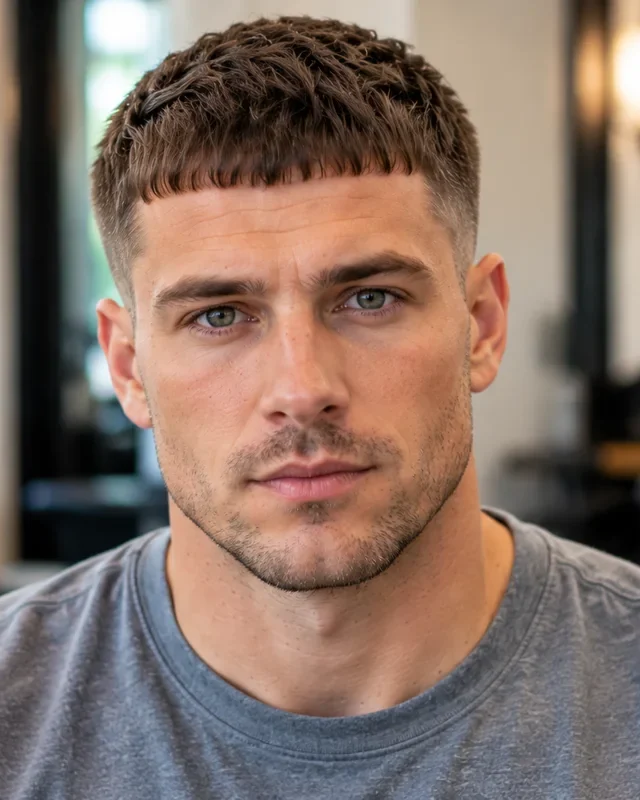
An Ivy League cut is a men’s haircut where the top is left slightly longer than a crew cut, usually 3 to 6 cm, so the front can be parted or brushed to the side, while the sides and back are tapered short. It is neat, low maintenance and traditional. Think of it as a crew cut with enough length on top to comb.
The name comes from the Ivy League universities in the northeastern United States, where the tidy, short, side-parted style was common on campus in the mid twentieth century. The cut has no fixed rules, and barbers use the term in slightly different ways, but the core is stable: short tapered sides, a longer top and a front that can lie to one side.
It helps to read the cut in three zones.
| Zone | Typical length | What the barber does |
|---|---|---|
| Front | 4 to 6 cm | Left longest so it can be parted or brushed over |
| Top, middle and crown | 3 to 5 cm | Cut level or slightly graduated, with a soft finish |
| Sides and back | Skin to 13 mm | Tapered to a clean neckline, not faded hard |
If you are comparing it with other cuts, the hub’s crew cut entry and side part entry are the closest neighbors, and we compare them below.
How long does hair need to be for an Ivy League cut?
Hair needs to be at least 3 cm on top for an Ivy League cut, and 4 to 5 cm at the front gives the best result. At 3 cm the hair lies flat and can be brushed to the side. At 6 cm it can be parted cleanly. Below 2.5 cm it is a crew cut, since there is nothing to part.
Hair grows about 1 to 1.25 cm a month. If you are growing out a crew cut, you reach an Ivy League length after about two to three months. That makes it one of the easiest cuts to land on without waiting through an awkward stage.
| Top length | What you can do | Style |
|---|---|---|
| Under 2.5 cm | No part yet | Crew cut |
| 3 cm | A flat brush-over, a short Harvard clip | Very short Ivy League |
| 4 to 5 cm | A clean side part | Standard Ivy League |
| 6 cm | A part with a soft sweep | Long Ivy League |
| Over 7 cm | A full side part or comb over | Side part or quiff territory |
The sides use standard clipper guards. A #1 to #3 guard (3 to 10 mm) is typical for a taper, and a #4 (13 mm) gives a softer, more conservative look. Brands differ a little, so ask the barber to show you the guard before the clippers start.

What is the difference between an Ivy League cut and a crew cut?
An Ivy League cut has a longer top, 3 to 6 cm, that can be parted or brushed to the side. A crew cut has a short, even top, usually 1 to 3 cm, that stands up or lies flat without a part. Both have tapered sides. The top length is the whole difference.
| Feature | Ivy League cut | Crew cut |
|---|---|---|
| Top length | 3 to 6 cm | 1 to 3 cm |
| Front | Brushed or parted to the side | Stands up or lies flat |
| Part | Optional, usually yes | No |
| Product | Cream or light pomade | None or a little wax |
| Styling time | 1 to 3 minutes | Under a minute |
| Trim every | 3 to 4 weeks | 2 to 4 weeks |
If you want the shorter, no-product version, the hub’s crew cut entry explains it in detail. If you want a more defined part and a fade, the side part is the next step up.

How is an Ivy League cut different from a side part, a Harvard clip and a Caesar cut?
An Ivy League cut is a side part with a short tapered side and no hard fade. A side part can be longer and can have a fade or a razored line. A Harvard clip is a very short version of the Ivy League cut. A Caesar cut has a short fringe brushed forward and no part.
| Style | What defines it | Top length | Finish |
|---|---|---|---|
| Ivy League cut | Short, tapered sides; partable top | 3 to 6 cm | Soft, neat |
| Harvard clip | A very short Ivy League cut | 2.5 to 3.5 cm | Flat, minimal |
| Side part | A defined part, often with a fade | 3 to 6 cm | Smooth, sharper |
| Caesar cut | Short straight fringe, no part | 2 to 4 cm | Matte, flat |
| Crew cut | Short even top, tapered sides | 1 to 3 cm | Natural, dry |
For a more defined parted look, see the hub’s side part entry. For a forward fringe with no part, see the Caesar cut entry.
What are the types of Ivy League cut?
There are six common ways to wear an Ivy League cut: the classic parted version, the Harvard clip, the taper fade version, the textured version, the brushed-forward version and the long version with a flip. They share a short tapered side and a partable top and differ in length, finish and how much the top is styled.
| Type | Top | Sides | Finish | Best for |
|---|---|---|---|---|
| Classic parted | 4 to 5 cm | Scissor taper | Neat, satin | Office, formal events |
| Harvard clip | 2.5 to 3.5 cm | Tapered | Flat, minimal | Low effort, short hair |
| Taper fade | 4 to 5 cm | Low taper fade | Satin, tidy | Men who want a sharper edge |
| Textured | 3 to 5 cm | Taper | Matte, soft | Casual, wavy hair |
| Brushed forward | 3 to 4 cm | Taper | Flat, short fringe | Receding hairlines |
| Long with a flip | 5 to 6 cm | Taper | Soft, flipped front | Thick, straight hair |
Classic parted Ivy League cut
The classic version is a scissor taper with a soft side part and a medium-hold pomade or cream. The sides sit close to the head, the top lies to one side and the neckline is natural. It is the version most men picture when they hear the name, and it suits almost every workplace.
Harvard clip
The Harvard clip is the short end of the range: 2.5 to 3.5 cm on top, brushed to the side or left flat, with tapered sides. It reads as a crew cut with a slight sweep at the front. It needs almost no product and works as a first step when growing out a buzz.
Taper fade Ivy League cut
This version swaps the scissor taper for a low taper fade, so the sides blend in a clean gradient. It stays sharper for longer and suits men who like a defined edge. It also costs a little more and needs a visit every three weeks. Our fade haircuts hub shows the options for the sides.

Textured Ivy League cut
The textured version uses a matte paste instead of pomade, so the top has visible strands and no shine. It is more relaxed and hides cowlicks better. It works well on wavy hair and for men who want a neat cut without a wet look.
Brushed-forward Ivy League cut
This version skips the part and brushes the short top forward and slightly sideways. It sits close to a Caesar cut and is a good choice for a receding hairline, since the fringe covers the temples. It needs the shortest styling time of all.
Long Ivy League cut with a flip
The long version leaves 5 to 6 cm at the front and lets it flip up slightly or sweep across. It looks softer and a little more casual, and it needs a bit more product. It is the version most men reach while growing toward a full side part.
Who suits an Ivy League cut best?
An Ivy League cut suits men with straight to wavy hair of medium thickness and almost any face shape. It looks best on oval, square and round faces, and the soft taper flatters a strong jaw. On a long face keep the top flat, and on a round face add a little height at the front.
| Face shape | Ivy League cut that works | Why |
|---|---|---|
| Oval | Any version | The most forgiving shape |
| Square | Classic parted | A soft sweep balances a strong jaw |
| Round | Taper fade with a little height at the front | Tight sides and height lengthen the face |
| Long or narrow | Harvard clip or a flat classic | Avoids adding height |
| Heart | Brushed forward or a long flip | Fullness on top balances a narrow chin |
| Diamond | Textured, with a soft taper | Softens wide cheekbones |
Hairline matters more than face shape. A high forehead looks balanced with a part set a little back, and a low hairline needs a flatter, shorter sweep. A cowlick at the front is the main trouble spot, and the sections below cover it.
How do you part an Ivy League cut?
To part an Ivy League cut, wet the hair, comb it straight back, then push the front forward a few millimeters and see where it splits. Part it along that natural line with the end of a comb, from the front hairline to just past the crown. A natural part stays in place far better than one you force.
- Wet the hair thoroughly, so it lies in its natural direction.
- Comb it straight back off the forehead.
- Push the front forward with your hand and watch where the hair splits.
- Draw the part with the end of a comb, following the split line.
- Comb the longer side across and the shorter side flat, then smooth once.
What goes wrong: choosing the side that looks better in the mirror. Hair at the front grows in a swirl, and fighting it means the part opens every few hours. If you want the part on the other side, tell the barber so they can cut the top to suit.

Which Ivy League cut suits your hair type?
An Ivy League cut works on most hair types, but each one needs a different top length and product. Straight hair shows the part and lies flat. Wavy hair needs a little weight. Curly hair needs moisture and a softer finish. Fine hair needs light product so the part does not open.
| Hair type | Top length that works | Product | Watch for |
|---|---|---|---|
| Thick, straight | 4 to 6 cm | Pomade or wax | Hair can bulk out at the sides, so keep the taper tight |
| Wavy | 4 to 5 cm | Light cream, paste | Waves lift at the part without weight |
| Curly | 4 to 6 cm | Curl cream, light gel | Curls shrink dry, so judge length dry |
| Coily | 3 to 5 cm | Moisturizer, light hold | Dryness and razor bumps at the taper |
| Fine | 3 to 4 cm | Light cream, sea salt spray | Heavy pomade clumps the hair and shows the scalp |
| Thinning | 3 to 4 cm | Matte paste or powder | A wet comb line reveals the scalp |
Is an Ivy League cut good for thin or receding hair?
Yes, it is one of the better choices. A short top with a soft taper keeps thin areas from standing out, and a brushed-forward version covers the temples. Keep the top at 3 to 4 cm, skip glossy product and avoid a razored part, which exposes the scalp.
Three changes help. Move the part about 1 cm off the natural line, so the hair stacks in a fuller pattern. Use a matte paste or powder instead of pomade, which pulls thin hair into strands. And keep the sides tapered, not faded to skin, since a harsh contrast makes thinning on top look more obvious. If the hairline is far back, a short, forward cut like the hub’s Caesar cut entry may look cleaner, and our buzz cut for thinning hair guide covers the shortest options.

An Ivy League cut hides thinning. It does not treat it. The American Academy of Dermatology explains the options for male pattern hair loss, and a dermatologist is the right person to see if you notice sudden or patchy shedding.
Can you get an Ivy League cut with curly or wavy hair?
Yes. Curly and wavy hair suit the cut when the top is 4 to 6 cm and you use moisture instead of stiff hold. The curls fall to the side in a loose pattern and the part acts as a guide, not a hard line. Cut the hair dry so you can see where the curls land, and keep the taper tight at the sides.
Apply a curl cream to damp hair, part it with your fingers or a wide-tooth comb and let it dry or diffuse it on low heat. Finish with a light gel for control. Avoid brushing dry curls, which turns them into frizz. On coily hair, a 3 to 5 cm top with a clean taper looks sharp and needs only a moisturizer.

Is an Ivy League cut right for the office, a suit or glasses?
Yes. It is one of the most workplace-friendly men’s haircuts, because it is short, tidy and conservative. It works with a suit, with glasses and with a beard, and it needs no more than a couple of minutes each morning.
- Suit and tie. The tapered sides and soft part look polished without drawing attention.
- Glasses. A clear forehead and short sides leave the frame as the focus.
- Beards. Blend the taper into a short or boxed beard in one line. A gap between a skin fade and a thick beard looks unfinished.
- Gray hair. Gray hair is often coarser and holds the part well. Use a light, matte product, since shine exaggerates the color.
- Older men. The cut is common past 40, because it handles thinning and gray without effort.

How do you ask your barber for an Ivy League cut?
Ask for an Ivy League cut by naming the top length, the part and the sides. For example: “An Ivy League cut, about 4 centimeters on top, long enough to part on the left, tapered sides with a number 2 at the bottom, a natural neckline and no hard fade.” Then ask the barber to comb it over before the first cut so you can check the length.
- Name the top: “about 4 centimeters” or “long enough to part.”
- Name the part side, or say “on my natural side.”
- Name the sides: “a scissor taper,” “a low taper fade” or “a number 2 at the bottom.”
- Say “no hard fade” if you want a conservative edge.
- Describe the neckline: “natural,” “squared” or “tapered.”
- Show a front and a side photo, and ask the barber to repeat the plan back.
What goes wrong: asking for an Ivy League cut and getting a crew cut. Some barbers use the two names interchangeably, so name the top length in centimeters to be sure. For more scripts that work in any chair, see how to ask for a haircut.

How do you style an Ivy League cut?
To style an Ivy League cut, towel-dry your hair until damp, work a pea-sized amount of cream or light pomade through it, then comb the top across along the part. Smooth the top once with the comb and leave it alone. The whole routine takes one to three minutes.
- Towel-dry until damp, not dripping.
- Warm a pea-sized amount of cream or pomade between your palms.
- Work it through from the back to the front.
- Draw the part with the end of a comb, following your natural line.
- Comb the longer side across and the shorter side flat.
- Check the profile in a mirror and finish with a light spray if needed.
What goes wrong: too much product. If the hair looks wet and stiff, you used too much, and you cannot remove it without a rinse. Start with a half portion and add more only where needed. And never part dry hair with a hard comb stroke, which makes the line crooked.

What is the best product for an Ivy League cut?
The best product for an Ivy League cut is a light styling cream or a water-based pomade for a neat, flexible hold, or a matte paste for a dry finish. Heavy gel gives a hard, wet finish that looks dated, and wax is too heavy for hair this short. Choose by the finish you want, then by the hold.
| Product | Hold | Finish | Washes out | Best for |
|---|---|---|---|---|
| Styling cream | Light | Natural, soft | Easily | Fine, wavy or curly hair |
| Water-based pomade | Medium to strong | Satin | Easily | The classic, neat look |
| Fiber paste | Medium | Low shine, flexible | Easily | Textured Ivy League cut |
| Matte clay | Strong | Dry, no shine | Easily | Thick or coarse hair |
| Hairspray | Light to strong | Invisible | Easily | Setting the part |
The common mistake is using too strong a product on short hair. Short hair needs only a little hold, and a strong clay or gel leaves it stiff and visible.
How do you keep an Ivy League cut neat all day?
To keep an Ivy League cut neat, use the natural part, apply a light product at the roots and comb it once in the morning. The cut is short enough that it rarely needs fixing. If the front lifts, wet your hand and press it flat, then smooth it with a comb.
- Use the natural part. Fighting it makes the line open every few hours.
- Apply at the roots. Product on the ends leaves the front free.
- Fix a cowlick. A cowlick at the front pulls the hair up, so dry it flat in the opposite direction while it is damp.
- Carry a comb. A pocket comb fixes the part in ten seconds.
Can you cut an Ivy League cut at home?
You can maintain the sides at home with clippers, but leave the top and the taper to a barber when you can. The way the top is layered decides how the part sits, and a mistake takes weeks to grow back. If you try, cut only the sides and the neckline and leave the top untouched.
- Wash and dry your hair, since wet hair looks longer than it is.
- Comb the top across along the part and clip it out of the way.
- Put on a #3 guard and run it up the sides and back, to where the top begins.
- Switch to a #2 and a #1 near the neckline, blending each step with short upward flicks.
- Release the top and check that the longer hair falls over the blend line.
- Clean the neckline with a trimmer and check the result with a handheld mirror.
What goes wrong: a hard line where the guard stops. Use a lower guard in small steps, and flick the clipper away from the head as you finish each pass. For the blend, our guide to cutting a low taper fade at home shows the technique.
How often should you trim an Ivy League cut?
Trim an Ivy League cut every three to four weeks. The sides lose shape first, so taper fade versions need a visit every three weeks, and scissor tapers can go four. The top can keep growing between trims, since a little extra length makes the part easier to hold.
| Weeks after the cut | What you will notice |
|---|---|
| 1 to 2 | Clean sides, tidy part |
| 3 to 4 | Sides fill in, the neckline softens |
| 5 to 6 | Neckline looks untidy, the top is heavier |
| 8 | Needs a full re-cut |
If you are short on time, ask for a sides-and-neckline tidy only. It costs less and keeps the shape while the top grows.
How much does an Ivy League cut cost?
An Ivy League cut at a barbershop in the United States commonly costs about $22 to $48 in USD, depending on the city and the shop. A taper fade version costs a little more than a plain scissor cut. Prices vary widely, so check with your own barber. Add $8 to $20 for a comb and a styling product.
What are the most common Ivy League cut mistakes?
These mistakes cost men the most time and regret.
- Getting a crew cut by mistake. Name the top length in centimeters.
- Parting on the wrong side. Fighting the natural line makes it open all day.
- Using too much product. Short hair looks greasy and flat.
- Asking for a hard fade. It changes the cut into a modern side part.
- Combing dry hair. It makes a crooked line and static, so start with damp hair.
- Ignoring a cowlick. It breaks the line at the front, so tell the barber.
How do you look after your scalp with an Ivy League cut?
An Ivy League cut leaves the sides and the part line exposed, so the skin needs sun protection and regular washing. Wash the product out every night with a gentle shampoo, and apply sunscreen along the part and on the tapered sides. These habits prevent most of the flaking, build-up and sunburn men report.
- Build-up. Cream and pomade left in overnight clog the scalp, so wash them out each night.
- Sun. The American Academy of Dermatology advises applying sunscreen to all exposed skin, including the scalp along a part line and the tapered sides.
- Razor bumps. The American Academy of Dermatology has clear steps for razor bump prevention, which matter most on a tight neckline.
How do you grow out an Ivy League cut?
When an Ivy League cut grows out, the sides fill in first and the top gets heavier, which makes the part easier to hold. With about 1 to 1.25 cm of growth a month, expect an awkward stage in weeks five to eight. Ask for a taper at the sides and a light trim at the ends, and the shape holds while it lengthens into a full side part.
If you decide to keep growing, the hub’s side part entry shows where extra length leads, and the full men’s haircut directory lists other options.
When is an Ivy League cut the wrong choice?
It is the wrong choice if you want a cut that needs no comb at all, if you have a strong cowlick at the front you cannot manage, if you want lift and texture instead of a neat line or if you want a bold fade. A crew cut or a textured crop is easier to live with.
Related collections
This cut sits inside the wider short haircut family. Browse the short haircuts for men hub for all 13 short cuts, explore the fade haircuts hub for the sides, or read the drop fade guide if you want the sides to curve down behind the ear.
Ivy League cut FAQ
What is an Ivy League haircut?
An Ivy League haircut is a longer crew cut with a top of about 3 to 6 cm that can be parted or brushed to the side, over short tapered sides.
What is the difference between an Ivy League cut and a crew cut?
The top length. An Ivy League cut has 3 to 6 cm on top that can be parted. A crew cut has a short, even top of 1 to 3 cm with no part.
How long does hair need to be for an Ivy League cut?
At least 3 cm on top, and 4 to 5 cm at the front gives the best result. Under 2.5 cm it is a crew cut.
What is a Harvard clip?
A Harvard clip is a very short Ivy League cut, about 2.5 to 3.5 cm on top, brushed to the side or left flat, with tapered sides.
What product is best for an Ivy League cut?
A light styling cream or water-based pomade for a neat hold, or a matte paste for a dry finish. Avoid heavy gel and wax on short hair.
Is an Ivy League cut good for thin hair?
Yes. Keep the top at 3 to 4 cm, use a matte paste, move the part about 1 cm off the natural line and keep the sides tapered. See a dermatologist if you notice sudden shedding.
Can curly hair have an Ivy League cut?
Yes. Keep the top at 4 to 6 cm, use a curl cream and ask for the top to be cut dry. A tight taper keeps the sides neat.
Is an Ivy League cut professional?
Yes. It is short, tidy and conservative, and it works with a suit, glasses and a beard in almost any workplace.
How often should you trim an Ivy League cut?
Every three to four weeks. Taper fade versions need a visit every three weeks, and the top can keep growing between trims.
How do you style an Ivy League cut?
Towel-dry, work a pea-sized amount of cream or pomade through, then comb the top across along your natural part. It takes one to three minutes.
About this guide
Buzzcutting publishes this guide as general information about men’s haircuts. The name Ivy League cut is used slightly differently by different barbers, so this guide describes its common features, and the lengths and tapers here are typical ranges that vary by barber and by the brand of clipper. The 1 to 1.25 cm monthly growth figure is a commonly cited average, and trim intervals, grow-out timelines and prices are approximate. The razor bump, sunscreen and hair loss pointers come from the American Academy of Dermatology, linked above. This guide has not been reviewed by a licensed barber or dermatologist, so check the details with your own barber.
An Ivy League cut should look like you just had a haircut, not like you just had a style, so stop at the first clean pass of the comb. Read how we write and review guides in our editorial policy.