

 →
 →
 →
 →
 →
 →
 →
 →
 →
 →
On this page
What is a French crop?Why is it called a French crop?How long should a French crop be?Where should a French crop fringe end on your forehead?What are the types of French crop?What is the difference between a French crop and a Caesar cut?How is a French crop different from a textured crop, an Edgar and a crew cut?Who suits a French crop best?Which French crop suits your hair type?Is a French crop good for a receding hairline or thinning hair?Does a French crop work on curly or wavy hair?Can you color a French crop?Does a French crop suit older men, gray hair or beards?How do you ask your barber for a French crop?How do you style a French crop?Can you cut a French crop at home?How often should you trim a French crop?How much does a French crop cost?What are the most common French crop mistakes?How do you look after your scalp and avoid razor bumps?How do you grow out a French crop?When is a French crop the wrong choice?Related collectionsFrench Crop FAQAbout this guideQuick answer. A French crop is a short men’s haircut with a top of about 2 to 4 cm and a blunt, straight fringe brushed forward, over tight tapered or faded sides. Ask for “a French crop, two to four centimeters on top, blunt fringe, mid taper.” Style it with a little matte paste and trim it every three to four weeks.
The photo on your phone shows a short, sharp cut with a clean straight line across the forehead. You show it to the barber and he nods, then asks, “Caesar, French crop or textured?” Three names, one photo, and three different haircuts. The French crop is the one with the blunt fringe and a little more length than the others, and getting it right comes down to two measurements: how long the top is, and where the fringe stops.
This guide is the deep dive behind the French crop entry in our short haircuts for men hub. It uses the same trim times as the hub and goes further: the length ladder, a forehead guide for the fringe, five versions, which hair types it suits, how to ask for it, a styling routine, a home cutting method and the mistakes that ruin the line.
What is a French crop?
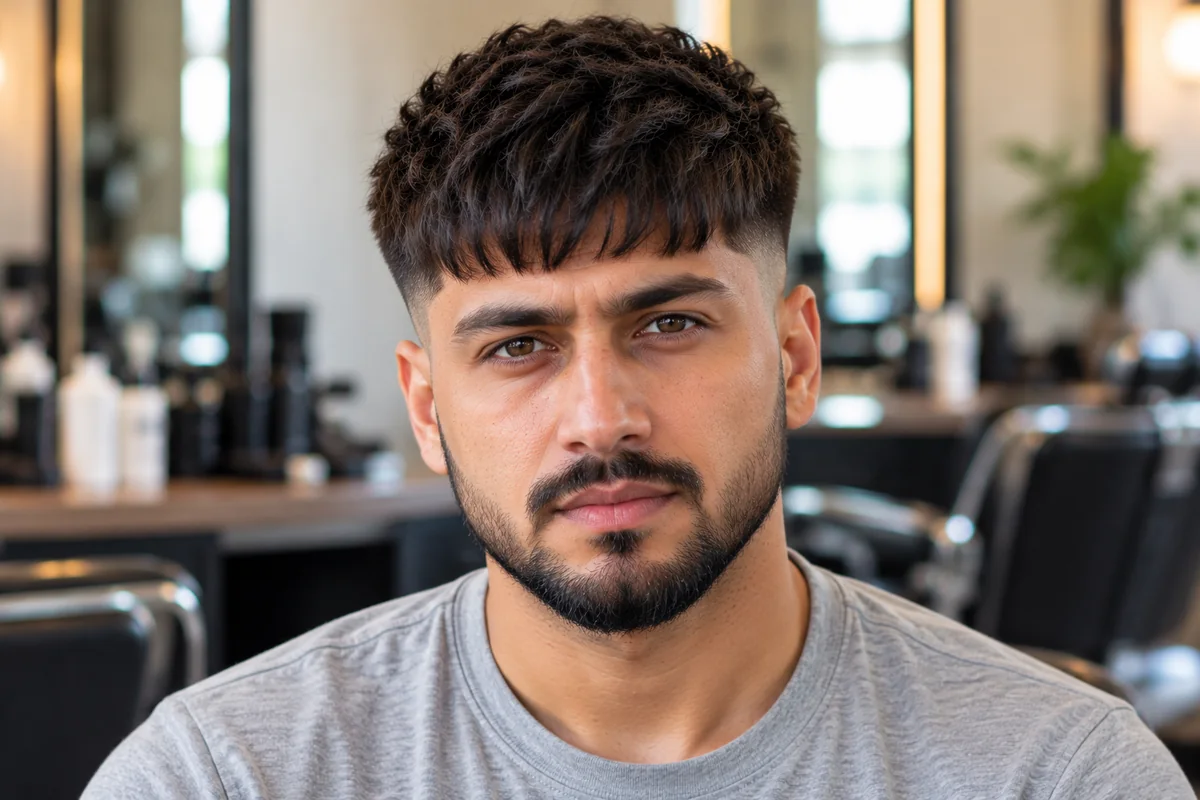
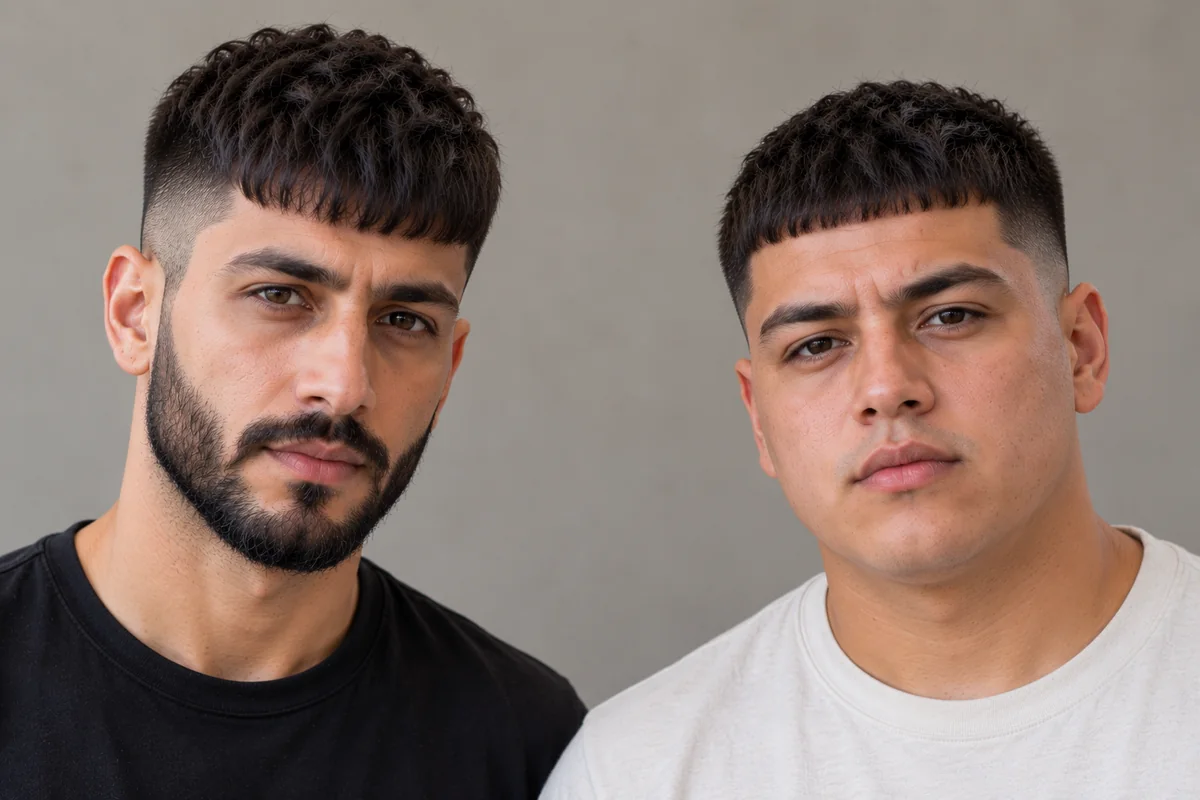
A French crop is a short haircut where the top is about 2 to 4 cm long, cut with a blunt, straight fringe that sits just above the eyebrows, over tight tapered or faded sides. The top is brushed forward, and a little texture is left in so the fringe does not look flat. It needs very little styling.
It sits close to the Caesar cut. The difference is mostly length and texture: the French crop leaves a little more on top, and the fringe is blunter and sits a little lower. It reads neat and modern without looking fussy, which is why it has become a standard request in barbershops.
Barbers read the cut in three zones, and it helps to describe it the same way.
| Zone | Typical length | What the barber does |
|---|---|---|
| Fringe | 2 to 3 cm | Cut straight across just above the eyebrows, then softened slightly |
| Top and crown | 2 to 4 cm | Scissor-cut with light texture, brushed forward |
| Sides and back | Skin to 10 mm | Tight taper or a low to high fade |
If you are comparing it with other short cuts, the hub’s Caesar cut entry and textured crop entry are the closest neighbors, and we compare them below.
Why is it called a French crop?
Nobody has a firm answer. “Crop” is an old barber’s word for hair cut short, and “French” appears to have been attached later as a style label, possibly because the blunt fringe look was popular in European fashion. Treat the name as a label for a shape, not a history, and ask by describing the cut rather than by its name.
That matters in practice. Barbers use “French crop,” “Caesar” and “crop” loosely, and different shops mean slightly different things. A request that includes a length in centimeters and a photo is far more reliable than the name alone.
How long should a French crop be?
A French crop is about 2 to 4 cm on top, with the fringe at 2 to 3 cm, and the sides at 0 to 10 mm. In clipper terms, the sides use a #0 to #3 guard, and the top is cut with scissors over a comb or with a long guard of #6 to #8 and then finished by hand.
These are the same standard guard sizes used across the hub. Brands differ slightly, so ask your barber to show you the guard before the clippers start.
| Top length | Guard equivalent | Look | Good for |
|---|---|---|---|
| About 2 cm | #8 (25 mm) | Very short, close to a Caesar cut | Fine hair, a tidy first try |
| About 3 cm | Scissors over comb | Classic French crop, clear fringe | Most men |
| About 4 cm | Scissors over comb | Fuller, softer fringe | Thick or wavy hair |
| 5 cm or more | Scissors | Moving into textured crop territory | Men who want movement |
Growth works against the fringe. Hair grows about 1 to 1.25 cm a month, so a 2.5 cm fringe reaches your eyebrows within about three weeks. That is why the cut looks sharpest in the first two weeks and starts to droop after three.
Where should a French crop fringe end on your forehead?
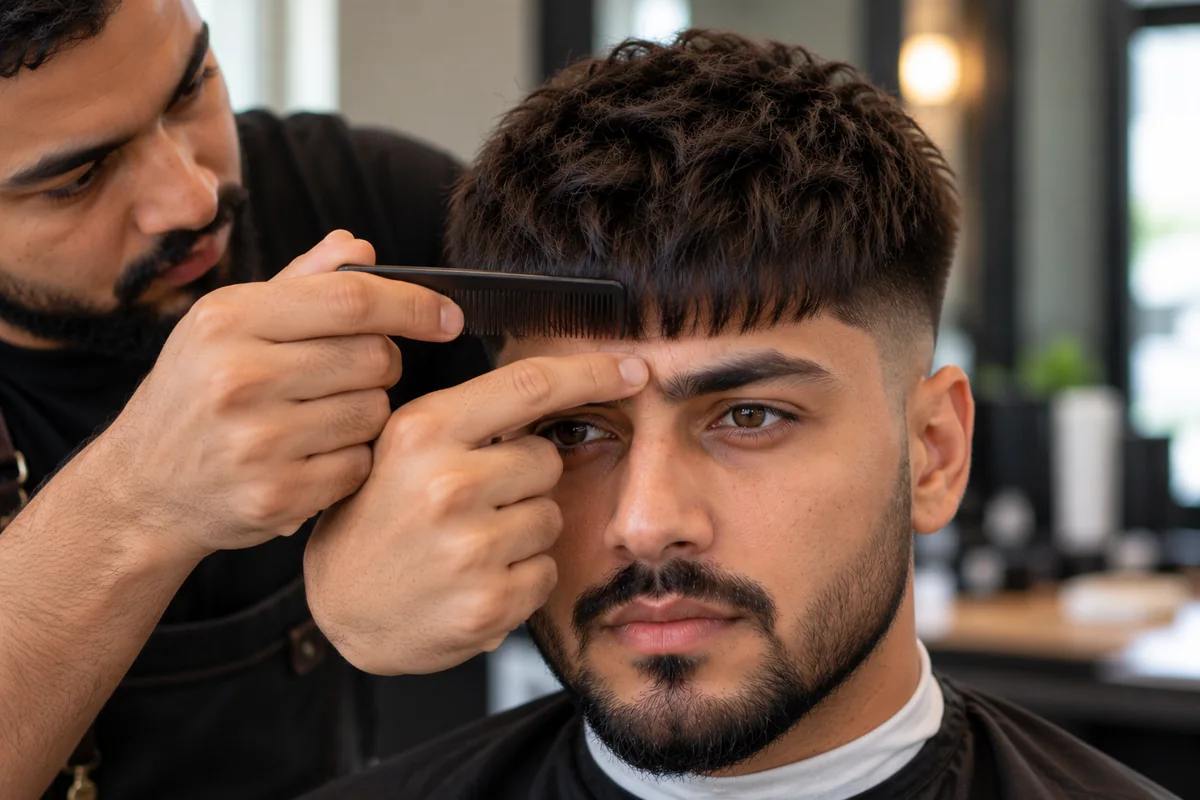
The fringe should end about 1 cm above your eyebrows when dry, or at the midpoint of your forehead if you have a short one. Shorter foreheads need a shorter fringe, taller foreheads can carry a fringe nearer the eyebrow. Always judge the line with dry hair, because wet hair sits lower.
| Forehead | Fringe length | Why |
|---|---|---|
| Short, under about 5 cm | About 1.5 to 2 cm | A longer fringe covers too much of the forehead |
| Average, 5 to 6.5 cm | About 2 to 3 cm | Sits just above the eyebrows |
| High, over about 6.5 cm | About 3 cm | Frames the forehead and softens it |
| Receding temples | About 3 cm, softened edge | Covers the recession without a hard line |
A simple trick: ask the barber to cut the fringe long, let it dry, then cut it up a little at a time. You can always take more off, and you cannot add it back.
What are the types of French crop?
There are five common versions: the classic French crop with a taper, the French crop with a fade, the textured French crop, the long French crop and the French crop with a line-up. They share a blunt forward fringe, and they differ in side length, top length and how sharp the edges are.
| Type | Top | Sides | Best for |
|---|---|---|---|
| Classic with a taper | 2 to 3 cm | Tight taper, no skin | Office, everyday, low upkeep |
| With a fade | 3 cm | Low, mid or high fade | Sharper look, strong head shape |
| Textured | 3 to 4 cm | Fade or taper | Thick hair, a relaxed finish |
| Long | 4 to 5 cm | Taper | Wavy hair, men who want a fuller fringe |
| With a line-up | 2 to 3 cm | Fade, crisp edge | Curly or coily hair, a clean frame |
Classic French crop with a taper
The classic version has a 2 to 3 cm top, a blunt fringe and sides that taper from a #3 down to a #1 or #0 near the ear. It is the most conservative and the easiest to wear. It styles in under a minute and grows out into a short, neat crop.
French crop with a fade
This version fades the sides to skin, usually low or mid. It looks sharper and more modern, and the fringe stands out more against the short sides. It needs a trim every two to three weeks because the fade softens quickly. If you like the blend, read our guide to the low taper fade, which is the most common fade under a short fringe.
Textured French crop
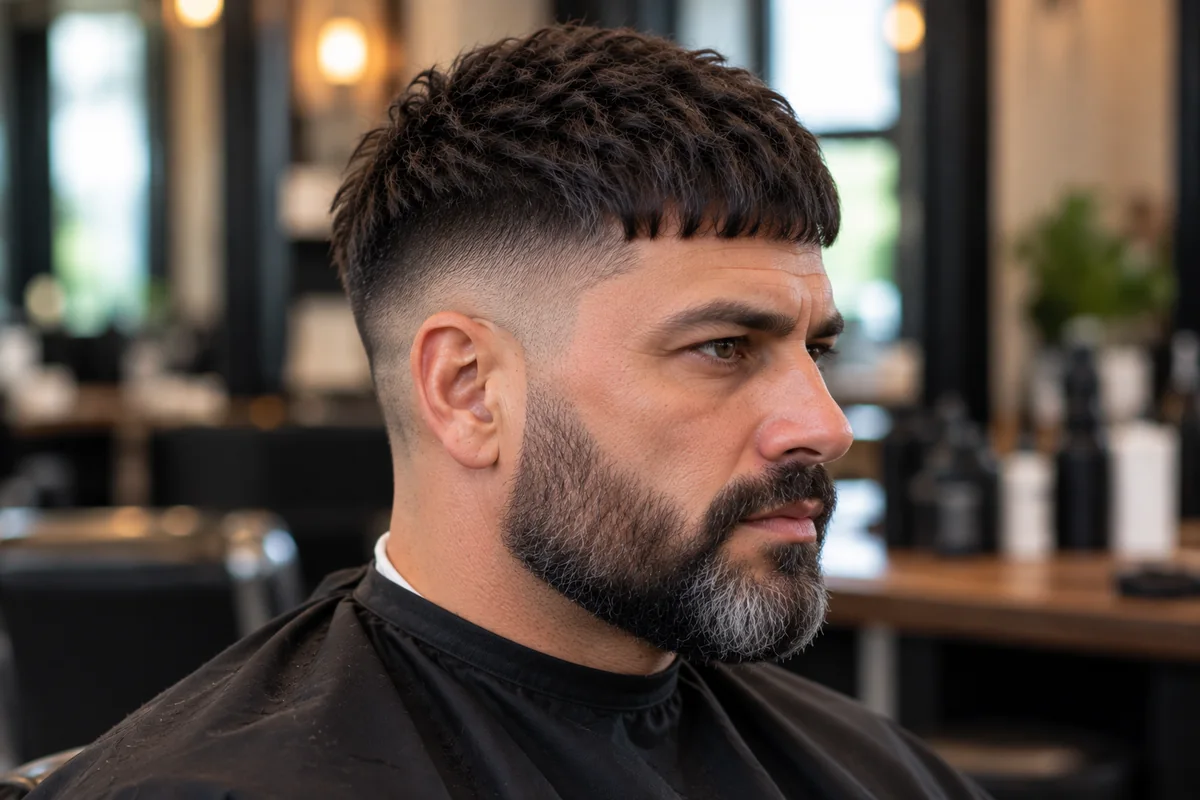
The textured version has the top point-cut so the fringe looks slightly broken instead of ruler-straight. It reads more relaxed and suits thick or wavy hair that fights a hard edge. At 4 cm and with heavy texture, it blends into the hub’s textured crop.
Long French crop
The long version leaves 4 to 5 cm on top, with a fuller, softer fringe. It needs a little more product and a comb, and it suits wavy hair that lifts at the front. Past 5 cm it stops being a crop and starts to look like a short quiff.
French crop with a line-up
The line-up version adds a crisp, shaped edge at the front hairline and temples with a trimmer. It is common on curly and coily hair, where the edge frames the fringe. The edge needs a touch-up every two weeks to keep the contrast.
What is the difference between a French crop and a Caesar cut?
A French crop has a top of 2 to 4 cm and a blunt fringe with some texture. A Caesar cut has a top of 1.5 to 3 cm and a thin, soft straight fringe. The French crop is a little longer, blunter and more textured, and the Caesar cut is shorter, flatter and tidier.
| Feature | French crop | Caesar cut |
|---|---|---|
| Top length | 2 to 4 cm | 1.5 to 3 cm |
| Fringe | Blunt, slightly lower | Thin, short, softer |
| Texture | Light to medium | Low |
| Sides | Tight taper or fade | Taper or fade |
| Styling | A little matte paste | A pinch of product or none |
| Trim every | 3 to 4 weeks | 2 to 4 weeks |
If you want the shortest and tidiest cut with the least upkeep, read the hub’s Caesar cut entry. If you want more length and more movement than a French crop gives, the textured crop is the next step up.
How is a French crop different from a textured crop, an Edgar and a crew cut?
A French crop has a blunt straight fringe at 2 to 4 cm. A textured crop has choppy ends at 3 to 5 cm. An Edgar cut has a boxier fringe and a very sharp, high fade. A crew cut has no fringe and is brushed forward. The fringe shape is the fastest way to tell them apart.
| Cut | Top | Fringe | Sides |
|---|---|---|---|
| French crop | 2 to 4 cm | Blunt, straight | Tight taper or fade |
| Textured crop | 3 to 5 cm | Choppy, broken | Fade or taper |
| Edgar cut | Short, flat or textured | Boxy, blunt | High, sharp fade |
| Caesar cut | 1.5 to 3 cm | Thin, soft | Taper or fade |
| Crew cut | 1.5 to 3 cm | None, brushed forward | Tapered |
The Edgar is the cut most often mistaken for a French crop. If you want the boxier shape with a sharp fade, our Edgar cut guide covers it. For the shortest options with no fringe at all, the hub’s crew cut entry is the place to look.
Who suits a French crop best?
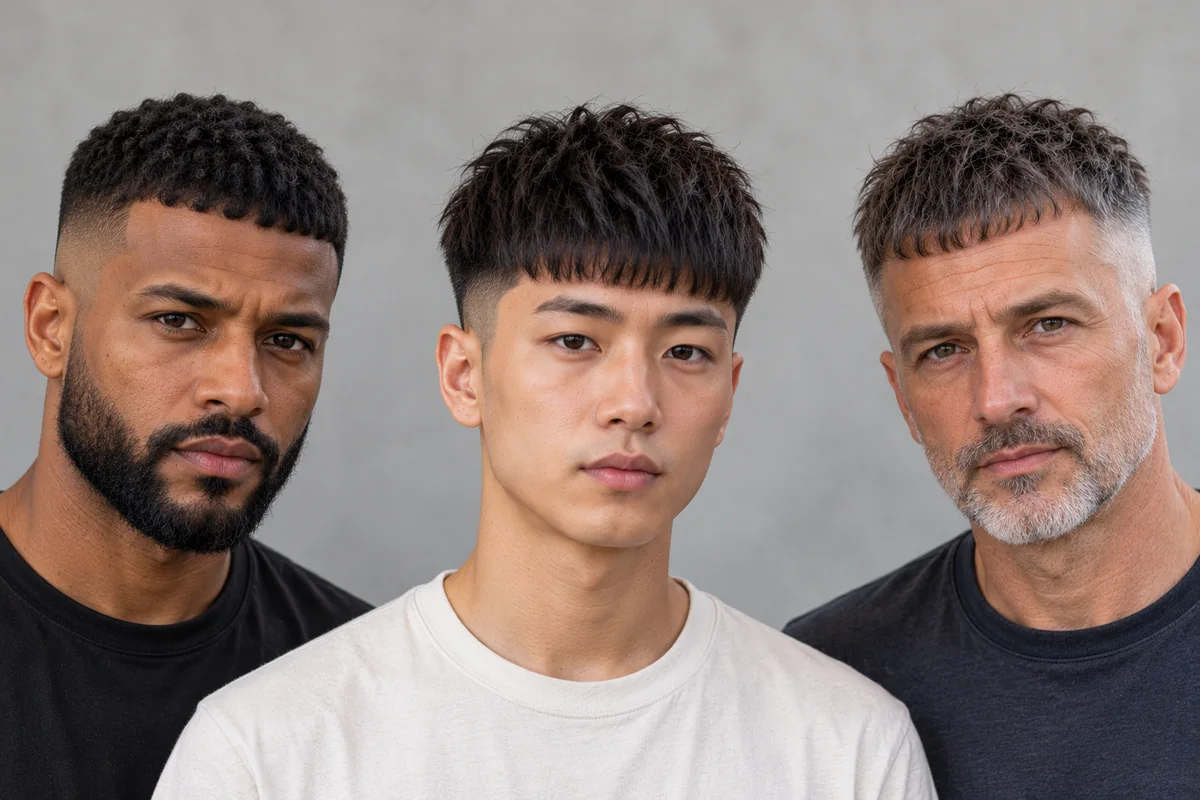
A French crop suits men with a medium forehead, a clean head shape and hair that grows forward or lies flat. It looks best on oval, square and heart-shaped faces. It works on round faces if the sides stay tight, and on long faces if the fringe is kept low. A very low hairline needs a shorter fringe.
| Face shape | French crop that works | Why |
|---|---|---|
| Oval | Any version | The most forgiving shape |
| Square | Classic with a taper | The jaw balances the blunt line |
| Round | Textured, with a mid fade | Texture adds height, and tight sides lengthen the face |
| Long or narrow | Classic with a lower fringe | A fringe shortens the forehead |
| Heart | Classic or textured, 3 cm top | Softens a wide forehead |
| Diamond | Long French crop, taper | Adds fullness at the temples |
Head shape matters as much as face shape. A tight taper shows every flat spot and dip, so run your hand over your skull before you commit. If you find one, ask for the sides one guard longer, and let the top at 3 to 4 cm do more of the work.
Which French crop suits your hair type?
A French crop works best on straight to wavy hair, because the blunt line needs hair that lies forward. It also works on curly and coily hair with a line-up, and on fine hair at a shorter length. Thick hair needs thinning or texture to stop the fringe from puffing up.
| Hair type | Top length that works | Technique | Watch for |
|---|---|---|---|
| Straight | 2 to 3 cm | Blunt cut, light texture | Cowlicks at the front pull the fringe sideways |
| Wavy | 3 to 4 cm | Slightly textured | Waves lift the fringe, so leave it a little long |
| Curly | 3 to 4 cm | Cut dry, softened line | Curls shrink when dry, so judge length once dry |
| Coily | 2 to 3 cm, with a line-up | Cut dry | Razor bumps on the neckline and hairline |
| Fine | 2 to 3 cm | Blunt cut, no thinning | Thinning shears leave it sparse |
| Thick | 3 to 4 cm | Thinning or slide cutting | Bulk makes the fringe puff and stick out |
French crop for straight and fine hair
Straight hair gives the cleanest blunt line, and it is where the cut looks best. Fine straight hair can look sparse with too much texture, so keep the top at 2 to 3 cm, ask for a blunt cut with no thinning shears and add a little texture powder at the roots for lift. A heavy wax flattens fine hair within an hour.

French crop for thick hair
Thick hair holds the shape well, but it puffs and sticks out if cut to one blunt length. Ask the barber to take out bulk with slide cutting or thinning shears at the roots and keep the line blunt at the ends. Keep the top at 3 to 4 cm so the fringe falls forward instead of up.
Is a French crop good for a receding hairline or thinning hair?
Yes. A French crop is one of the best short cuts for a receding hairline, because the forward fringe covers the area where the hairline has moved back. Keep the top at 3 cm, the fringe at about 3 cm with a slightly softened edge, and the sides short so attention stays at the front.
Three things make it work. The fringe should be long enough to cover the temples without touching the eyebrows. The edge should be soft rather than razor-straight, because a hard line makes recession look deeper. And the top should be even, so thin areas do not stand out from thick ones. Our guide to a buzz cut for thinning hair explains the options if the thinning is mostly on top or at the crown.

A French crop hides thinning. It does not treat it. The American Academy of Dermatology explains the options for male pattern hair loss, and a dermatologist is the right person to see if you notice sudden or patchy shedding.
Does a French crop work on curly or wavy hair?
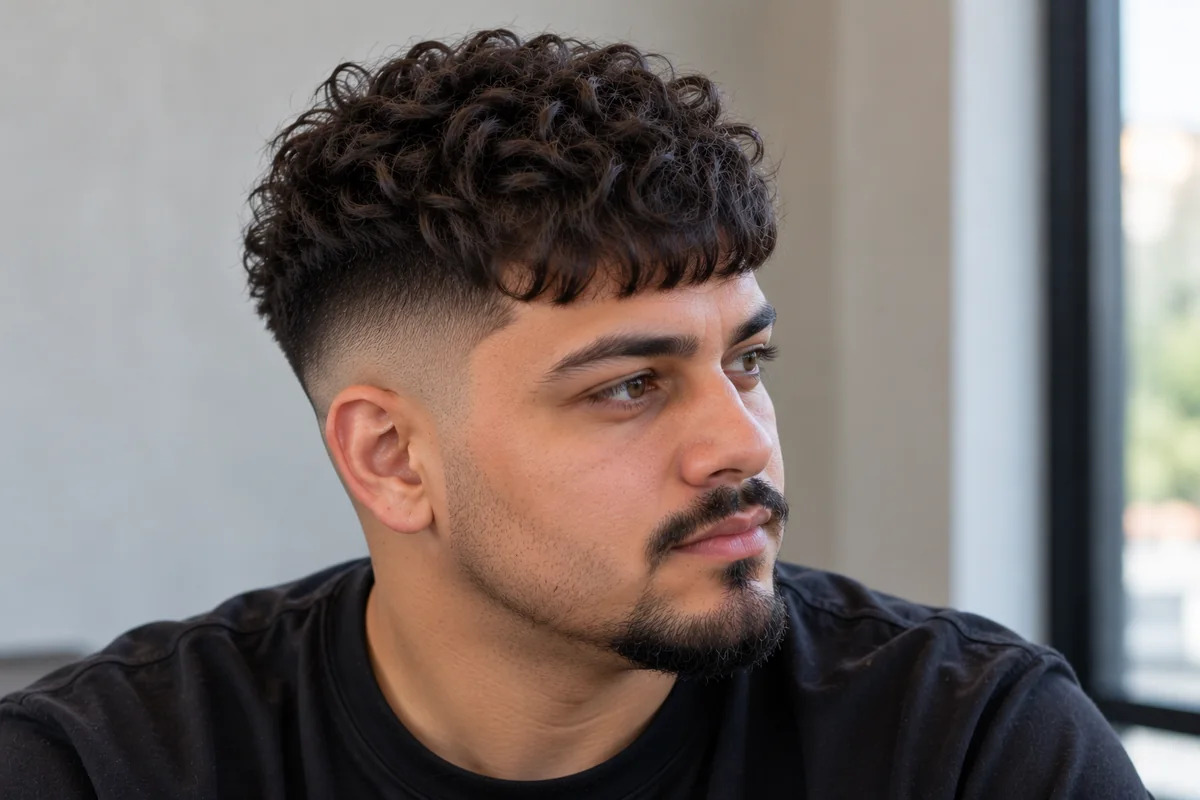
Yes, with adjustments. Curly and wavy hair lift and shrink as they dry, so the fringe sits higher than the length suggests. Ask the barber to cut it dry and leave the fringe a little long. A fade at the sides and a crisp line-up at the front make the shape look deliberate.
Use a light moisturizer or curl cream instead of a stiff wax, and let the hair air-dry or diffuse it on low heat. On waves, a small amount of sea salt spray gives grip without making the fringe stiff. Avoid brushing curls out, since that turns them into frizz and ruins the clean line.
Can you color a French crop?
Yes. Short crops are a popular base for bleached or toned tops, because the color shows clearly against faded sides. Keep the length at 2 to 3 cm, ask for the color to be applied to the top only, and use a conditioning product afterward, since bleach dries the hair. A professional colorist will tell you whether your hair can take it.
The practical downside is maintenance. Roots show within three or four weeks on a short cut, so color means a barber and a colorist visit on the same schedule. If you only want a subtle change, a toner or a single tone lighter is easier to live with than a full bleach.
Does a French crop suit older men, gray hair or beards?
Yes. The cut is tidy and low-effort, which is why it works from the twenties through the fifties and beyond. Gray hair looks clean and deliberate when cut short, and a trimmed beard pairs well with a tapered French crop, as long as the beard blends into the sideburn instead of ending in a hard line.
- Gray or white hair. Keep the top at 3 cm so the gray reads as texture, not as thinning, and use a matte product because gray hair shows shine.
- Beards. Blend the taper into the sideburn and beard in one line. Avoid a big gap between a faded side and a full beard.
- Glasses. A fringe above the eyebrows sits clear of most frames, so the cut works with almost any pair.
- Office or interview. A classic French crop with a taper is among the lowest-risk modern cuts for a formal setting.
How do you ask your barber for a French crop?
Ask for a French crop by naming the top length, the fringe, the sides and the neckline. For example: “A French crop, about 3 centimeters on top, blunt fringe just above my eyebrows, a mid taper on the sides and a natural neckline.” Then ask the barber to show you the fringe length before cutting it.
- Name the top: “about 3 centimeters,” or “short, about 2.”
- Describe the fringe: “blunt, straight, just above the eyebrows.”
- Name the sides: “a mid taper” or “a low fade.”
- Describe the neckline: “natural,” “squared” or “tapered.”
- Ask for light texture if you have thick hair, or none if you have fine hair.
- Show a photo of the cut you want and, if you can, one you do not want.
What goes wrong: saying “French crop” and nothing else. Some barbers give a Caesar cut, others a textured crop, and some cut the fringe too short. A photo and a measurement settle it in ten seconds. For more scripts that work in any chair, see how to ask for a haircut.

How do you style a French crop?
A French crop needs very little styling. Towel-dry your hair, brush the top forward with a comb or your fingers and, if you want hold, work a pea-sized amount of matte paste or clay through it. For a sharper blunt line, comb the fringe straight while it is damp and let it dry in place.
- Towel-dry until damp.
- Comb the top forward over the forehead.
- Blow-dry on medium heat, brushing forward, to set the direction.
- Warm a pea-sized amount of matte paste between your palms.
- Work it through from the back to the front with your fingertips.
- Press the fringe flat with your fingers for a clean line, or pinch it for texture.
What goes wrong: shiny gel or heavy wax. It makes short hair look wet and separates the fringe into spikes. Wash the product out every night, because residue on a short cut shows up as flakes.
Can you cut a French crop at home?
Yes, but the fringe is the hard part. Clip the sides with graduated guards, clip the top to a long guard, then comb the front forward and cut the fringe straight across with sharp scissors. Cut slowly, cut dry hair and cut the fringe longer than you want, then trim it up after it dries.
- Wash and dry your hair, since wet hair looks longer than it is.
- Put on a #3 guard and run it up the sides and back, against the grain, to about ear height.
- Switch to a #2 and a #1 near the neckline, blending each step with short upward flicks.
- Put on a #8 guard and cut the top front to back, then side to side.
- Comb the top forward and pinch the fringe between two fingers.
- Cut straight across about 1 cm above your eyebrows, then check it in the mirror.
- Soften the line by snipping into the ends, then clean the neckline with a trimmer.
What goes wrong: a fringe cut too short. Hair springs up as it dries, so a fringe cut at the eyebrows can end up a centimeter higher. Cut long, dry, then trim again. For blending sides at home, our guide to cutting a low taper fade at home shows the technique.

How often should you trim a French crop?
Trim a French crop every three to four weeks. The fringe and the fade lose their shape first, so faded versions need a visit every two to three weeks, and tapered versions hold for about four. With about 1 to 1.25 cm of growth a month, the fringe is too long by week three.
| Weeks after the cut | What you will notice |
|---|---|
| 1 to 2 | Sharp fringe, clean sides |
| 3 to 4 | Fringe reaches the eyebrows, taper softens |
| 5 to 6 | Heavy, shapeless, closer to a textured crop |
| 8 | Grown out, needs a full re-cut |
If you cannot visit that often, book a quick fringe and neckline tidy between full cuts. It costs less and keeps the line.
How much does a French crop cost?
A French crop at a barbershop in the United States commonly costs about $25 to $45 in USD, depending on the city and the shop. A fade version can cost a little more, and a quick fringe and neckline tidy between full cuts usually costs less. Prices vary widely, so check with your own barber.
What are the most common French crop mistakes?
These mistakes cost men the most time and regret.
- A fringe cut too short. Hair springs up as it dries, so cut it long and trim again.
- A razor-sharp line with no softening. It looks severe and makes a receding hairline look deeper.
- Too much product. Shiny gel and heavy wax look wet and flat on short hair.
- Ignoring a cowlick. A cowlick at the front pulls the fringe sideways, so tell the barber.
- Thinning shears on fine hair. They leave the top looking sparse.
- Asking for a French crop with no photo. You may get a Caesar cut or a textured crop.
How do you look after your scalp and avoid razor bumps?
With short sides and a forehead that can be partly exposed, your scalp and neckline get more sun and clipper friction. Apply sunscreen, avoid very close shaving right after a cut and ask the barber to clip with the grain at the neckline. These three habits prevent most of the redness and bumps men report.
- Sun. The American Academy of Dermatology advises applying sunscreen to all exposed skin, including the sides and back of a faded scalp.
- Razor bumps. The American Academy of Dermatology has clear steps for razor bump prevention, which matter most on a tight neckline and a sharp line-up.
- Dryness. A fragrance-free moisturizer on the scalp after washing keeps it from flaking.
How do you grow out a French crop?
When a French crop grows out, the fringe reaches your eyebrows first, then the top fills in as a textured crop. With about 1 to 1.25 cm of growth a month, expect the awkward stage in weeks five to eight. Keep the neckline and sides cleaned up and push the fringe to one side with a little paste.
If you decide to keep growing, the hub’s quiff entry and side part entry show natural next steps, and the full men’s haircut directory lists longer options.
When is a French crop the wrong choice?
It is the wrong choice if you want a cut with height, if you have a very low hairline, or if a strong cowlick sits at the front. A longer crop or a plain taper may suit you better. It also works poorly on hair that is very coarse and tightly curled unless you add a line-up and keep the length at 2 to 3 cm.
Related collections
This cut sits inside the wider short haircut family. Browse the short haircuts for men hub for all 13 short cuts, explore the fade haircuts hub for blended sides, or read the drop fade guide if you want the sides to curve down behind the ear.
French Crop FAQ
What is a French crop?
A French crop is a short men’s haircut with a top about 2 to 4 cm long and a blunt straight fringe brushed forward, over tight tapered or faded sides.
What is the difference between a French crop and a Caesar cut?
A French crop is slightly longer, blunter and more textured, with a top of 2 to 4 cm. A Caesar cut is shorter and flatter, with a thin straight fringe at 1.5 to 3 cm.
What is the difference between a French crop and a textured crop?
A French crop has a blunt straight fringe. A textured crop has choppy, broken ends and a slightly longer top, usually 3 to 5 cm.
How long should hair be for a French crop?
You need at least 4 cm of hair on top before the cut, so the barber can shape a fringe of 2 to 3 cm. Shorter hair can only be cut to a buzz or a very short crop.
Is a French crop good for a receding hairline?
Yes. The forward fringe covers the area where the hairline has moved back. Keep the edge slightly soft, and see a dermatologist if you notice sudden or patchy shedding.
Does a French crop work on curly hair?
Yes. Keep the top at 3 to 4 cm, ask for the fringe to be cut dry and a little long, and add a line-up to frame it. Curls shrink when dry, so judge the length dry.
Does a French crop work on fine or thin hair?
Yes, at 2 to 3 cm. Ask for a blunt cut with no thinning shears, and use a texture powder instead of a heavy wax.
How often should you trim a French crop?
Every three to four weeks. Faded versions need a trim every two to three weeks, because the fringe and the fade lose their shape as the hair grows 1 to 1.25 cm a month.
What product is best for a French crop?
A matte paste or clay, in a pea-sized amount. Avoid shiny gel and heavy wax, which look wet and flat on short hair.
Can you cut a French crop yourself?
Yes, with clippers and sharp scissors. Clip the sides first, then cut the fringe last and a little long, and trim it again when it is dry.
About this guide
Buzzcutting publishes this guide as general information about men’s haircuts. It uses standard clipper guard sizes and typical lengths, which vary by barber and by the brand of clipper. The 1 to 1.25 cm monthly growth figure is a commonly cited average, and trim intervals, fringe lengths, grow-out stages and prices are approximate. The origin of the name is unclear and is described here as such. The razor bump, sunscreen and hair loss pointers come from the American Academy of Dermatology, linked above. This guide has not been reviewed by a licensed barber or dermatologist, so check the details with your own barber.
The fringe is a line you draw once and live with for three weeks, so cut it long and let your forehead tell you when to stop. Read how we write and review guides in our editorial policy.