

 →
 →
 →
 →
 →
 →
 →
 →
 →
 →
On this page
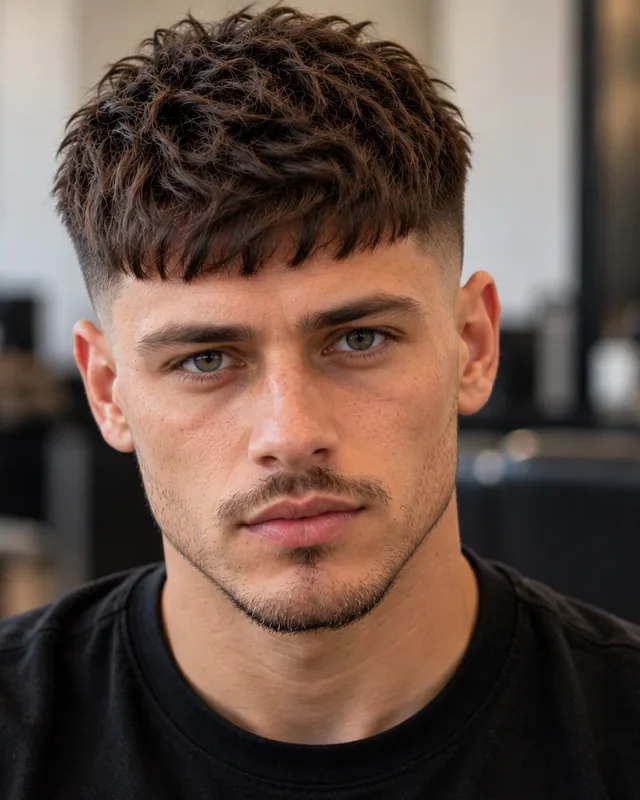
What is a warrior cut haircut?How long does hair need to be for a warrior cut?What are the types of warrior cut?What is the difference between a warrior cut and a textured crop?How is a warrior cut different from a crew cut and a Caesar cut?Who suits a warrior cut best?What is a line-up and why does a warrior cut need one?Which warrior cut suits your hair type?Can you get a warrior cut with thin or receding hair?Does a warrior cut work on curly or coily hair?Does a warrior cut suit older men, beards or glasses?How do you ask your barber for a warrior cut?How do you style a warrior cut?What is the best product for a warrior cut?Can you cut a warrior cut at home?How often should you trim a warrior cut?How much does a warrior cut cost?What are the most common warrior cut mistakes?How do you look after your scalp with a warrior cut?How do you grow out a warrior cut?When is a warrior cut the wrong choice?Related collectionsWarrior cut FAQAbout this guideQuick answer. A warrior cut is a loosely named men’s haircut with faded sides, a textured top that is longer through the middle, and a sharp line-up at the hairline. There is no single official recipe, so ask for the pieces: “a mid fade, 4 to 6 cm on top, longer in the center, textured, with a crisp line-up.” Bring two photos and trim it every three to four weeks.
Type “warrior cut” into a search bar and you get fifty different haircuts. A fade with a mohawk-ish center. A buzzed crop with a beard. A long slick back with shaved sides. A short textured top with a razor line. That is the real problem with this haircut. The name is a style label, not a technical term, and two barbers can hear the same two words and cut two different heads.
This guide is the deep dive behind the warrior cut entry in our short haircuts for men hub. It keeps the hub’s description (faded sides, a textured top that runs longer in the middle, a sharp line-up) and does the work the name does not: it breaks the cut into parts you can describe to a barber, shows six ways to wear it, compares it with the crop and the crew cut and explains how to style and keep it.

What is a warrior cut haircut?
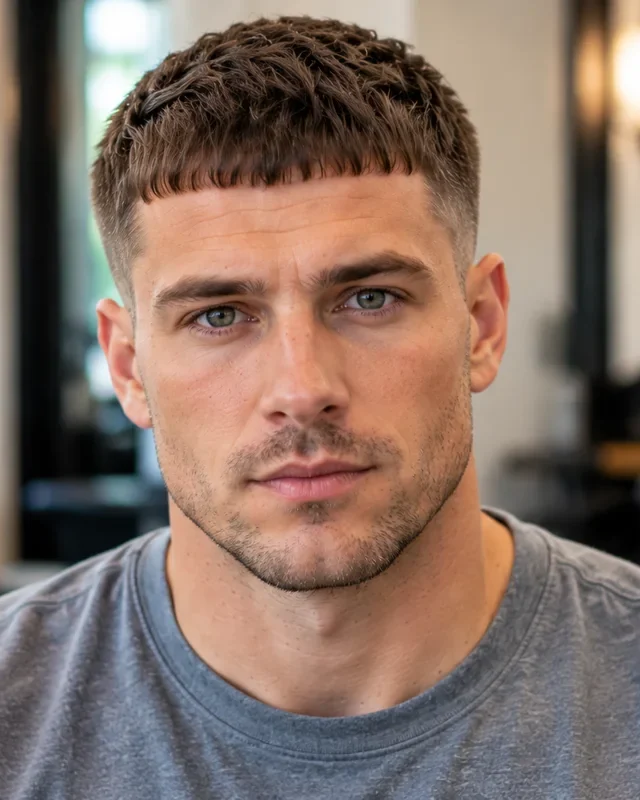
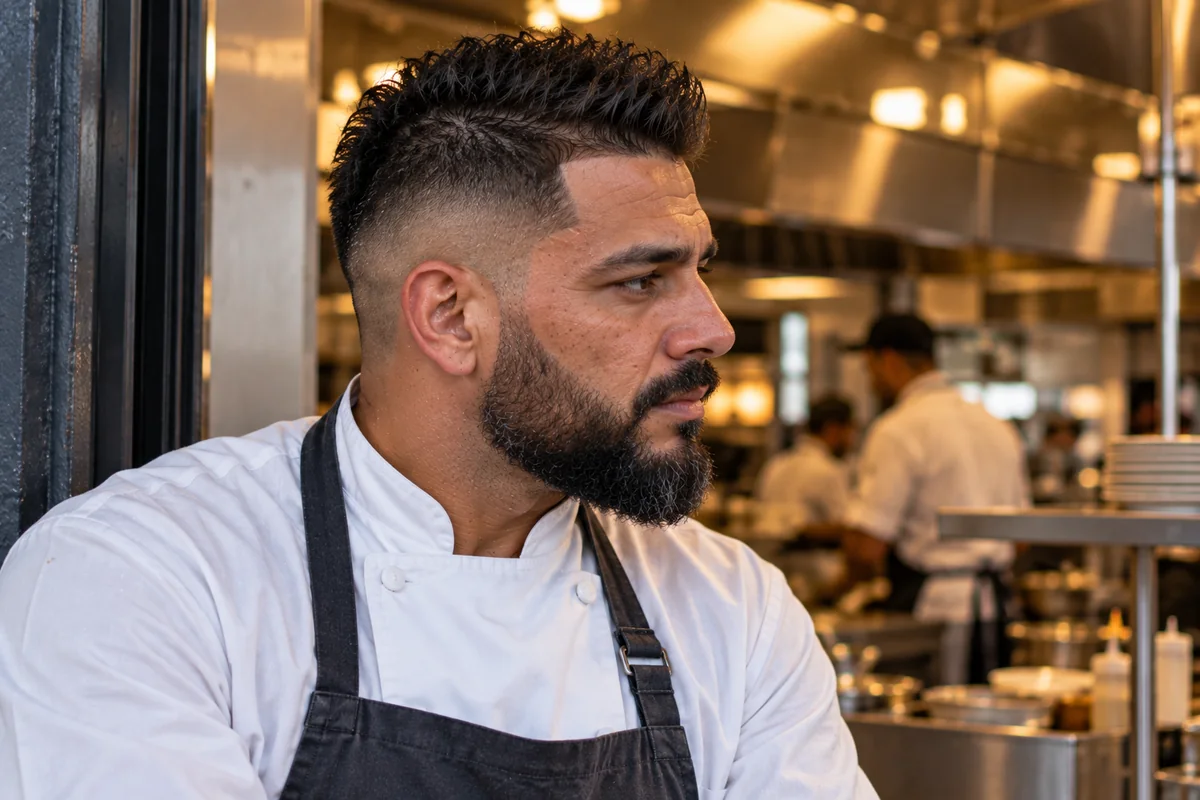
A warrior cut is a men’s haircut with short, faded sides, a textured top that is longer through the center than at the edges and a sharp, razored line-up at the hairline and temples. The name is a style label, so the exact length and fade vary. Most versions sit between 3 and 7 cm on top.
The look borrows from imagery of fighters and soldiers: tight sides, a strong shape on top and edges you can see from across a room. The name has no fixed definition and no single origin, which is why the safest way to get it is to describe the parts. A good barber does not need the name at all.
The cut has four parts, and each one is something you can name in the chair.
| Part | Typical choice | What the barber does |
|---|---|---|
| Sides and back | Low, mid or high fade, skin to 6 mm | Clippers and guards, blended up to the top |
| Top, center | 5 to 7 cm | Left longest, scissor-cut with texture |
| Top, edges | 3 to 5 cm | Shorter at the temples so the center stands out |
| Line-up | Sharp, squared or natural | Trimmer or razor across the hairline and temples |
If you are comparing it with other cuts, the hub’s textured crop entry and crew cut entry are the closest neighbors, and we compare them below.
How long does hair need to be for a warrior cut?
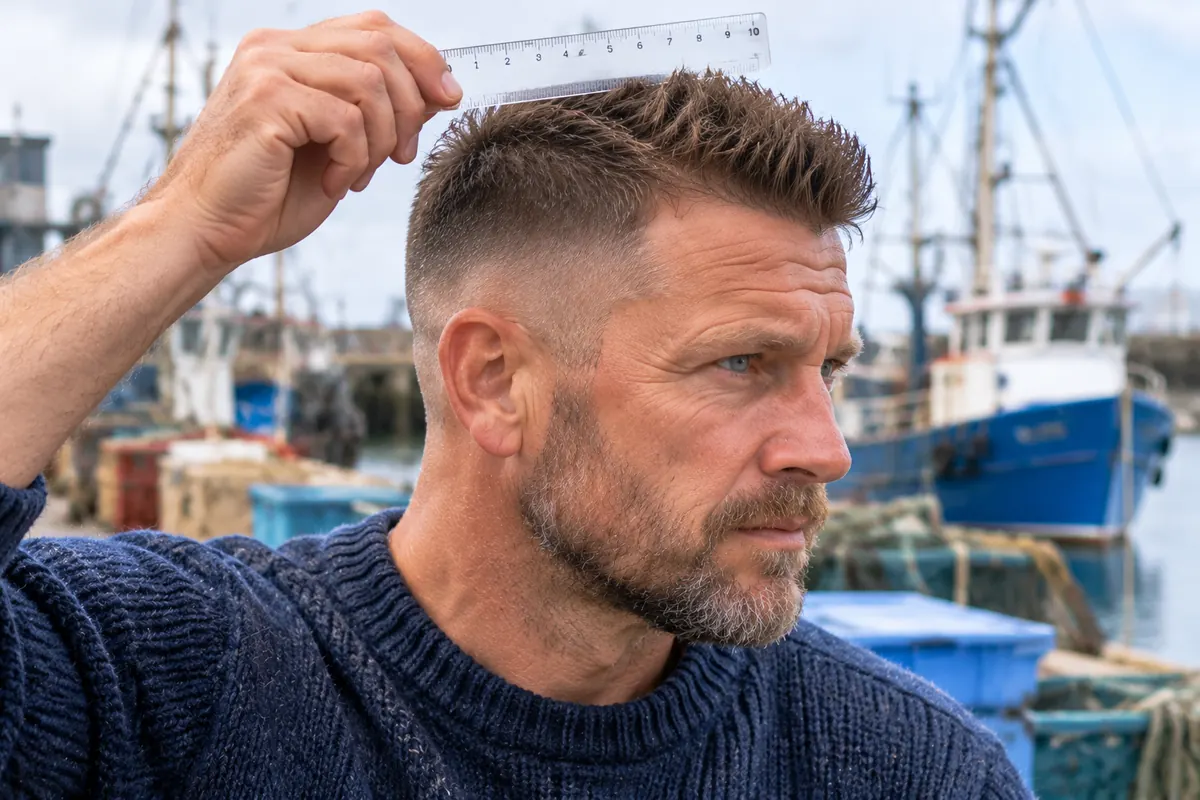
Hair needs to be at least 3 cm on top to get a warrior cut, and 5 to 6 cm in the center gives the clearest shape. At 3 cm the top is a short textured crop with a fade. At 7 cm it can be styled up or back. Below 2 cm there is not enough length to show the contrast.
The center is the part people notice. A warrior cut leaves the middle strip of the top longer than the sides of the top, so from the front the hair reads as a raised shape, not a flat mat. Hair grows about 1 to 1.25 cm a month, so going from a 1 cm buzz to 5 cm takes roughly four months.
| Top length | What you can do | Result |
|---|---|---|
| Under 2 cm | Not yet | Wait, or choose a crew cut |
| 3 cm | A short warrior cut | A textured crop with a fade, small contrast |
| 4 to 5 cm | A standard warrior cut | Clear center, easy to style |
| 6 to 7 cm | A tall warrior cut | Stands up or sweeps back with product |
| Over 8 cm | A longer top with faded sides | Closer to a slick back or an undercut |
The sides use standard clipper guards. A #0 to #2 guard (0 to 6 mm) is typical, with a skin fade at the bottom. Brands differ a little, so ask the barber to show you the guard before the clippers start.
What are the types of warrior cut?
There are six common ways to wear a warrior cut: the classic faded warrior, the high fade warrior, the mohawk fade warrior, the warrior cut with a beard, the long-top warrior and the short buzzed warrior. They share faded sides and a sharp line-up and differ in fade height, top length and how bold the center is.
| Type | Top | Sides | Finish | Best for |
|---|---|---|---|---|
| Classic faded | 4 to 6 cm | Mid fade | Matte, textured | Most men |
| High fade | 4 to 6 cm | High skin fade | Matte or satin | Strong contrast, tight sides |
| Mohawk fade | 5 to 7 cm, narrow center | High fade, wide | Matte, spiky | Bold, casual looks |
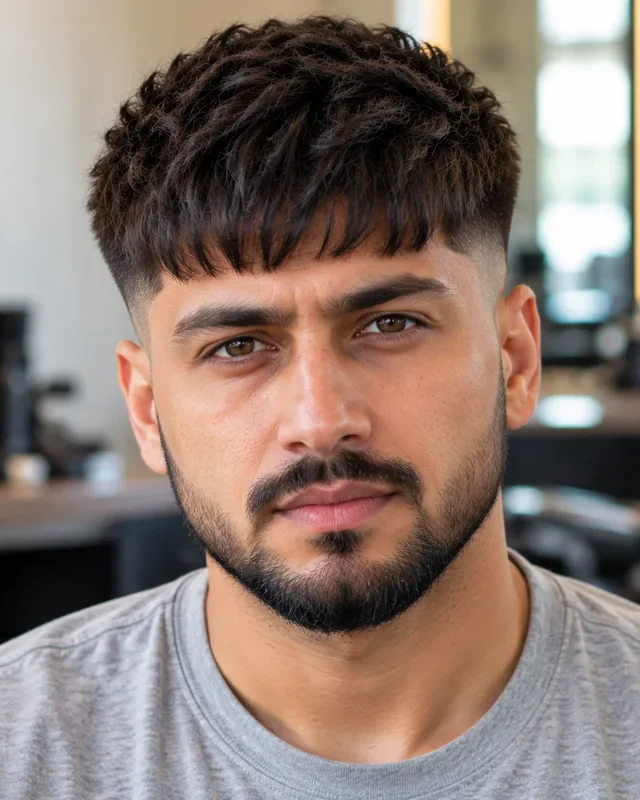
| With a beard | 4 to 6 cm | Fade blended into the beard | Matte | Men with thick facial hair |
| Long top | 7 to 9 cm | Mid or low fade | Satin, combed back | Thick, straight hair |
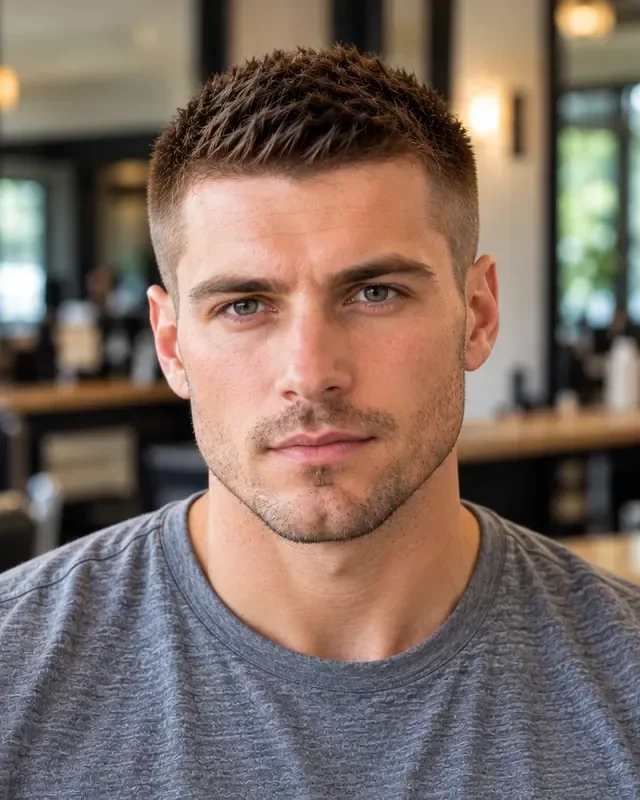
| Short buzzed | 2 to 3 cm | Low fade | Dry, natural | Low effort, hot climates |
Classic faded warrior cut
The classic version is a mid fade, a textured top of 4 to 6 cm and a crisp line-up. The fade starts around the temple and blends into the top without a hard line. It is the version most barbers will give you if you ask for the name and nothing else, and it suits almost every hair type.
High fade warrior cut
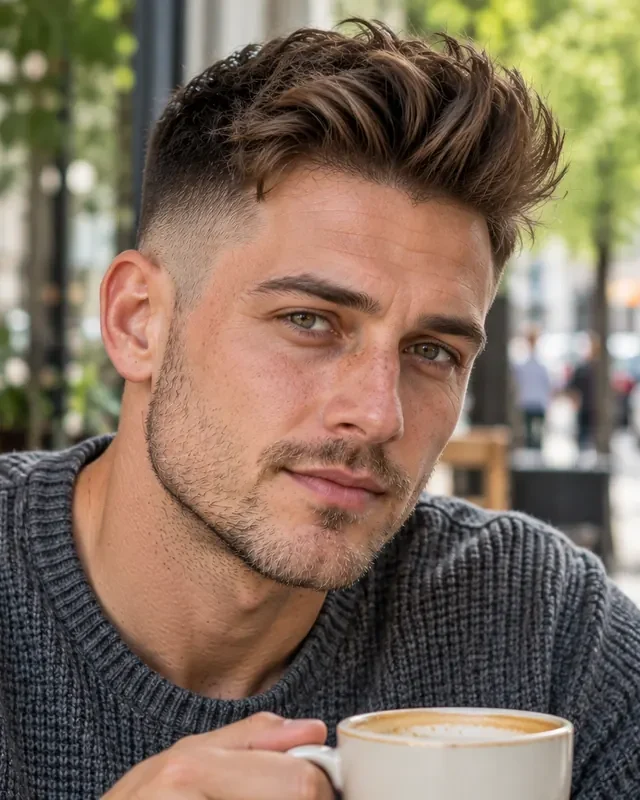
A high fade starts the blend above the temple, so the sides are skin-short and the contrast with the top is sharp. It makes the top look taller and the face narrower. It also needs the most upkeep, because the short sides show growth within two weeks.
Mohawk fade warrior cut
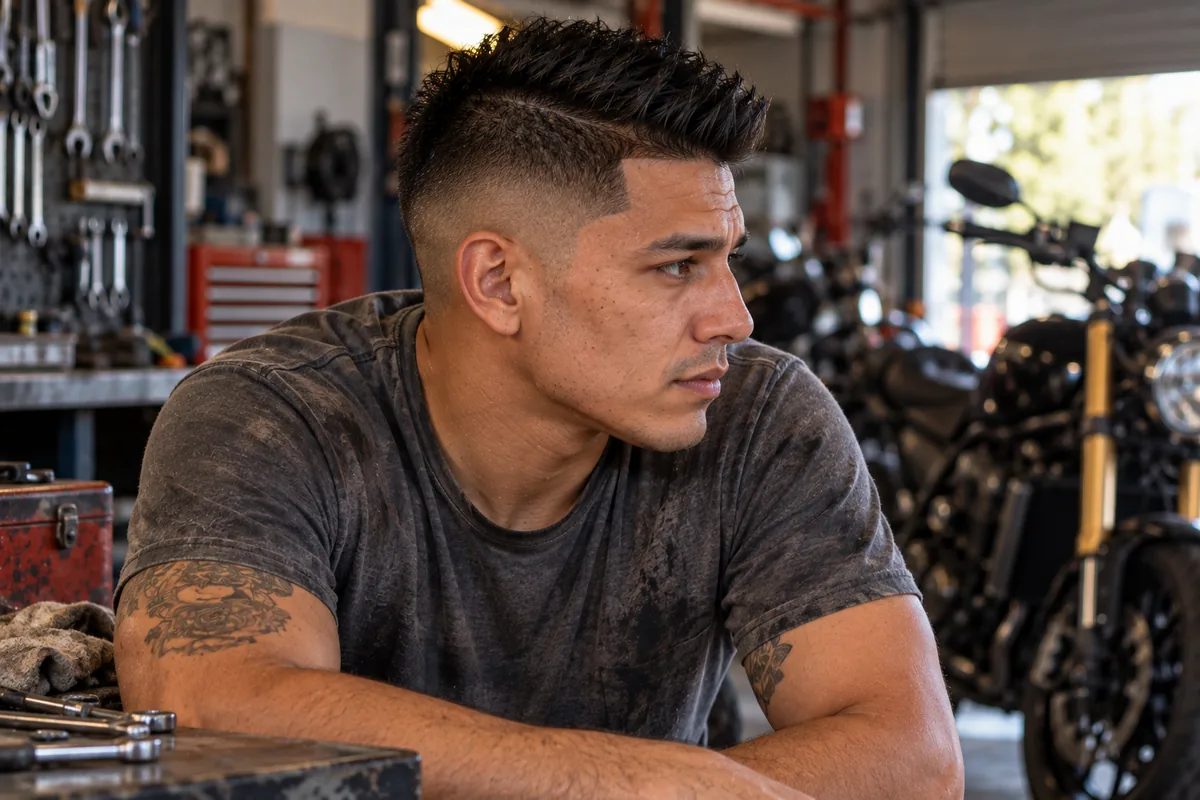
The mohawk version narrows the longer center into a strip and fades both sides high. It is bolder and more casual than the classic, and it works best when the hair is thick enough to stand in a ridge. It is not a full mohawk, since the strip stays wide enough to look like a haircut, not a statement. Our guide to the fade haircuts hub shows how the fade height changes the look.
Warrior cut with a beard
The warrior cut is often paired with a full or boxed beard, and the fade runs down into the beard in one line. The haircut is the frame and the beard fills the lower face. If you have a beard, ask the barber to blend the sideburn into it, since a gap between a skin fade and a thick beard looks unfinished.
Long-top warrior cut
The long-top version leaves 7 to 9 cm in the center and combs it back or up, with the sides faded. It sits between a warrior cut and a slick back, and it is the best choice if you want to keep length while the sides stay tidy. If you like the shape, the hub’s slick back entry explains the comb-through.
Short buzzed warrior cut
The short version keeps the top at 2 to 3 cm with a low fade and a sharp line-up. It reads as a clean crop with edges, and it needs almost no styling. It is the practical pick for hot climates and busy mornings.
What is the difference between a warrior cut and a textured crop?
A warrior cut has a faded side and a center that runs longer than the edges of the top, with a sharp line-up. A textured crop has an even, point-cut top that falls forward as a short fringe. The warrior cut is built around a raised center, and the textured crop is built around a choppy fringe.
| Feature | Warrior cut | Textured crop |
|---|---|---|
| Top shape | Longer center, shorter edges | Even length, forward fringe |
| Top length | 3 to 7 cm | 3 to 5 cm |
| Sides | Mid or high fade | Low to mid fade |
| Line-up | Sharp, a key feature | Optional |
| Styling | Pushed up or back | Pushed forward |
| Trim every | 3 to 4 weeks | 3 to 4 weeks |
If you want a forward fringe instead of a raised center, the hub’s textured crop entry is the better fit.

How is a warrior cut different from a crew cut and a Caesar cut?
A warrior cut has a longer, textured top and a high contrast fade. A crew cut has a short, even top that is tapered into the sides. A Caesar cut has a short, straight fringe and no raised center. Of the three, the warrior cut is the only one with a visible step in length across the top.
| Style | What defines it | Top length | Finish |
|---|---|---|---|
| Warrior cut | Longer center, high contrast fade, sharp line-up | 3 to 7 cm | Matte, textured |
| Crew cut | Short even top, tapered sides | 1 to 3 cm | Natural, dry |
| Caesar cut | Short straight fringe | 2 to 4 cm | Matte, flat |
| Textured crop | Point-cut top, forward fringe | 3 to 5 cm | Matte, choppy |
| Undercut | Disconnected short sides | 6 to 12 cm | Any |
For a plainer cut with no contrast, see the hub’s crew cut entry. For the version with disconnected sides, read our undercut guide.
Who suits a warrior cut best?
A warrior cut suits men with medium to thick hair, a defined jaw and a head shape that looks good with short sides. It looks best on oval and square faces and works on round faces with a high fade and a taller center. On a long face, keep the center modest so the cut does not add height.
| Face shape | Warrior cut that works | Why |
|---|---|---|
| Oval | Any version | The most forgiving shape |
| Square | Classic with a mid fade | The jaw balances the contrast |
| Round | High fade with a taller center | Tight sides and height lengthen the face |
| Long or narrow | Short buzzed or classic with a low fade | Avoids adding height |
| Heart | Classic with a low fade | Fullness on top balances a narrow chin |
| Diamond | Classic with a mid fade | Softens wide cheekbones |
Head shape matters as much as face shape. A fade shows every bump and flat spot, so feel the back of your head before you ask for a skin fade. A barber can sometimes shift the fade higher or lower to hide a lump.
What is a line-up and why does a warrior cut need one?
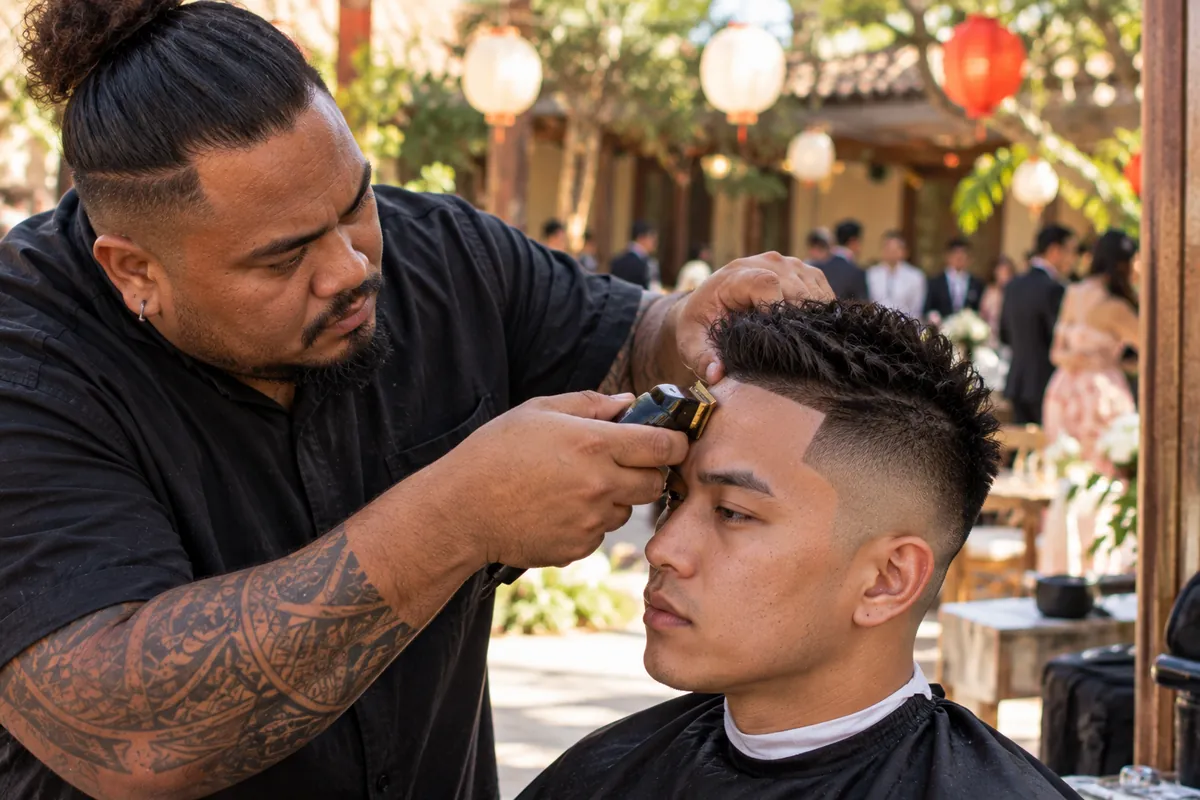
A line-up, also called an edge-up or shape-up, is a crisp line cut across the hairline, temples and sideburns with a trimmer or razor. It squares off the hairline and gives the warrior cut its sharp frame. Without it the cut looks like a regular fade with texture on top.
The line-up comes in three shapes. A natural line-up follows the hairline and only cleans the stray hairs. A squared line-up draws a straight edge at the front and a right angle at the temples. A rounded line-up softens the corners. Choose by hairline: a squared line suits a strong, straight hairline, and a natural one suits a receding or uneven one, since a hard line shows the gap.
| Line-up | Look | Best for | Upkeep |
|---|---|---|---|
| Natural | Clean, follows the hairline | Receding or uneven hairlines | Every 3 to 4 weeks |
| Squared | Sharp, straight edge | Strong, even hairlines | Every 2 to 3 weeks |
| Rounded | Soft corners | Most men, a gentler look | Every 3 weeks |
What goes wrong: a line-up pushed too far forward. It moves the hairline back and cannot be undone until the hair regrows. Ask the barber to follow your natural hairline and stop there.
Which warrior cut suits your hair type?
A warrior cut works on most hair types, but each one needs a different top length and product. Thick hair holds the raised center well. Fine hair needs a shorter center and light product. Curly hair gives a natural texture and needs a moisturizing product. Coily hair works best at 3 to 5 cm with a sharp fade.
| Hair type | Top length that works | Product | Watch for |
|---|---|---|---|
| Thick, straight | 4 to 7 cm | Matte clay | Hair can bulk out, so ask for thinning shears |
| Wavy | 4 to 6 cm | Paste, sea salt spray | Waves can fight the shape, so cut them dry |
| Curly | 4 to 6 cm | Curl cream, light gel | Curls shrink dry, so judge length dry |
| Coily | 3 to 5 cm | Moisturizer, light oil | Dryness and razor bumps at the fade |
| Fine | 3 to 5 cm | Powder, light paste | Heavy product flattens the center |
| Thinning | 3 to 5 cm | Powder, matte paste | High contrast can show the scalp |
Can you get a warrior cut with thin or receding hair?
Yes, with a shorter top, a lower fade and a natural line-up. A high skin fade next to thinning hair makes the thin areas stand out. A low or mid fade with a 3 to 5 cm textured top makes the hair look denser. Keep the line-up natural, since a hard squared edge exposes the recession.
Three changes help. Choose a low or mid fade so the contrast stays soft. Use a matte powder or paste, which adds the look of volume. And keep the top short enough to stand without product, since weight pulls thin hair down. If the hairline is far back, a shorter cut like the hub’s crew cut entry may look cleaner, and our buzz cut for thinning hair guide covers the shortest options.

A warrior cut hides thinning. It does not treat it. The American Academy of Dermatology explains the options for male pattern hair loss, and a dermatologist is the right person to see if you notice sudden or patchy shedding.
Does a warrior cut work on curly or coily hair?
Yes, and the contrast of a skin fade with natural curls looks sharp. Keep the top at 4 to 6 cm, fade the sides and ask for a clean line-up. Cut the top dry, since curls shrink as they dry, and keep the shape rounded instead of spiky.
Apply a curl cream or a light oil to damp hair, shape the top with your fingers and let it air-dry or diffuse it on low heat. Coily hair may look best with a 3 to 5 cm top and a defined twist or wave pattern. Avoid brushing dry curls, which turns them into frizz. Fades on coily hair raise the risk of razor bumps, so see the scalp care section below.

Does a warrior cut suit older men, beards or glasses?
Yes. A warrior cut works with a beard, with glasses and at most ages, as long as the fade is mid or low and the top is not too spiky. Gray hair adds texture and looks natural with a matte finish.
- Gray or white hair. Gray hair is often coarser and holds texture well. Use a light, matte product, since shine exaggerates the color.
- Beards. Blend the fade into the beard in one line. A boxed or full beard completes the look, and a gap between the fade and the beard looks unfinished.
- Glasses. The short sides leave the frame clear, and a raised center balances heavy frames.
- Office. A mid fade with a 4 cm top and a natural line-up looks tidy in most workplaces.
How do you ask your barber for a warrior cut?
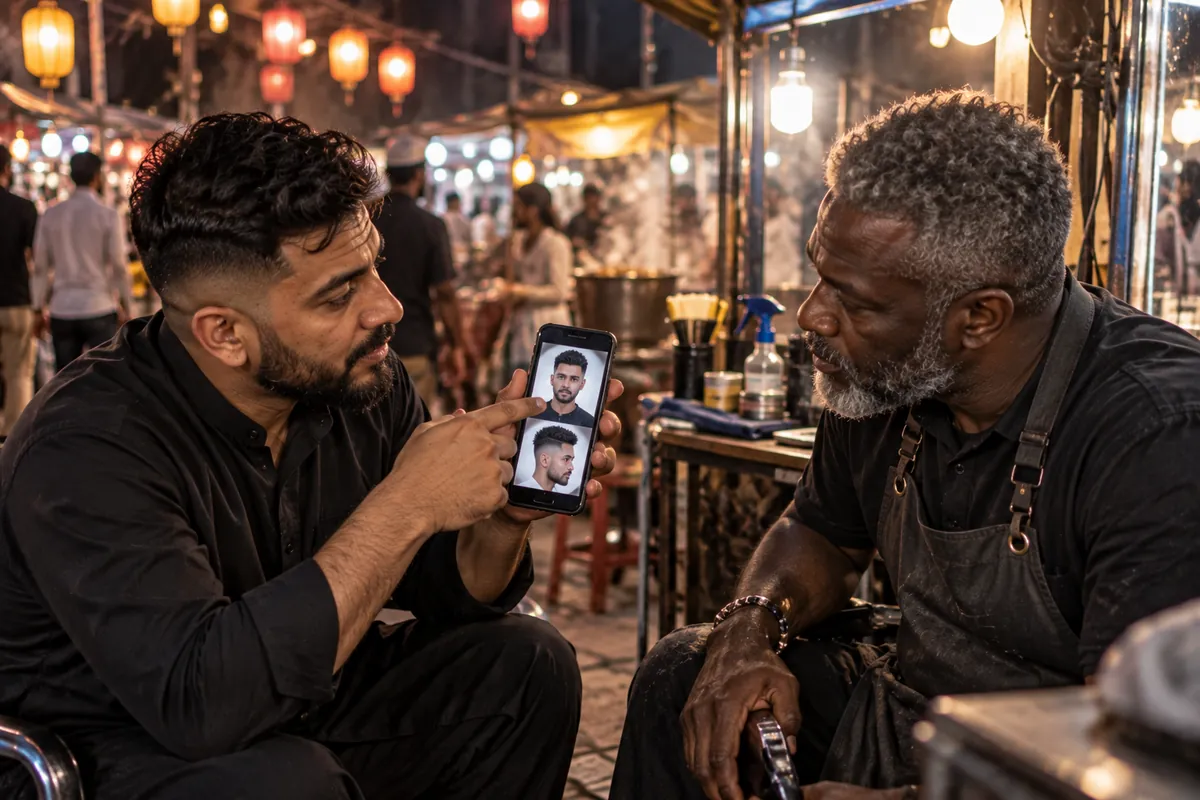
Ask for a warrior cut by describing its parts, not just the name. For example: “A mid fade, a textured top about 5 centimeters long, longer in the center and shorter at the temples, a natural line-up and a squared neckline.” Then show two photos, one from the front and one from the side, and ask the barber to repeat the plan back.
- Name the fade: “low,” “mid” or “high,” and “skin” or “to a number 1.”
- Name the top: “about 5 centimeters, longer in the center.”
- Say “textured” so the barber point-cuts the top.
- Name the line-up: “natural,” “squared” or “rounded.”
- Describe the neckline: “natural,” “squared” or “tapered.”
- Show two photos and ask the barber to repeat the plan back.
What goes wrong: saying “warrior cut” and nothing else. Because the name has no fixed definition, the barber fills in the blanks, and you may get a different cut than you pictured. The photos and the numbers remove the guesswork. For more scripts that work in any chair, see how to ask for a haircut.
How do you style a warrior cut?
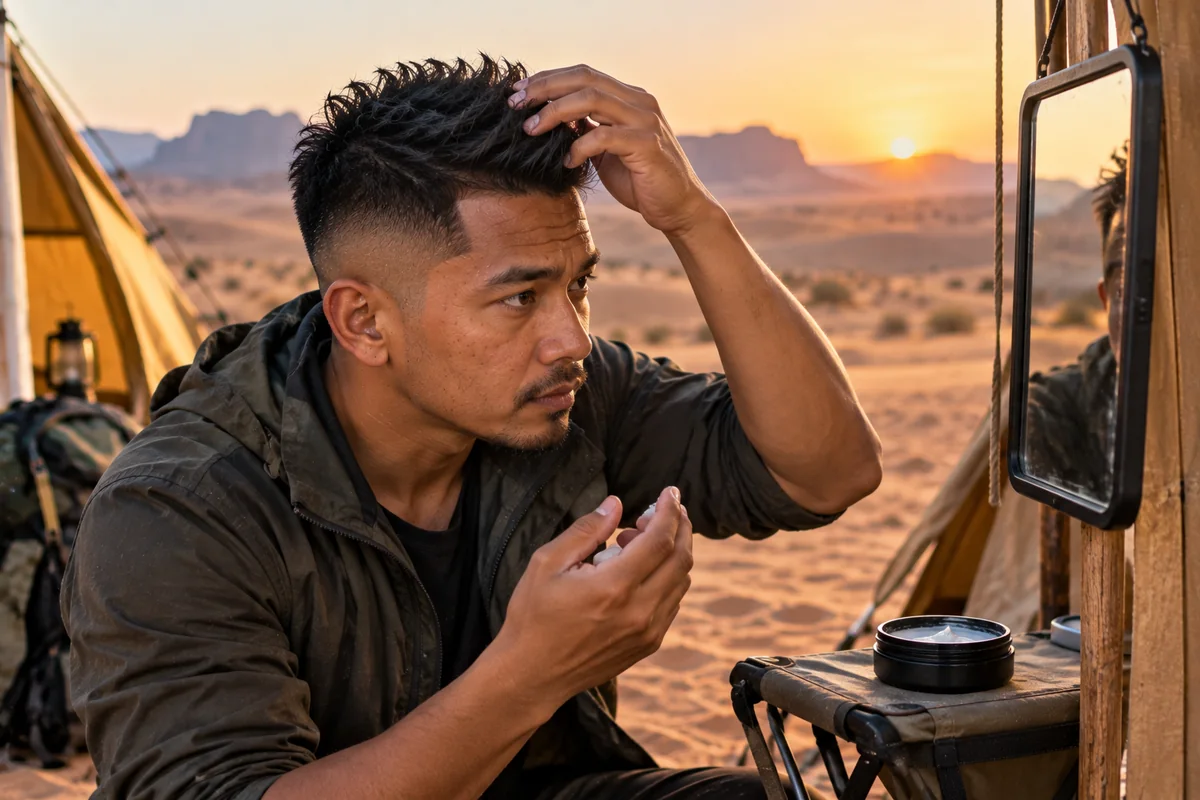
To style a warrior cut, towel-dry your hair until damp, blow-dry the top up and slightly back, then work a pea-sized amount of matte clay through it and shape the center with your fingertips. Leave the edges flat and the center raised, and finish with a light spray.
- Towel-dry until damp, not dripping.
- Blow-dry the center up and back, lifting it with your fingers.
- Warm a pea-sized amount of matte clay between your palms.
- Work it through the center, from the front to the crown.
- Press the edges flat with the heel of your hand.
- Shape the center with your fingertips and finish with a light spray.
What goes wrong: too much product. It weighs down the center and makes the top look flat. Start with a half portion and add more only where needed. And do not comb the center flat afterward, since the texture is the point of the cut.
What is the best product for a warrior cut?
The best product for a warrior cut is a matte clay for a dry, textured finish, or a fiber paste for a lighter, more flexible hold. Powder adds volume to fine hair. Pomade gives a glossier, smoother finish, which suits a long-top version. Choose by the finish you want, then by the hold.
| Product | Hold | Finish | Best for |
|---|---|---|---|
| Matte clay | Strong | Dry, no shine | Thick or coarse hair, tall center |
| Fiber paste | Medium | Low shine, flexible | Most hair types |
| Texture powder | Light | Matte, lifted | Fine or thinning hair |
| Sea salt spray | Light | Matte, grainy | Wavy hair, a base layer |
| Water-based pomade | Strong | Satin to glossy | Long-top warrior cut |
| Hairspray | Light to strong | Invisible | Setting the shape |
The common mistake is using a shiny product on a textured cut. Shine flattens the point-cut texture and makes the center look wet. A matte finish keeps the strands separate.
Can you cut a warrior cut at home?
You can maintain the sides at home with clippers, but leave the fade, the line-up and the textured top to a barber. A fade has no margin for error, and the line-up needs a steady hand and a mirror angle you cannot easily get on yourself. If you try, only tidy the neckline and the sideburns.
- Wash and dry your hair, since wet hair looks longer than it is.
- Comb the top up and clip it out of the way.
- Put on the same guard the barber used and run it over the sides, in short upward strokes.
- Tidy the neckline with a trimmer, following the existing shape.
- Clean the sideburns with a trimmer, following the existing line.
- Check the result with a handheld mirror and stop.
What goes wrong: trying to redraw the line-up. A line moved 2 mm too far cannot be undone until the hair grows. For the blend, our guide to cutting a low taper fade at home shows the technique.
How often should you trim a warrior cut?
Trim a warrior cut every three to four weeks. A high skin fade and a squared line-up lose their sharpness first, so those versions need a visit every two to three weeks. The top can keep growing between trims, as long as the sides stay tidy.
| Weeks after the cut | What you will notice |
|---|---|
| 1 to 2 | Sharp fade, clean line-up |
| 3 to 4 | Fade fills in, line-up softens |
| 5 to 6 | Fade is gone, edges look untidy |
| 8 | Needs a full re-cut |
If you are short on time, ask for a sides-and-line-up tidy only. It is faster and cheaper and keeps the shape while the top grows.
How much does a warrior cut cost?
A warrior cut at a barbershop in the United States commonly costs about $30 to $60 in USD, depending on the city and the shop. It costs more than a plain clipper cut because it includes a fade, a textured top and a line-up. Prices vary widely, so check with your own barber. Add $10 to $25 for a styling product.
What are the most common warrior cut mistakes?
These mistakes cost men the most time and regret.
- Asking by name only. The name has no fixed meaning, so bring photos and numbers.
- Choosing a skin fade without checking your head shape. Fades show every bump.
- Pushing the line-up too far forward. It moves the hairline back until it regrows.
- Using a shiny product. It flattens the texture.
- Skipping trims. A high fade loses its shape in two weeks.
- Copying a photo of different hair. A look on straight, thick hair will not work on fine hair.
How do you look after your scalp with a warrior cut?
A warrior cut leaves the sides and the hairline exposed, so the skin needs sun protection and care after each shave or trim. Apply sunscreen to the faded sides, keep the neckline clean and treat razor bumps early. These habits prevent most of the redness, ingrown hairs and sunburn men report.
- Sun. The American Academy of Dermatology advises applying sunscreen to all exposed skin, including a faded scalp and the line-up area.
- Razor bumps. The American Academy of Dermatology has clear steps for razor bump prevention, which matter most on a skin fade and a razored line-up.
- Product build-up. Clay and paste left in overnight clog the scalp, so wash them out each night.
How do you grow out a warrior cut?
When a warrior cut grows out, the fade disappears first, then the top gets heavier and the center loses its shape. With about 1 to 1.25 cm of growth a month, expect an awkward stage in weeks five to eight. Ask for a taper at the sides and a light trim at the top, and the shape softens into a textured crop or a longer cut.
If you decide to keep growing, the hub’s slick back entry shows where extra length leads, and the full men’s haircut directory lists other options.
When is a warrior cut the wrong choice?
It is the wrong choice if you will not book a trim every few weeks, if your head shape has bumps a skin fade would show, if your skin gets razor bumps easily or if you want a cut that looks the same at every stage. A crew cut or a textured crop is easier to live with.
Related collections
This cut sits inside the wider short haircut family. Browse the short haircuts for men hub for all 13 short cuts, explore the fade haircuts hub for the sides, or read the drop fade guide if you want the sides to curve down behind the ear.
Warrior cut FAQ
What is a warrior cut haircut?
A warrior cut is a loosely named haircut with faded sides, a textured top that runs longer in the center and a sharp line-up at the hairline.
How long does hair need to be for a warrior cut?
At least 3 cm on top, and 5 to 6 cm in the center gives the clearest shape. Under 2 cm there is not enough length to show the contrast.
Is there an official warrior cut?
No. The name is a style label with no fixed definition, so describe the fade, the top length, the texture and the line-up, and bring photos.
What is the difference between a warrior cut and a textured crop?
A warrior cut has a raised center and a sharp line-up. A textured crop has an even, point-cut top that falls forward as a short fringe.
What fade is best for a warrior cut?
A mid fade suits most men. A high skin fade gives more contrast, and a low fade is softer and better for thinning hair.
What product is best for a warrior cut?
A matte clay for a dry, textured finish, or a fiber paste for a lighter hold. Powder adds volume to fine hair.
Can thin hair have a warrior cut?
Yes. Choose a low or mid fade, a 3 to 5 cm top and a natural line-up. See a dermatologist if you notice sudden shedding.
Can curly hair have a warrior cut?
Yes. Keep the top at 4 to 6 cm, use a curl cream and ask for the top to be cut dry. A skin fade makes a strong contrast with curls.
How often should you trim a warrior cut?
Every three to four weeks. High skin fades and squared line-ups need a visit every two to three weeks.
Is a warrior cut professional?
A mid fade with a 4 cm top and a natural line-up looks tidy in most workplaces. A high fade with a spiky center suits more casual settings.
About this guide
Buzzcutting publishes this guide as general information about men’s haircuts. The name warrior cut has no formal definition, so this guide describes the common features of the style, and the lengths and fades here are typical ranges that vary by barber and by the brand of clipper. The 1 to 1.25 cm monthly growth figure is a commonly cited average, and trim intervals, grow-out timelines and prices are approximate. The razor bump, sunscreen and hair loss pointers come from the American Academy of Dermatology, linked above. This guide has not been reviewed by a licensed barber or dermatologist, so check the details with your own barber.
A warrior cut is only as sharp as its last line-up, so book the next visit before you leave the chair. Read how we write and review guides in our editorial policy.